
FTTH

Content tagged with "FTTH"

Fiber to the Home
Displaying 821 - 830 of 1315

Transcript: Community Broadband Bits Episode 228

This is episode 228 of the Community Broadband Bits Podcast. Fiber Infrastructure and Right of Way Manager David Young of Lincoln, Nebraska, describes the city's work with local Internet Service Provider, Allo Communications. Listen to this episode here. 

Listen to, or read the transcript for, episode 182 in which David Young, Mike Lang, and Steve Huggenberger discuss conduit policy in more detail.


David Young: Engaging your provider, engaging your community upfront and deciding what your model should be and then creating a plan and executing that plan is very important.

Lisa Gonzalez: This is episode 228 of the Community Broadband Bits podcast from the Institute for Local Self-Reliance. I'm Lisa Gonzalez . A number of states have laws on the books that obstruct local governments from directly providing high quality Internet access to businesses and residents, or even partnering with local providers. Nebraska happens to be one of them. In Lincoln the community found a way to work within the confines of the law by using publicly owned conduit and creating a welcoming environment for private Internet Service Providers. As a result, Lincoln has entered into an agreement with the local provider Allo Communications who will use the conduit to build its Fiber-to-the-Home network. David Young, Lincoln's Fiber Infrastructure and Right of Way Manager talks with Chris this week. David discusses the early days of the project and how it has evolved. He also shares more information about the franchise agreement and more about the partner Lincoln chose. Be sure to take a few moment and listen to Chris' interview with David and several of his colleagues in episode 182 from last December. Now here are Chris and David Young, Lincoln, Nebraska's Fiber Infrastructure and Right of Way Manager talking about the community's conduit network and how they are capitalizing on it to bring better connectivity and technology to Lincoln.

Community Fiber Network Diversifying Economy in Louisiana

Acadiana, the southern region of Louisiana, is seeing a resurgence of industry thanks in large part to it publicly owned fast, affordable, reliable network. Years ago, the city of Lafayette, Louisiana, built the LUS Fiber network to connect homes and business.

Now, LUS Fiber is helping to diversify Acadiana’s economy, which once almost exclusively relied on the oil industry. Fiber networks offer much potential for economic development. 

“The State of Business” in the Silicon Bayou

The October-November issue of the Acadiana Profile at MyNewOrleans.com ran an article on the changing landscape of Acadiana’s businesses. Author Kimberly Singletary provides an overview of three growing industries: technology, manufacturing, and healthcare. All three need access to reliable, high-speed connections.

Singletary spoke with One Acadiana, an economic development organization in Lafayette:

“We’ve had a long history of innovation in IT and software,” says Jason El Koubi, CEO of One Acadiana. “But it's still very much an emerging field.”

Due to what El Koubi describes as “almost a grassroots movement in cultivating IT over the years,” the Acadiana region enjoys a robust offering of internet services resulting in a competitive, cheap and extremely fast LUS Fiber network.

LUS Fiber offers affordable, high-speed connectivity to several software developers that have made Acadiana their new home. The network offers speeds of up to 2 Gigabits (2,000 Megabits per second). In 2014, LUS Fiber attracted three companies, bringing almost 1,000 jobs to the “Silicon Bayou.” Another company, Waitr, an Uber-like food delivery service, is planning to add an operations center to Lafayette, which will bring another 100 jobs to the community.

More Than Tech: Industries Need Connectivity

Estes Park, CO, Moving Ahead One Year After Opt Out Vote

Estes Park, Colorado, recently moved into the design engineering phase as it considers how to bring high-quality connectivity to businesses and residents.

One Step At A Time

With a $1.37 million grant from the Energy Mineral Impact Assistance Fund, the Colorado Department of Local Affairs (DOLA) is providing the funding to proceed with the engineering phase. Larimer Emergency Telephone Authority (LETA) is providing additional grant funding to extend the project further to include a wider geographic area for 911 and public safety purposes.

This phase of the project should be complete by next summer and will result in a shovel-ready plan. At that time, the Town Board will consider the information and decide how to proceed. The goal is to develop a network to make Gigabit per second (1,000 Mbps) capacity available to the Estes Park Light and Power service area.

So Far, So Good

Last fall, 92 percent of those voting on the issue chose to opt out of SB 152, the restrictive state law that prevents Colorado local governments from offering telecommunications services or advanced services or partnering with private partners to do so. Since then, they have hired a consultant to draft a feasibility study and examine model business options.

The community’s municipal electric utility already has fiber in place, and has the personnel, knowledge, and significant assets to ease the operation and management of a Fiber-to-the-Home (FTTH) network utility. The consulting firm estimated that, if the city chooses to deliver services themselves, they should focus on Internet access rather than adding video and voice to the list of services. Estimates for the project are approximately $27 - $30 million.

For video of the community's Project Stakeholder Kickoff Presentations, check out their Broadband Initiative page.

NC Rural Electric Cooperatives Teach Model Collaboration

Throughout the October Broadband Communities Magazine conference, folks kept repeating this sentiment: some partnerships are smooth and others have rough patches. At the conference, we heard from several electric cooperatives who had partnered with other cooperatives to provide next-generation connectivity to their communities.

We specifically want to highlight the work of two North Carolina electric cooperatives: Lumbee River EMC and Blue Ridge Mountain EMC. They were both included in our report North Carolina Connectivity: The Good, The Bad, and The Ugly. Each co-op took the bold step of building a Fiber-to-the-Home (FTTH) network throughout sparsely populated regions. At the conference, we were able to learn first-hand about their experiences.

Despite the Distance: Lumbee River EMC & HTC

HTC Chief Executive of Marketing Brent Groome described how the two cooperatives collaborated despite being nearly an hour away from each other. Their work together has involved a commitment to similar values and dedication to improving rural communities. (Lumbee River EMC’s representative was unable to attend the conference as much of the service territory had suffered flooding from the recent hurricane.)

Lumbee River EMC’s entry into Internet service brought fiber connectivity to southeastern North Carolina. The co-op provides electricity to more than 50,000 members. In 2010, the USDA provided Lumbee River EMC with nearly $20 million in funding to install fiber. A state law, however, imposes certain restrictions on electric co-ops and USDA funding. The electric co-op had to find another company with the drive and expertise to provide Internet service.

Holland, Michigan, Releases RFI, Responses Due Dec. 20th

Holland, Michigan, continues to pursue better local connectivity and hopes to find a private sector partner interested in using publicly owned fiber.

Recently, the city released a Request for Information (RFI) to reach out to potential partners who might be interested in working with the city for a Fiber-to-the-Premises (FTTP) project. Responses are due December 20, 2016.

Developing Over Time

The community of approximately 33,000 people deployed fiber-optic infrastructure in the early 1990s for power smart grid capability for their municipal electric utility. Since then, Holland Board of Public Works (HBPW) has expanded the network to provide connectivity for local school facilities and wholesale Internet services to a few local businesses that require high capacity data services. Over the years, Holland has increased the network to about 76 miles of backbone fiber and more than 150 total miles, which includes laterals.

After engaging in a pilot project, HBPW released a study that analyzed possible business models and routes for a FTTP network designed to provide Gigabit per second (1,000 Megabits per second) capacity. Cost estimates for two separate options - one to provide service to all of HPBW’s service area and one only to premises within the city - came in at $63.2 million and $29.8 million respectively. The study assumed a “hybrid open access” model in which Holland would offer retail services but also lease excess capacity to private providers who also want to offer services to residents or businesses.

Looking At All The Options

Now that Holland has completed a study that provides one option, the community is interested in hearing what potential partners have to offer. The city seeks a partnership that:

Madison Starts Muni Fiber Effort, Considers Citywide Effort - Community Broadband Bits Podcast 227

The second-largest city in Wisconsin and the home of the University of Wisconsin, Madison, is pursuing a path-breaking municipal Fiber-to-the-Home (FTTH) strategy. They have already started by deploying fiber to several low-income neighborhoods and working with local ISP ResTech to offer services.

Madison CIO Paul Kronberger joins us for Community Broadband Bits episode 227 to discuss their plan. We start by discussing how they decided to deploy FTTH as a digital divide strategy. Like more and more of the communities considering this approach, Madison does not have a municipal electric utility.

We also discuss how Madison plans to deal with the state law that limits municipal fiber network investments and why Madison has decided to work with a private provider even though the city will retain ownership of the network. Read more of Madison coverage here.

This show is 18 minutes long and can be played on this page or via Apple Podcasts or the tool of your choice using this feed

Transcript below. 

We want your feedback and suggestions for the show-please e-mail us or leave a comment below.

Listen to other episodes here or view all episodes in our index. See other podcasts from the Institute for Local Self-Reliance here.

Thanks to mojo monkeys for the music, licensed using Creative Commons. The song is "Bodacious."


Research on Rural Connectivity Power from Electric Co-ops at BBC Mag Conference

In October in Minneapolis, Broadband Communities Magazine hosted the “Fiber for the New Economy” conference. The first day featured a set of four panels on the role of rural electric cooperatives in providing much-needed connectivity to far-flung communities.

We want to provide the highlights and give further context to some of the most fascinating stories. In this post, we’ll cover some of the latest research coming out of Ball State University’s Center for Information and Communication Sciences.

Indiana’s Electric Cooperatives 

Researcher Emma Green from Ball State University kicked off the track. Her presentation, “Rural Broadband: Technical and Economic Feasibility,” outlined the potential role of rural electric cooperatives in facilitating last mile (connectivity to homes and business) and middle mile (regional connectivity) deployment. 

Green's research centered on Indiana, where 14 percent of the population does not have broadband access (speeds of at least 25 Megabits (Mbps) download and 3 Mbps upload). In rural areas of the state, however, more than half of the population does not have access to those speeds. Green's research underscored how rural electric cooperatives can use their assets (such as Smart Grids, Right-of-Way access, and pole ownership) to facilitate middle mile connectivity. 

We previously noted some of this research from Ball State University in our post BBC Mag Spotlights Rural Electric Co-ops. Focusing on the middle mile is not always a pathway to long-term last mile solutions, and our Christopher Mitchell has often pointed out those pitfalls. Unless a provider is willing to invest in the critical last mile connections, middle mile networks have only a minimal impact.

Rural Electric Co-ops Power Up A Gig In Pacific Northwest

Rural electric cooperatives are providing next-generation connectivity. In Oregon a consortium of electric cooperatives called LS Networks built a middle mile network a few years ago and now are taking the next step with last mile connectivity.

LS Networks’ Connected Communities program hopes to bring last mile fiber connectivity to 25 communities in rural Oregon and Washington. Internet access will officially be available in early 2017 in some communities. Depending on the needs of each community, the solution could be Fiber-to-the-Home (FTTH), or fixed wireless using the fiber-optic network for backhaul.

Connected Communities

The project started in July, but LS Networks only now made the official announcement. The Connected Communities program asks folks to nominate their community to be connected by filling out a short form. LS Networks will offer two types of monthly plans [pdf]: 100 Megabits per second (Mbps) for $40 and a Gigabit (1,000 Megabits) for $70. Customers will also be able to purchase voice service for an additional $15 per line and 50 cents per phone number.

Currently, the small, northern Oregon town of Maupin is the only official Connected Community. LS Networks is already at work building out a fiber connection to nearly all of the 400+ homes and businesses in the community. On November 9th, Maupin residents can take part in a town hall meeting at the South Wasco County High School to learn more about LS Networks’ plans and the Connected Communities program.

Consortium of Cooperatives

Paul Bunyan Communications Keeps Expanding Gigabit Territory

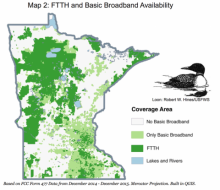
Paul Bunyan Communications in Minnesota reports it has expanded its “GigaZone” Internet service territory to Turtle River, Puposky, and Tenstrike and to additional areas of Bemidji.

More than 2,800 additional locations now have access to, among other services, Internet speeds of up to 1 Gigabit per second (Gbps) following the recent upgrades to its fiber-optic communications network, the Bemidji-based co-op notes.  

"Over the next several months we'll be activating the GigaZone in many more areas,” Gary Johnson, CEO of Paul Bunyan Communications, said in a company statement. "We will continue to do as much as we can to bring the GigaZone to all our members and the communities we serve as fast as we can." 

GigaZone Locations Top 20,000 

The co-op said its GigaZone service is now available to more than over 21,600 locations. Previous areas served include rural Park Rapids, Lake George, Trout Lake Township east of Grand Rapids, most of Grand Rapids, Cohasset, and LaPrairie.

The co-op has an online map showing the active areas of the GigaZone as well as future areas that are set for construction. The co-op said that members who subscribe to GigaZone Broadband can also add PBTV Fusion and/or low cost unlimited long distance phone service.

Co-op Wins Award In 2015

About a year ago, we reported that Paul Bunyan Communications won the 2015 Leading Lights National Award for Most Innovative Gigabit Broadband Service. The northern Minnesota cooperative beat out both local innovative local firms like C Spire and national companies like Google. 

Google Fiber Pauses - But No One Else Should

Google Fiber has finally announced its plans for the future after weeks of dramatic speculation that it will lay off half its workforce and give up on fiber-optics entirely. Google has now confirmed our expectations: they are pausing new Google Fiber cities, continuing to expand within those where they have a presence, and focusing on approaches that will offer a better return on investment in the short term.

Nothing Worth Doing Is Easy

In short, Google has found it more difficult than they anticipated to deploy rapidly and at low cost. And in discussions with various people, we think it can be summed up in this way: building fiber-optic networks is challenging and incumbents have an arsenal of dirty tricks to make it even more so, especially by slowing down access to poles.

That said, Google is not abandoning its efforts to drive better Internet access across the country. In the short term, people living in modern apartment buildings and condos will be the greatest beneficiary as Google takes the Webpass model and expands it to more cities. But those that hoped (or feared) Google would rapidly build Fiber-to-the-Home (FTTH) across the country are likely disappointed (or slightly relieved, if they happen to be big incumbent providers). 

This is a good moment to talk about the lessons learned from Google Fiber and what we think communities should be thinking about. 

Let's start by noting something we have often said: Google Fiber and its larger "access" approach have been incredibly beneficial for everyone except the big monopolists. Its investments led to far more media coverage of Internet access issues and made local leaders better understand what would be possible after we dismantle the cable broadband monopoly. 

Benoit Felton, a sharp international telecommunications analyst wrote a very good summary of Google Fiber titled Salvaging Google Fiber's Achievements. Some of my thoughts below overlap his - but his piece touches on matters I won’t address, so please check out his analysis.

I want to focus on a few key points.