
FTTH

Content tagged with "FTTH"

Fiber to the Home
Displaying 1 - 10 of 1315

Industry Astroturf Hits Longmeadow, MA Ahead Of Key Fiber Vote Today

Locals in Longmeadow, Massachusetts say they’re being bombarded with misleading mailers, texts, and phone calls from a telecom-industry linked group trying to mislead the public ahead of a key vote on the city’s plan to begin construction of a municipal broadband fiber network.

U.S. telecom monopolies have a long and sordid history of paying proxy organizations to try and undermine popular municipal broadband deployment projects. The goal is always to mislead, confuse, and disorient the public ahead of key municipal votes in order to shield regional telecom monopolies from reform and meaningful competition.

Such groups almost always pretend to be objective third parties trying to protect taxpayers from harm. But in reality they’re an extension of the lobbying efforts of unpopular regional monopolies, who know that publicly opposing these popular networks isn’t a great look.

Image
A grassy knoll in Longmeadow MA with Bay Path College brick building in background behind an American flag waving in the breeze

These tactics are popping up yet again this month in Longmeadow, where “dark money” group “Mass Priorities” is working overtime to derail the city’s effort to build its own fiber network.

Longmeadow residents are voting today (May 12) on whether to approve an $8.6 million loan to construct the first phase of what will ultimately be a town-wide fiber broadband network.

Okanogan County Public Utility District Lights Up Fiber In Rural WA

The Okanogan County Electric Cooperative (OCEC) and the Okanogan County Public Utility District (PUD) say they’re making steady progress on bringing affordable fiber broadband access to Okanogan County, a highly rural stretch of rugged land in Washington state on the border of Canada.

According to the organizations, the coalition is poised to bring next-generation fiber to as many as 1,366 peppered along the upper Methow Valley this year starting near Chewuch River and ending at Lost River. Many of these areas will be seeing fiber upgrades for the first time ever after years stuck on the wrong side of the digital divide.

According to a presentation at a town hall last month, officials stated that the project will include 98 miles of underground fiber deployment and 88 miles of new aerial fiber deployment. A mainline backbone fiber between Twisp and Winthrop is completed and functional, providing a redundant loop feed of fiber between the two areas, they stated.

Image
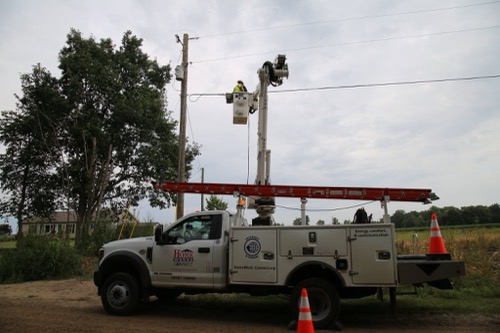
students at the Okanogan PUD bootcamp are being trained on how to properly climb a utility pole and work on the equipment

Construction on the project started back in March, and should be completed by the end of the year, OCEC’s contractor, Shawn VanGeystel of Cannon Construction, recently told the Methow Valley News.

The electrical cooperative’s fiber arm is named MethowNet. It offers three tiers of fiber service, though pricing varies slightly between the North and South Valley.

Major Flagstaff Fiber Expansion Through Wecom Public-Private Partnership

Daunted by the high costs of building its own municipal fiber network, Flagstaff Arizona instead struck a public private partnership (PPP) in late 2024. A year and a half later and that partnership is starting to drive significant new fiber deployments and some significant new investment to the city of 77,000.

Or that’s at least the conclusion of a new whitepaper by the Fiber Broadband Association, a policy coalition of municipal broadband networks and key fiber industry giants such as Adtran, GFiber, Corning, Calix, and Graybar.

The analysis, "Broadband Community Profile: A Public-Private Partnership for Fiber – Flagstaff, Arizona," explores how the PPP the city struck Arizona-based Wecom Fiber is expected to inject at least $100 million into local economy over five years while saving the city an estimated $18 million in capital expenses.

Frustrated by market failure and a lack of meaningful broadband competition among regional telecom monopolies, Flagstaff considered building its own municipal fiber network in 2023. But city officials found that even just connecting 34 city-owned buildings (estimated to be around $20 million) would be untenable given budgetary constraints.

Roanoke Cooperative Plans $2.4 Million Rural North Carolina Fiber Expansion

Roanoke Cooperative’s Fybe has been awarded $2.4 million in state funds to expand affordable access to high speed Internet to 826 locations across eight predominantly rural North Carolina counties that for years have been left lingering in a broadband desert.

Fybe, the cooperative's fiber business, will receive $2.4 million through the state’s Stop-Gap Solutions program to connect 826 locations across Bertie, Chowan, Gates, Granville, Halifax, Hertford, Martin, and Northampton counties. The fiber expansion is expected to be completed by the end of 2026.

“This investment allows us to continue expanding reliable, high-speed internet to rural communities that need it most,” Fybe President Bo Coughlin recently said of the expansion. “Access to broadband is essential for education, healthcare, business growth, and everyday life, and we’re proud to be part of the effort to ensure more North Carolinians can stay connected.”

Image
A group of young African American kids gather around a Roanoke Cooperative employee on Ag Safety Day

North Carolina’s Stop-Gap Solutions program is designed to reach hard-to-access locations and close gaps in broadband coverage. The program is administered by the North Carolina Department of Information Technology’s Division of Broadband and Digital Opportunity and is funded primarily through the federal 2021 American Rescue Plan Act (ARPA).

San Juan Islands’ Rock Island Communications Passes 7,000 Subscribers

The remote islands of San Juan County, Washington are increasingly being served with next-generation fiber and wireless thanks to Rock Island Communications (RIC), a locally-owned Internet subsidiary of the Orcas Power & Light Cooperative (OPALCO).

Part of a member-owned, cooperative utility that’s been providing electricity to the county since 1937 – RIC is celebrating a decade of what it calls “remarkable growth” for the tall task of remote island deployments to the county of 18,000.

The subsidiary says it just reached 7,000 subscribers across San Juan County, and that its annual revenue has grown dramatically during the last decade – from approximately $1.8 million in 2015 to more than $12.3 million in 2025.

“Over the past decade, Rock Island has also achieved several important financial milestones that demonstrate the success of OPALCO’s long-term vision,” OPALCO’s Krista Bouchey says of the expansion. “The company became cash-flow positive in 2020, and in 2023 and 2024 achieved positive net income, marking a major turning point after years of investing in infrastructure and growing its subscriber base.”

Image
Rock Island Communications headquarters in building that looks like house

The San Juan Islands are clustered in the most northwest tip of Washington state, off the coast of the cities of Bellingham and Anacortes, not far from the Canadian border. A little more than a third of the residents of the 20 islands are seasonal, and the lion’s share of the territory is only accessible by ferry.

Pennsylvania’s Claverack Cooperative Passes 100 Mile Fiber Milestone

Pennsylvania’s Claverack Rural Electric Cooperative (REC) says it’s making steady inroads in expanding affordable fiber access throughout rural Bradford and Wyoming Counties, where many frustrated locals have been stuck on the wrong side of the digital divide for the better part of a generation.

Not long ago, Claverack joined a growing roster of electric cooperatives that are extending into broadband access, often leveraging the experience and expertise that informed their efforts at rural electrification almost a century earlier. According to Claverack officials, they recently passed a notable milestone: the cooperative just wrapped up a project that delivered 100 miles of new fiber-optic cable to pass roughly 1,300 previously-unserved and underserved homes and businesses in rural Bradford and Wyoming counties.

“We were proud to share this milestone with the people who made it possible,” Steve Allabaugh, Claverack REC president and CEO, said of the project. “Years of planning, investment, and collaboration brought us to this moment.”

Image
Claverack REC sign at dusk with a gorgeous orange and deep purple sky

The Wysox, Pennsylvania-based cooperative currently services a 2,250‐square‐mile territory across eight counties in Northeastern Pa. (Bradford, Lackawanna, Luzerne, Lycoming, Sullivan, Susquehanna, Tioga, and Wyoming counties), maintaining more than 2,800 miles of electrical power lines and delivering electricity service to over 19,000 paying members.

Lenoir City Public Utility Makes Speedy Progress On Tennessee Fiber Build

Lenoir City, Tennessee officials say they’re making steady progress on their goal to deliver affordable fiber well beyond the Southern city of 12,998. 

Under the collaborative umbrella of the Lenoir City Utilities Board (LCUB) and Tennessee Valley Authority (TVA), officials say they’re leveraging century-old experience in rural electrification to help bridge the digital divide across Knox and Loudon counties.

“We’re now in our fourth year of construction on our community broadband network, and we have 37,676 passings available at this time,” Allen Rollings, Director of Broadband at LCUB told ILSR. 

“LCUB will continue to build until our entire electric service territory is able to access our broadband service.”

LCUB’s history dates back to 1938, when Lenoir City signed a contract with the TVA to provide public power. As with many municipalities and cooperatives, this foundational "public utility" mindset helped pave the way for eventually treating broadband as a 21st-century necessity rather than a luxury.

LCUB is the eighth largest utility among the 153 Tennessee Valley Authority distributors, serving over 96,000 electricity customers.

Image
Lenoir City Utilities Board fiber service map

In 2016, LCUB built an 80-85 mile perimeter fiber ring designed to aid SCADA systems that monitor the electrical grid. Such upgrades improved the utilities’ automated metering, remote fault detection, substation monitoring and overall efficiency.

Municipal Broadband Leaves Big National ISPs in the Dust, Report Finds

A new speed analysis published by Ookla finds that municipal broadband providers consistently leave their private Internet service provider (ISP) competition in the dust.

Small Towns, Big Speeds: How Some Municipal Broadband Providers Outperform Their ISP Peers” examined speed test data that included some of the largest municipal networks in the U.S. from December 2024 through December 2025 and compared their performance to each other and to their privately-owned ISP competitors.

Though it wasn’t in-depth study on other aspects of performance (or business models) – but a more narrowly-focused comparison of speed among 14 municipal providers – still the analysis shines a light on a leading performance indicator: “eight municipal providers in the U.S. that we monitored using Ookla Speedtest data beat their broadband competitors in median upload speeds and one municipal provider, Sherwood Broadband, outpaced the competition in median download speeds.”

Here are some of the report’s topline takeaways:

  • Fort Collins, Colorado’s Connexion was the leader in median upload speed, delivering an average median upload speed of more than 300 (Megabits per second) Mbps for the entire 13-month period from December 2024 to December 2025.
  • Sherwood Broadband in Sherwood, Oregon, was the top provider in median download speeds, delivering an average median download speed that surpassed 400 Mbps eight months out of a 13-month period from December 2024 to December 2025.
  • UTOPIA Fiber in Utah is a standout in latency, delivering the lowest latency of all 14 municipal broadband providers with a multi-server latency consistently in the low 6 milliseconds (ms) to 8 ms range.

The Problem With 'Unfair Competition'

Updated Resource: Community Networks Continue to Win Big in California's Infrastructure Grant Program

Last May, we shared a dashboard we built to track how community networks were doing in California's Last-Mile Federal Funding Account broadband grant program. With a new round of winners recently announced, we've updated our dashboards to show who, where, and how much community networks are getting. In the first round, they were seeing unprecedented success, punching far above their weight in comparison to the monopolies (which have a long track record of success in landing the bulk of state broadband grant dollars across the country). 

We're happy to say that the latest round shows community networks doing equally well. In late 2025 and early 2026, California announced an additional nine grants. Every county in California has now received grant funding for last-mile broadband expansion. Two of the awards were multi-county projects, stretching to include counties that were also served through the first round of funding.

Hoopa Valley Utility Authority was a big winner again, selected for a nearly $40 million award to serve areas of Trinity and Humboldt Counties. The project, called Hoopa TRAIL for Hoopa Trinity Rural Access Initiative Linkup, will serve nearly two thousand locations with gigabit symmetrical speeds. Taken together, community networks secured half of the awards and funding announced in this round. Other awards went to the Contra Costa Transportation Authority, for a planned public-private partnership, Comcast, AT&T, a regional Internet service provider, and a unique nonprofit-private partnership. Altogether, over $110 million was awarded in this round of grants, bringing the running total in the program to $1.23 billion.

Chittenden County CUD Continues Affordable Fiber Expansion In Vermont

Vermont’s Communications Union Districts (CUDs), which were the subject of a 2024 ILSR report, continue to make steady inroads in delivering high-quality broadband access to long-neglected rural Vermont residents. 

That includes the Chittenden County Communication Union District (CCCUD), which recently announced the completion of a planned fiber extension into the heavily rural communities of Essex Town, Essex Junction, Jericho, Shelburne, Westford, and Williston.

The deployment was completed in partnership with Fidium Fiber, which says the expansion brought fiber optic connectivity to more than 1,900 homes and businesses across the six towns for the first time ever.

Users in these markets have the option of three tiers of service: a symmetrical 100 megabit per second (Mbps) tier for a promotional rate of $30 a month; a symmetrical 1 gigabit per second (Gbps) tier for a promotional rate of $50 per month; and a symmetrical 2 Gbps option for a promotional rate of $60 per month. Those prices jump to $70, $110, and $125 per month when the promo period ends.