
Billy Ray on the Origins of the First Muni Broadband Network: Community Broadband Bits Episode #74
We caught up with Carole Monroe from New Hampshire FastRoads to get an update on what is happening in the legislature this sesssion. We reported last spring on HB 286, intended to allow local communities more decision making power. The bill did not advance last session, but new language may breath new hope into the proposal.
If the bill passes, it will remove restrictions that prevent local governments from bonding to finance broadband infrastructure. This and similar bills have been introduced in the past, but large incumbent providers always seem to stop them.
Monroe tells us that this session the bill clarifies the definition of "open access network." The bill also changes language regarding "unserved and underserved" areas. Now the bill requires municipalities to include areas without "adequate" broadband if they choose to finance through bonds. "Adequate" in the bill language relies on the FCC definition of broadband as it changes over time, currently 4 Mbps download and 1 Mbps upload. The change does not restrict building in all areas as long as some areas without "adequate" coverage are included.
The new language also clarifies that municipal networks built only for government purposes do not have to be part of the open access model. Past versions of the bill questioned application of the open access model to municipal I-Nets.
While some of the language of the bill has changed, the fundamental goals remain the same. Local communities need to make the decision to bond. In order to do so, state barriers must be removed. Current state law only allows bonding for broadband infrastructure under strict criteria which only apply in a fraction of the state.
Monroe reiterates that the bill intention is also to create a more competitive environment. She noted that the area is already benefitting from a competitive spirit. Broadband pricing proposals to community anchor institutions show significantly lower rates per Mbps. Service level agreements are more favorable to community anchor institutions since the creation of FastRoads.
Comcast's donations to political action committees (PACs) suggest Comcast has poured dramatically more resources into defeating McGinn. The Broadband Communications Association of Washington PAC, which received 94 percent of its 2013 contributions from Comcast, donated $5,000 to the group People for Ed Murray less than a month after Gigabit Squared's pricing announcement. That was the PAC's largest single donation. Unsurprisingly, People for Ed Murray has made significant expenditures supporting Murray's candidacy.
Centennial is asking its voters to reclaim local authority this election. City leaders want to make better use of an existing fiber optic system but a 2005 Colorado state law pushed by a corporate telephone company precludes it. If the citizenry reclaims its local authority through referendum, the City can take the next step toward providing indirect services via its fiber network.
We contacted City Council Member Ken Lucas to find out more about the ballot question. Centennial is a relatively young city that was incorporated in 2001 and has about 100,000 residents. Lucas told us that this ballot question is not only about using their fiber resources. The community of Centennial considers this a critical step toward maintaining a business friendly environment.
The National Transportation Safety Board (NTSB) provided grants to install the existing network for traffic control, security cameras, and public works monitoring. The City contributed only approximately $100,000 to the network, valued at $5 million. Traffic and public safety now use only two strands of the network that runs through the center of town. City leaders want to use the remaining 94 strands to improve access in the community. To see a map of the fiber and open conduit in Centennial, check out the City's PDF.
Approximately 94% of Centennial businesses and 85% of households are within one mile of the fiber backbone. Residents and business owners can now choose between Comcast or CenturyLink and rates are high. Lucas tells of one business owner who asked Comcast to provide 1 Gbps service to his building. Comcast offered to lease a line to the business at a high rate, but the customer would still have to pay $20,000 for installation.
WUNC, a public radio station out of Chapel Hill in North Carolina, covered community owned networks and broadband availability on its recent "State of Things" midday program. I was a guest along with a local resident and a public relations executive from Time Warner Cable to discuss North Carolina's broadband compared to other states and its law that effectively bans local governments from building networks.
The discussion is good, though I certaily could have done a better job. Ultimately I thought the host did a good job of bringing in each guest to make their points, though Time Warner Cable was totally unprepared to talk about how North Carolina can expand access. Instead, they talked about the cable giant's requirements to invest in networks in rural areas.
We are going to follow up on these points but for now wanted to make sure you have a chance to listen to the show. Our coverage of the bill discussed in the radio show is available here.
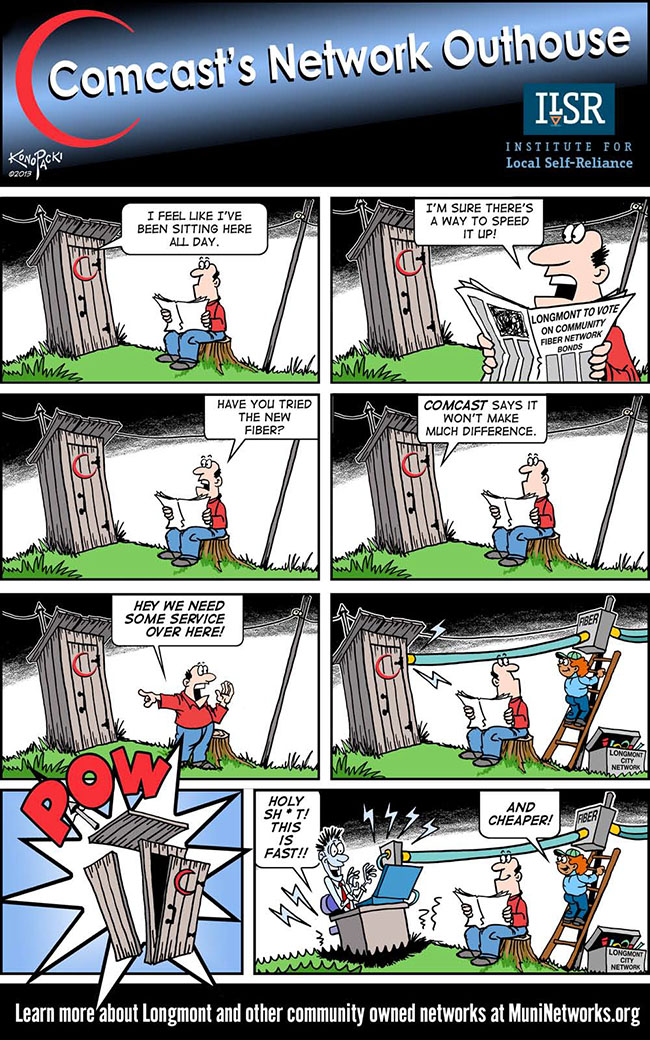
Download this comic as a pdf. Sign up for our one-email-per-week newsletter with ongoing coverage of community owned networks.
The local newspaper notes that some local businesses have already signed on, including a clinic:
Jurey said the city's network is three times faster than the speeds the clinic got before at a cost savings of $1,600 a month.On November 5, citizens will decide a referendum on whether to expedite the building by issuing revenue bonds without increasing local taxes. A brochure explaining pro and con is available here [pdf]. Approving the bonds means building the network to everyone in a few years while not approving it will mean building the network over several decades. We recently did a podcast with Longmont Power and Communications Broadband Services Manager Vince Jordan and a local citizen campaigning for the referendum. Listen to that show here. Read the rest of our coverage about Longmont here.
We have followed happenings in Opelika, Alabama, for three years as the community investigated the benefits of a fiber network. They contended with a Charter misinformation campaign and voted yes on a referendum. Construction began in 2012, Opelika Power Services (OPS) tested the network, and recently the Opelika City Council approved proposed rates.
OANow.com now reports that the FTTH network and smart grid project is ever-so-close to offering triple play services to the city's 28,000 residents and local businesses.
OPS offers three standard bundled plans, but customers can also customize. All three include voice:
Data offerings for customized plans range from 10/5 Mbps for $34.95 to 1 Gbps symmetrical for $499.95.
This is an older column, but the introduction is so dead-on, I wanted to draw more attention to it:
If Dwight Eisenhower had General Motors and George W. Bush had Halliburton, Barack Obama arguably has Comcast. US presidents are often linked to one or two corporations that donate a lot of money to them and then benefit from their actions. Comcast, which is America’s largest cable television and internet provider and is a near monopoly in most of its largest cities, is no exception.
The company’s meteoric rise in the past decade parallels the relative decline of internet service in the US.
It comes from an Edward Luce column in the Financial Times from February. He goes on to note the strong ties between the FCC and Comcast and between Comcast and President Obama. Remember that President Obama has golfed with Comcast CEO Brian Roberts and the CEO is on the President's Council on Jobs and Competitiveness.
Susan Crawford's Captive Audience offers a good examination of Comcast, the threat it (and other massive cable corporations) poses to our communities, and just how savvy it is in lobbying.
Don't be shocked as this Adminstration continues to push wireless and other telecommunications "solutions" that don't threaten Comcast's market domination of cable. Between a dysfunctional Congress and an inevitably interest-group-compromised Executive Branch, communities are on their own.
As a patriotic American, I find the current political atmosphere where telecom lobbyists set the agenda to be a nightmare. All over the world, high-end fiber is being deployed while powerful monopolies in the United States work to prevent it from coming here. Some of those monopolies are even drafting "model legislation" to protect themselves from both community broadband and commercial competition.He nails a number of important points, including the absurdity of allowing de facto monopolies to write the legislation that governs them. However, Andew Oliver's article is a bit muddled on the issue of "monopoly." I have argued with several people that the term "monopoly" has historically meant firms with large market power, not the more stringent definition of "the only seller" of a good. It is not clear how Oliver is using the term. Because of this confusion, you can come away from his piece with the firm idea that it is primarily government's fault we have a duopoly of crap DSL and less crappy cable. He repeatedly says "state-sponsored monopolies." However, no local or state government may offer exclusive franchises for cable or telecom services and the federal government hasn't officially backed monopolies for decades. This is a key point that many still fail to understand - a majority seem to believe that local governments bless monopolies when local governments actually are desperate for more choices. This is why they fall all over themselves to beg Google to invest in their community or they build they own networks (over 400 communities have wired telecom networks that offer services to some local businesses and/or residents). Poor laws and regulations have helped the massive cable and telephone companies to maintain their status - that is why they spend so much on lobbying and political contributions at all levels of government.