
Billy Ray, Community Broadband Pioneer, Joins us For Community Broadband Bits #33
The Tar Heel economy is continuing its transition from tobacco and textiles to high technology. Internet startups populate the Research Triangle, and Charlotte’s financial services economy depends on high-quality data connections. Truly, next-generation Internet connections are crucial to the state. It is deeply disturbing that the Federal Communications Commission ranks North Carolina at the bottom nationally – tied with Mississippi – in the percentage of households subscribing to a “basic broadband” connection. The residents and businesses of nearly every other state have superior connections.Read the whole thing here.
This post comes to us from Patrick Lucey of the Open Technology Institute at the New America Foundation. The post was originally published there, but we are excited to feature it here as well.
Really, I think the cable business in the U.S. looks very attractive. It looks like the telcos are not going to aggressively overbuild cable with fiber and so, cable has a definite advantage when comes to high speed broadband, which seems to be something the public is totally in love with. ... But no, I think cable is very strong on the broadband side and I think the threat of wireless broadband taking away high speed connectivity is way overblown. There just is not enough bandwidth on the wireless side to substantially damage cable's unique ability to delivery very high speed connectivity. So I think everybody is going to do well in this mix.I excised some middle comments that were also interesting - suggesting that cable may lose video customers but will do very well by continuing to grow broadband subscribers (a much higher profit margin service). For years, we have been saying that wireless is not a competitor to wired (specifically cable) and that there is no danger of competition when it comes to cable. Nice to see the insiders agree. Now if the we could just get the FCC to listen to those comments rather than the those of lobbyists...
Credit to Susan Crawford's new book, Captive Audience, where I read it first.
Photo courtesy of JSquish via Wikipedia Commons
Six minute interview from Susan talking about the failure of policy in America to expand access to fast, affordable, and reliable networks.
And so each of the last two years, we have had modest increases in the cost of the broadband service, and yet we've had tremendous sales. We're 33%, 31% penetrated. We hope someday all of America has broadband. So the goal would be 100 or 90 [percent take rate]. We have one competitor.And over the course of that 2011 interview [pdf], Roberts makes it clear that he (correctly) regards DSL as a very weak competitor. The only problem Comcast has is in those few markets where they overlap with Verizon's FiOS (or, left unstated, in areas like Chattanooga where the community itself has built a technologically superior network). Credit to Susan Crawford's new book, Captive Audience, where I read it first.
Walking the floor of the Consumer Electronics Show last week, I kept thinking of that line from Jaws, “You’re going to need a bigger boat.” All the Internet-connected, data-hungry gadgets that are coming to market sent a strikingly clear message: we’re going to need faster broadband networks. ... It’s essential to economic growth, job creation and U.S. competitiveness.Yes! If only the head of the Federal Communications Commission understood what is preventing us from building those networks. Hint: It isn't a lack of demand. Google was inundated with applications for its gigabit service. Hundreds of communities have built their own networks (some of which he praises). Local businesses get it. Mayors get it. City councils get it. And unlike Chairman Genachowski, they know what the problem is: little incentive for massive, established cable monopolies to invest in networks when they are harvesting record profits and subscribers have no other choices. Wall Street not only gets it, it actually rejoices in it!
Comcast's traditional Cable Communications continues to grow and generate copious cash flow.. We're big fans of the firm's Video and High-Speed Internet businesses because both are either monopolies or duopolies in their respective markets.What is our FCC Chair doing about this problem? He helped Comcast to grow even bigger, with more market power to crush those rivals that he is calling on to build gigabit test beds. Chairman G wants to spur hundreds of David's while refusing to curb Goliath's power. Bad news, Mr. Chairman, Goliath actually wins most of the time. Rather than doing his job, Genachowski is begging others to do it for him.
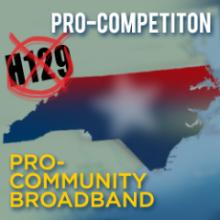
In late 2006, Wilson, North Carolina, voted to build a Fiber-‐to-‐the-‐Home network. Wilson’s decision came after attempts to work with Time Warner Cable and EMBARQ (now CenturyLink) to improve local connectivity failed.
Wilson’s decision and resulting network was recently examined in a case study by Todd O’Boyle of Common Cause and ILSR's Christopher Mitchell titled Carolina’s Connected Community: Wilson Gives Greenlight to Fast Internet. This new report picks up with Wilson’s legacy: an intense multiyear lobbying campaign by Time Warner Cable, AT&T, CenturyLink, and others to bar communities from building their own networks. The report examines how millions of political dollars bought restrictions in the state that will propagate private monopolies rather than serve North Carolinians.
Download the new report here: The Empire Lobbies Back: How National Cable and DSL Companies Banned The Competition in North Carolina
These companies can and do try year after year to create barriers to community-‐owned networks. They only have to succeed once; because of their lobbying power, they have near limitless power to stop future bills that would restore local authority. Unfortunately, success means more obstacles and less economic development for residents and businesses in North Carolina and other places where broadband accessibility is tragically low.
It certainly makes sense for these big companies to want to limit local authority to build next-‐generation networks. What remains puzzling is why any state legislature would want to limit the ability of a community to build a network to improve educational outcomes, create new jobs, and give both residents and businesses more choices for an essential service. This decision should be made by those that have to feel the consequences—for better and for worse.
This story was originally posted on the ILSR website.