
Chattanooga Profiled in Al Jazeera America

“There are companies that do what we do, but we can do it in hours, and they can take weeks,” said Posey. “Anywhere else, it would take a lot more time and a lot more money ... Chattanooga is essential to our business model.”
Al Jazeera America's Peter Moskowitz recently spoke with Clay Posey, one of the entrepreneurs flocking to Chattanooga for the network. Posey works in one of the startup incubators there, Co.Lab, developing his idea for pre-operative models that allow surgeons to prepare before operating on patients.
While Chattanooga may not be the norm and may not be an easy venture for every municipality, it lifts the bar. From the article:
“Whenever a corporation like Comcast wants to do something like raise prices, we can point at Chattanooga and say, ‘Why can’t we have something like that?’” said Christopher Mitchell, head of the community broadband networks initiative at the nonprofit Institute for Local Self-Reliance. “It establishes a baseline or at least an aspirational standard.”
The article describes lobbying efforts by large corporate providers designed to stop the municipal networks model. Another Chattanooga entrepreneur told Moskowitz:
“Having public or quasi-public Internet service providers is a good solution to consolidation because they most likely won’t be sold,” said Daniel Ryan, a local Web developer who helped run the digital operation of Barack Obama’s 2012 presidential campaign. “Do I think if every city did this, Comcast would go out of business? No. But it means there will always be competition.”
Moskowitz included a brief historical summary of the network, its contribution to the electric utility, and the challenges created by state barriers. He included our Community Broadband Networks map.





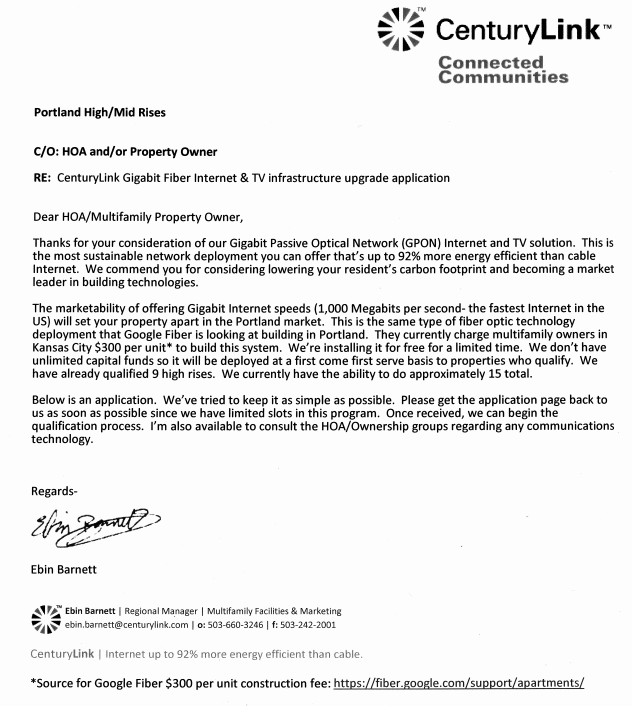
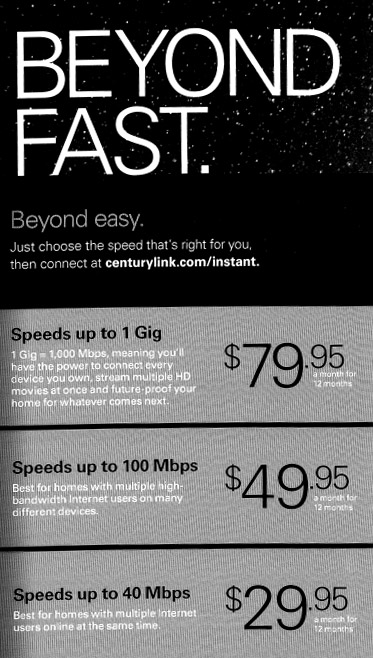 The promotional sheet claims CenturyLink will offer speeds "up to" 1 Gig for $79.95/month for 12 months. 100 Mbps runs $49.95 and 40 Mbps is $29.95 - each for 12 months. No mention of upload speeds but CenturyLink has demonstrated a real aversion to symmetry so users can expect far slower upstream than what modern municipal networks and Google fiber deliver.
The standard operating procedure in apartment buildings will be for CenturyLink to try to lock up the internal wiring to buildings and deny it to competitors. FCC rules make exclusive agreements with landlords unenforceable, but there are a host of tricks that incumbents use to prevent any competition and landlords getting a kickback often have little reason to encourage competition.
The CenturyLink copy notes that its fiber optic GPON option is "up to" more than 92 percent energy efficient than cable modem Internet access. I have to wonder how it compares to DSL energy efficiency and whether that number holds up better than the "up to" 12 Mbps claims they make on DSL circuits that seldom peak at 5 Mbps.
At any rate, it is more than we can expect in the many communities CenturyLink is serving where there the local government have done nothing to spur competition by investing in publicly owned assets that could form a municipal network or be used to entice independent service providers to enter the market. In particular, I would be curious where else CenturyLink is rolling out fiber to buildings without any upfront charges.