
American Rescue Plan

Content tagged with "American Rescue Plan"

Related Topics
Displaying 51 - 60 of 249

Waves in Baltimore Gets $2 Million To Deploy Fiber To More Apartment Complexes

The City of Baltimore is using $2 million of its American Rescue Plan Act (ARPA) funding to bring fiber to 12 new city apartment buildings. It’s the latest effort in the city’s attempt to bridge the digital divide and bring affordable Internet access to long-marginalized communities.

According to the formal announcement from the Baltimore Mayor’s Office, Mayor Brandon Scott and the Baltimore Office of Broadband and Digital Equity (OBDE) have awarded the $2 million grant to Waves, a nonprofit formerly known as Project Waves.

“This grant program is more than just wires and signals – it’s about unlocking opportunity,” Scott said of the announcement. “By partnering with Waves, we’re ensuring residents with the greatest need have a chance to learn, connect, and build a better future for themselves and their families.”

Image
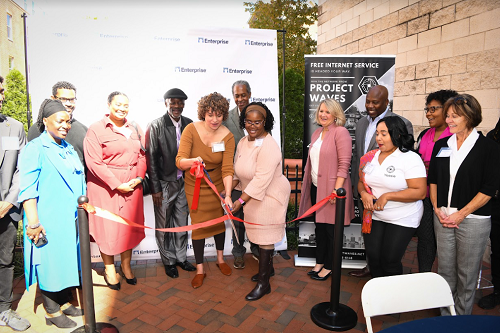
Project Waves ribbon cutting

Waves was first launched in 2018 in direct response to the Trump FCC’s repeal of net neutrality and the general failures of federal telecom policy to address digital inequity. Project Waves (profiled by ILSR last year) initially used Point-to-Multipoint wireless connectivity to deliver free wireless broadband service to about 300 multi-dwelling unit (MDU) residents.

In the last few years, the organization has shifted to Hybrid Fiber Coaxial connectivity to provide more reliable connectivity by running fiber to the buildings and leveraging the existing wiring in the multi-dwelling units it serves, providing access to more than 1,000 local Baltimore residents, at no cost to residents.

Minnesota ISPs Say They May Not Participate In BEAD, Citing Restrictions

States are poised to receive $42.5 billion in new Broadband, Equity, Access, And Deployment (BEAD) subsidies in the new year thanks to the 2021 infrastructure bill. But a growing number of ISPs in states like Minnesota say they may not participate in this latest round of federal grants, citing bureaucracy and burdensome restrictions.

While American Rescue Plan Act (ARPA) grants came with significant leeway as to how grant money could be spent, BEAD grants, overseen by the National Telecommunications And Information Administration (NTIA), come with numerous requirements related to lien mandates, low-cost service obligations, and deployment technology.

Those restrictions serve a purpose in the wake of the boondoggle that was the FCC’s Rural Digital Opportunity Fund, which resulted in a massive number of defaulting bids and unfinished projects because companies bidding on projects lacked the competency or financing to finish their awarded projects. It’s a major reason the NTIA was put in charge of BEAD.

But many Minnesota ISPs are still bristling at BEAD’s requirements, according to Brent Christensen, president and CEO of the Minnesota Telecom Alliance, an organization that represents 70 ISPs across the North Star State.

Image
Cost accounting

“My members are telling me they’re not going to participate,” Christensen recently told MinnPost when asked about the $42.45 billion broadband program. “The way that BEAD is structured. I don’t know how anybody’s going to participate.”

Roanoke Cooperative Thinks Big With North Carolina Fybe Fiber Expansion

North Carolina’s Roanoke Cooperative continues to make steady progress with expansion of its Fybe last mile fiber network within The Tar Heel State.

Cooperative officials tell ILSR that the cooperative and a coalition of organizations across North Carolina have major expansion plans in the works, starting with a fiber build in Halifax County, population 47,298.

Currently, Fybe provides fiber broadband service to around 6,000 subscribers in North Carolina, but thanks to an historic infusion of federal and state grants, the hope is to expand fiber access to the bulk of unserved addresses county-wide.

Fybe COO Bo Coughlin tells ILSR that the lion’s share of the cooperative's upcoming efforts to bring affordable connectivity to unserved and under-served portions of North Carolina will be under the banner of a coalition dubbed Encore, a nonprofit collaboration between MCNC, North Carolina Electric Membership Cooperatives (EMC), and Fybe.

“MCNC has been around for 40 years,” Coughlin notes. “It started as an economic Development institution funded by the state. Their goal was originally to help birth the microchip industry in RTP down in Raleigh, but today they provide transport to around a hundred universities, charter schools, and community anchor institutions across nearly 100 counties.”

Image
Fybe service territory map

Back in April, Fybe won a $9 million Growing Rural Economies with Access to Technology (GREAT) grant to help bring fiber to the largely underserved, heavily-rural residents of Martin, Bertie, Halifax, and Hertford counties.

“So currently, we pass about 5,000 total homes across Northampton and Halifax,” Coughlin said of Fybe’s current footprint.

NEK Broadband’s Big Merger and Bold Vision - Episode 627 of the Community Broadband Bits Podcast

In this episode of the podcast, Chris is joined by Ry Marcattilio and Christa Shute, Executive Director of NEK Broadband, to discuss the evolving landscape of community broadband in Vermont. They explore the transformative merger of NEK Broadband and CVFiber, now covering 71 towns, and the innovative ways the organization is bridging connectivity gaps in one of the most rural and economically challenged areas of the state.

The conversation highlights NEK’s strides in workforce development, with local job training programs for broadband installation and maintenance, as well as partnerships with the Vermont Community Broadband Board and state funding efforts that have secured over $100 million in grants. Christa shares the importance of affordability programs like the NEK Digital Equity Pilot to sustain connectivity for low-income residents following the end of the Affordable Connectivity Program.

This show is 30 minutes long and can be played on this page or via Apple Podcasts or the tool of your choice using this feed.

Transcript below.

We want your feedback and suggestions for the show-please e-mail us or leave a comment below.

Listen to other episodes or view all episodes in our index. See other podcasts from the Institute for Local Self-Reliance.

Thanks to Arne Huseby for the music. The song is Warm Duck Shuffle and is licensed under a Creative Commons Attribution (3.0) license

New York Announces Another $140 Million in Municipal Broadband Grants

New York’s Municipal Infrastructure Program (MIP) continues to provide grant funds to build municipal broadband networks across the state, as state broadband officials recently announced the program’s largest round of funding to date.

As we reported in June, the MIP program – specifically designed to fund municipally-owned networks as part of the Empire State’s $1 billion ConnectALL initiative – awarded $70 million to a half dozen projects earlier this summer.

Then, earlier this month, another $140 million in grant awards were announced for an additional six projects, promising to deliver “more than 1,200 miles of publicly-owned fiber optic infrastructure and wireless hubs, connecting (passing) over 60,000 homes and businesses with affordable, symmetric service – offering equal download and upload speeds at rates below regional averages.”

Image
NY ConnectALL logo

The funding will be used to expand broadband infrastructure (and seed competition) in the Central New York, Finger Lakes, Mohawk Valley, North Country, Mid-Hudson and Western New York regions.

In a prepared press statement, New York Gov. Kathy Hochul characterized the grants as “a transformative step forward in our mission to connect every New Yorker to affordable, high-speed Internet.”

Open Access ErieNet Fiber Network Gets Underway In Western New York

Erie County, New York’s ErieNet broadband initiative is poised to begin construction in Buffalo, NY, after the Buffalo Common Council recently passed a resolution approving the Telecommunications License Agreement with ErieNet LDC. The approval is a major step toward bringing affordable next-gen broadband access to long-neglected parts of Western New York.

ErieNet is a nonprofit, local development corporation (LDC), launched in September 2022, designed to construct and manage a municipal-based open-access fiber optic backbone. ECC Technologies has been chosen to handle sales, marketing, and tech support operations for the network.

“Construction has already begun for ErieNet with underground conduit installations, and utility work necessary to make utility poles ready for ErieNet fiber optic cable attachments,” ECC Technologies’ VP Matthew Crider tells ISLR. “We expect segments of our network to come online beginning in March of 2025; and have the ErieNet 400+ mile open access network substantially built by the end of 2025.”

Image
ErieNet map

“Bringing high-quality broadband to Erie County begins in the City of Buffalo, and the Common Council’s approval opens up the way to make that happen,” Erie County Executive Mark Poloncarz said in a prepared statement.

Crider told ILSR that the current construction budget for the network is approximately $34 million, funded through American Rescue Plan Act (ARPA) broadband grants.

Bell Canada’s Ziply Acquisition Raises Questions About Open Access In The Pacific Northwest

Canada’s biggest telecom giant has acquired Ziply Fiber – and a sizable swath of municipal operation agreements for open access fiber scattered across the Pacific Northwest. Bell Canada and Ziply’s joint announcement indicates that the full deal will be around $5 billion Canadian, plus an additional $2 billion in acquired debt.

The acquisition could help accelerate Ziply’s planned expansion across the Pacific Northwest, where the company’s fiber network currently passes 1.3 million locations across Montana, Idaho, Oregon, and Washington State.

At the same time, Bell Canada’s history of anti-competitive behavior could herald a culture shift at the ascending provider. Ziply and Bell Canada’s rapid-fire acquisition of smaller providers across the Pacific Northwest could also risk undermining the pro-competitive benefits of the kind of open access policies Ziply previously embraced.

Image
Bell Canada service vehicle

Ziply was formed when WaveDivision Capital purchased Frontier Communications’ Pacific Northwest operations in 2020. It has quickly become a major player across the four states thanks in part to numerous public private partnerships with municipalities, and a 2022 announcement of $450 million in new private sector funding.

California Announces Another $207 Million In Last Mile Broadband Grants

California’s $2 billion Last Mile Federal Funding Account Grant Program (FFA) has announced another $207 million in new broadband grants across Amador, Los Angeles, and Solano Counties.

The FFA program, part of a broader $6 billion California “Broadband For All” initiative, is aimed at boosting broadband competition and driving down costs statewide.

According to the state’s announcement, $61 million in new grants were awarded by the California Public Utilities Commission (CPUC) for five Last Mile FFA broadband infrastructure grant projects in Amador and Solano Counties, bringing affordable fiber Internet access to approximately 10,000 Californians.

Image
Vallejo CA welcome sign

The CPUC award details indicate that the grants will be awarded to the Golden State Connect Authority (GSCA) and the City of Vallejo to help bring fiber access to 2,278 unserved locations in Amador and Solano counties.

The City of Vallejo will leverage $3.8 million in state grants to complete four different projects laying predominantly underground fiber, with the city retaining ownership of the finished network and Smart Fiber Networks providing last mile consumer-facing service.

Arkansas Electric Cooperatives Pass 1 Million Broadband Connection Milestone

The Electric Cooperatives of Arkansas say they recently finished delivering fiber broadband capability to more than one million Arkansans as part of a $4.66 billion expansion.

More than 40,000 miles of fiber have been installed by 17 cooperative broadband providers, including 15 local broadband providers, one wholesale broadband provider, and one middle-mile fiber company.

In a prepared statement, Arkansas cooperatives indicate they have $2.2 billion in additional projects lined up connecting an additional 13,000 residents in the “Natural State.” Once completed, Arkansas cooperatives will have deployed 53,000 miles of fiber and connected 1.2 million state residents to fiber.

Informed by their efforts at rural electrification nearly a century earlier, U.S. electrical cooperatives have increasingly been pushing into fiber broadband deployment. Initially as a way to better monitor and manage complex modern electrical grids, then ultimately as a way to extend access to predominately rural customers trapped on the wrong side of the digital divide.

Image
Arkansas family happy with elec coop broadband

Nearly 80 percent of the state cooperatives’ investment in fiber infrastructure has been self-funded without grant subsidies, the coalition notes. Many of the markets they’ve targeted have long been neglected by regional cable and phone giants that believe the investment into rural counties isn’t worth the time and resources, or won’t be profitable enough, quickly enough for Wall Street.  

Kendall County’s Broadband Ambition - Episode 622 of the Community Broadband Bits Podcast

In this episode of the podcast, Chris speaks with Christina Burns, Kendall County Administrator, and Zach Bachmann, a board member and Chair of the Connect Kendall County Commission. They delve into Kendall County's ambitious infrastructure project aimed at expanding Internet connectivity across its diverse landscape, which ranges from suburban hubs to rural farmlands.

Christina and Zach discuss the county's strategic approach to building a comprehensive broadband network. This initiative, driven by public need and supported by a $15 million state grant and revenue bonds, will be managed by the newly formed non-profit, Fox Fiber, in partnership with Pivot-Tech. They share insights into the challenges and innovations involved, including public-private partnerships, community engagement, and sustainable financial strategies to ensure the network serves both densely populated and rural areas effectively.

The episode highlights the county's commitment to economic development, educational opportunities, and public service while ensuring that every resident, from urban centers to isolated communities, benefits from improved Internet access. The conversation underscores the collaborative spirit and strategic planning necessary for public broadband projects to succeed, illustrating how Kendall County’s model could inspire similar initiatives nationwide.

This show is 34 minutes long and can be played on this page or via Apple Podcasts or the tool of your choice using this feed.

Transcript below.

We want your feedback and suggestions for the show-please e-mail us or leave a comment below.

Listen to other episodes or view all episodes in our index. See other podcasts from the Institute for Local Self-Reliance.

Thanks to Arne Huseby for the music. The song is Warm Duck Shuffle and is licensed under a Creative Commons Attribution (3.0) license