
American Rescue Plan

Content tagged with "American Rescue Plan"

Related Topics
Displaying 141 - 150 of 249

FCC nominee Gigi Sohn Named Executive Director of the American Association of Public Broadband

Two months after President Biden’s belated and long-stalled Federal Communications Commission (FCC) nominee withdrew her nomination after a year-long attack campaign against her, today at the Broadband Communities Summit in Houston, Texas, Gigi Sohn announced her next move: Sohn will serve as the first Executive Director for the American Association of Public Broadband (AAPB).

A non-profit organization formed by a group of municipal officials, AAPB’s mission is to advance advocacy efforts on behalf of publicly-owned, locally-controlled broadband networks. Since the organization first announced its formation at the Broadband Communities Summit in May of 2022, it has been working to educate federal and state policymakers who “have turned to the telecom lobby for help and are receiving biased guidance” on the community broadband networks approach, just as $42.5 billion from the Infrastructure Investment and Jobs Act (IIJA) is set to flow to state governments to expand high-speed Internet access this summer.

During a keynote luncheon at the summit, Sohn was joined by AAPB founding board members Bob Knight and Kimberly McKinley on the main stage for a candid discussion in which she reflected on the state of Internet access in the U.S. and her experience that led to her to withdraw her nomination to the FCC. Near the end of the luncheon she announced her new role with AAPB, which was greeted by a standing ovation from the hundreds of attendees in the audience.

Freedom to Choose Community Broadband Future

The announcement was followed by a press briefing where she elaborated on her vision for AAPB.

“I will be the first Executive Director of the American Association of Public Broadband. Until now, there has not been a membership-based advocacy organization that works to ensure that public broadband can grow unimpeded by anti-competitive barriers. That’s despite the success of public broadband to help places like Chattanooga and the Massachusetts Berkshires transform from sleepy hamlets to vibrant centers of economic opportunity, education and culture,” she said at the press briefing.

Cleveland, Tennessee’s City-Owned Utility Getting Into Broadband Business

The Cleveland, Tennessee city council has approved the creation of the Cleveland Utilities Authority, the first step in allowing the city-owned utility to get into the broadband business. The goal: improve utilities services and provide city residents with faster, cheaper, and more reliable fiber access after years of neglect by often-apathetic regional telecom monopolies.

The plan, approved by the city council with a 7-2 vote (see full video here), paves the way for Cleveland’s city-owned utility, Cleveland Utilities, to begin deployment of a $72 million fiber network. The city’s plan, documented in detail here, is heavily inspired by the successes seen by Chattanooga, Tennessee’s publicly-owned utility, EPB.

Of the initial $72 million investment, $64 million will be funded by public-issued debt, and go towards construction of the network, which Cleveland Utilities states should begin in March of 2024 and be completed in “roughly two to three years” barring complications.

Image
Cleveland Utilities logo

An additional interdivisional loan of $8 Million will fund three years of operation for the new division. The utility’s plan is based on a 30 percent take rate, and aims to become cash flow positive between years 2-3, with all debt paid between years 10 and 12.

Maryland Awards $92 Million In Grants For 35 Projects

Maryland officials have announced that the state is doling out $92 million in new broadband grants to expand access to affordable broadband. The latest round of funding was made possible via the Connect Maryland Network Infrastructure Grant Program, and will help expand broadband access to 14,500 unserved locations statewide.  

According to a state press release, this latest round of funds should help fund portions of 35 different projects scattered around the state. A full breakdown of award winners indicates that while Comcast and Verizon secured $14.4 million and $11 million respectively in new funding, smaller ISPs and cooperatives were, unlike in many states, well represented.

Quantum Telecommunications, a smaller local ISP founded in 1995, was slated to receive $15.3 million in funding to connect 1,693 locations to broadband. Choptank Electric Cooperative, first founded in 1938, was among the biggest award winners, receiving $16 million to deliver broadband to 1,693 locations currently lacking broadband access.

New Report: Universal Broadband Infrastructure Would Return $43 million Annually to Counties Across Rural Black Belt

In partnership with the Southern Rural Black Women’s Initiative (SRBWI), today ILSR is releasing a new report that examines the link between high-speed Internet infrastructure, access to healthcare, and the economic implications involved.

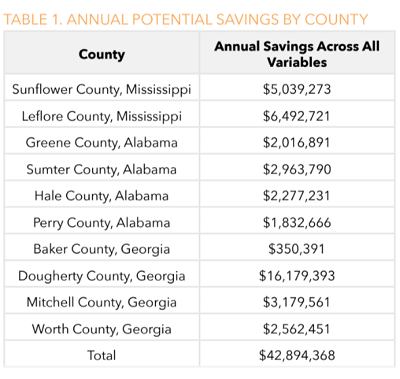
The report – “Increased Wellness and Economic Return of Universal Broadband Infrastructure: A Telehealth Case Study of Ten Southern Rural Counties” – has particular relevance for those living in rural broadband deserts as it details how universal, affordable, broadband infrastructure would return $43 million per year using telehealth across 10 counties in the Black Belt of Alabama, Georgia, and Mississippi.

At a virtual press briefing today, SRBWI leaders and organizers were joined by Dr. Sandra B. Reed of Emory Healthcare; as well as ILSR Senior Researcher and the report’s lead author, Ry Marcattilio, to explain how robust broadband infrastructure could pay for itself in short order and open up untold access to healthcare, educational opportunities, economic development, community engagement, and other benefits along the way.

Image
Telehealth report savings table

“It’s easy to miss the connection, but hard to overlook what’s at stake as rural hospitals close and the cost of transportation to get to far-off healthcare facilities presents a real barrier. This is about access to healthcare and Black women being denied the opportunity to take advantage of telehealth. The broadband infrastructure that’s needed for that just isn’t there,” said Shirley Sherrod, SRBWI State Lead for Georgia and Director of the Southwest Georgia Project in Albany Georgia.

Broadband … to Access Longer, Healthier Lives

Bipartisan Push To Make Broadband Grants Tax Exempt Moves Forward

A bipartisan coalition of lawmakers continues to make slow but steady progress on legislation that would make federal broadband grants tax exempt, providing significant relief for big and small companies alike trying to bridge America’s stubborn digital divide.

U.S. Representatives Jimmy Panetta (D-CA) and Mike Kelly (R-PA) and Senators Mark Warner (D-VA) and Jerry Moran (R-KS) recently reintroduced the Broadband Grant Tax Treatment Act (BGTTA) in both the House and Senate. The bill would amend IRS code to ensure that funding for broadband deployment from the Infrastructure Investment and Jobs Act (IIJA) and the American Rescue Plan Act (ARPA) will not be considered taxable income.

“We have made significant strides to ensure that access to high-speed internet is available to more Americans than ever,” Senator Warner said in a statement. “But taxing broadband investment awards diminishes our efforts. This legislation ensures that individuals and businesses are able to reap the benefits of every dollar set aside for broadband expansion and deployment so that we can accomplish our goal of bringing reliable broadband to every corner of Virginia.”

The exemptions included in the bill would also apply retroactively to any qualified grant amounts received in 2021 and 2022.

South Carolina Grants Fund 56 New State Broadband Projects

The South Carolina Broadband Office (SCBBO) has announced 56 newly funded projects through its new broadband grant program, which state leaders say will dramatically improve resident access to affordable, next-generation broadband networks statewide.

South Carolina historically hasn’t been a hotbed of community broadband deployment, and is one of 17 states that have passed restrictions on municipal network creation, funding, and expansion. Still, there are numerous electric cooperatives in the state busy creatively bridging the digital divide that stand to benefit from an historic infusion of new grant funding.

The state’s latest round of funding comes courtesy of South Carolina’s American Rescue Plan Act, State and Local Fiscal Recovery Funds Priority 1.0 program (ARPA SLFRF 1.0).  

All told, the SCBBO says it has doled out $129.6 million in broadband grand awards to 15 different Internet service providers (ISPs) across 34 different South Carolina counties.

“We are incredibly excited about this next chapter of broadband expansion in South Carolina,” Jim Stritzinger, Director of the SC Broadband Office said in a statement.  “Across the state, most have probably noticed the ISP road crews working diligently to provide high-speed internet access to our homes and businesses. This set of investments will provide a substantial boost to the work that is already underway.”

According to state officials, All ARPA SLFRF 1.0 grants are required to be completed by December 31, 2024. Once completed, the state says these grants will have funded 5,000 additional miles of fiber statewide as well as last mile access to at least 38,995 locations.

Syracuse, NY Votes to Provide Low Cost Fixed Wireless Broadband to Low Income Households

City officials in Syracuse, New York have formally approved a new project to provide heavily discounted wireless broadband to low-income city residents. The plan is being made possible courtesy of the $1.9 trillion American Rescue Plan Act (ARPA), $123 million of which has been doled out to Syracuse city leaders for various urban improvement efforts.

After issuing a request for proposals (RFP) last year, Syracuse officials say they’ve selected Community Broadband Networks FLX to help build the fledgling, city-owned network. City officials say the finished project, which is estimated to be completed by the end of the summer, should cover 10 Census tracts in the south, southwest and west sides of the city for a total project cost of somewhere around $3.5 million.

Once completed, the network should provide wireless broadband service at speeds up to 100 megabits per second (Mbps) to roughly 2,500 Syracuse residents currently living below the poverty line in a city of 146,000.

Image
Syracuse NY seal

On Monday, March 27 the Syracuse Common Council voted to formally approve the project, which will utilize fixed wireless technology in a bid to reduce overall project costs. Participating users will be given a free router and modem, which in turn will connect to city transmitters affixed to local city-owned buildings and utility poles.

Florida Designates $144 Million in ARPA Funds for 58 Broadband Projects

Florida’s state broadband office is doling out $144 million in grants to 58 different broadband expansion projects across 41 Florida counties.

The funding is being delivered courtesy of Florida’s Broadband Opportunity Grant Program, itself made possible by federal legislation—the American Rescue Plan Act (ARPA)— that many Florida lawmakers opposed.

The full breakdown of the deployments make it clear that, similarly to what we’ve seen in states like Montana, the lion’s share of state funding will be going to regional cable monopolies.

Roughly $89 million of Florida’s $144 million grant award will be going to the state’s three largest cable broadband providers: Cox, Comcast, and Charter. Comcast obtained $45 million, Charter was awarded approximately $28 million, and Cox was awarded $16 million. A more detailed breakdown of the awards obtained by Telecompetitor indicates that the vast majority of the projects are partnerships with cable giants.

Summit County, Ohio Building $75 Million, 125-Mile Fiber Ring

Summit County, Ohio says it’s making progress on a $75 million, 125-mile fiber-optic ring made possible courtesy of American Recovery Plan Act (ARPA) funds. The project will start by providing gigabit connectivity to all county first responders, after which county leaders say they’ll focus on shoring up lagging broadband access to long-neglected communities.

A 2017 report by an outside consultant found that Summit County, like so much of America, struggles with a dearth of affordable broadband access thanks to a heavily monopolized U.S. broadband market. The county’s fixed-line broadband market is dominated by two major incumbents, Centurylink and Comcast, and wireless access remains spotty across large swatches of the county’s more rural territories.

Introduced last year, Summit County Executive Ilene Shapiro noted the network will first connect all 31 city, village and township governments to gigabit speed broadband and a data center. The network is expected to cost as much as $75 million. $35 million of that total will be pulled from the $105 million in ARPA funding received by the county.

Image
Summit County Ohio police vehicle

Summit County’s interest in more affordable broadband extends back years. County leaders played a key role in beating back monopoly efforts in the state legislature to effectively ban publicly-owned broadband networks. Once those efforts were defeated, county leaders began formulating their broadband expansion plans in earnest.

Powering Up With BrightRidge in Johnson City, Tennessee - Episode 542 of the Community Broadband Bits Podcast

This week on the show, Christopher is joined by Stacy Evans, Chief Broadband and Technology Officer at BrightRidge, the municipal network for Johnson City, Tennessee. When last we spoke, the electric utility-powered network had just passed its first dozen homes. Three and a half years later, the municipal network has passed more than 10,000 premises. It returns more than $5 million per year to local goverment via payments in lieu of taxes (PILOT) (not to mention keeping electric prices low), and has driven both of the incumbent providers to increase speeds and lower prices. Christopher and Stacy talk about the value that's returned to the region, and how BrightRidge is only gaining steam - it's two years ahead of its build schedule, and using grants and Rescue Plan funds to reach thousands of households not accounted for in the original design, ensuring that as many people will get access to affordable, locally owned fiber as quickly as possible.

This show is 32 minutes long and can be played on this page or via Apple Podcasts or the tool of your choice using this feed

Transcript below. 

We want your feedback and suggestions for the show-please e-mail us or leave a comment below.

Listen to other episodes here or view all episodes in our index. See other podcasts from the Institute for Local Self-Reliance here.

Thanks to Arne Huseby for the music. The song is Warm Duck Shuffle and is licensed under a Creative Commons Attribution (3.0) license.