
rural

Content tagged with "rural"

Related Topics
Displaying 501 - 510 of 1070

Referendum Lights Up Lyndon Fiber - Community Broadband Bits Podcast 272

Michigan's Lyndon Township set a local election turnout record in August when voters supported a measure to build a municipal fiber network by 2:1 margin. The initiative was largely organized and supported by the Michigan Broadband Cooperative, a local effort to improve Internet access in the community. 

To better understand their approach, organizing, and future plans, we have three guests on episode 272 of the Community Broadband Bits podcast. Ben Fineman volunteers as the president of the Michigan Broadband Cooperative, Marc Keezer is the Lyndon Township Supervisor, and Gary Munce led the ballot campaign and is also a board member of the Michigan Broadband Cooperative.

We discuss a variety of issues around their approach, including how the increased property tax to pay for the network will work. We also discuss the education campaign, next steps, and their hopes for helping other communities avoid at least some of the hard work they went through. 

This show is 30 minutes long and can be played on this page or via Apple Podcasts or the tool of your choice using this feed

Transcript below. 

We want your feedback and suggestions for the show-please e-mail us or leave a comment below.

Listen to other episodes here or view all episodes in our index. See other podcasts from the Institute for Local Self-Reliance here.

Thanks to Arne Huseby for the music. The song is Warm Duck Shuffle and is licensed under a Creative Commons Attribution (3.0) license.

Transcript: Community Broadband Bits Episode 271

This is the transcript for Episode 271 of the Community Broadband Bits Podcast. Research Associate Hannah Trostle takes over as host in order to quiz Christopher Mitchell on the latest developments in community networks. Listen to this episode here.


Christopher Mitchell: I can't believe we're freek'n talking about satellite again!

Lisa Gonzalez:This is Episode 271 of the community broadband bits podcast from the Institute for Local Self-Reliance. I'm Lisa Gonzalez. What do the FCC satellite internet access mobile broadband. Madison, Wisconsin, and utility poles in Louisville, Kentucky, have in common. They're all in the recent community broadband news and they're all in this week's podcast. In this episode, Research Associate Hannah Trostle boots Christopher from the host chair to interview him about some significant recent developments. For more details on these and other topics check out the appropriate tags at MuniNetworks.org. Now, here's Hannah and Christopher.

Hannah Trostle: Welcome to the Community Broadband Bits podcast. This is your host this week Hannah Trostle. Joining me is the normal host Christopher Mitchell.

Christopher Mitchell: I don't know how normal I am but thank you for having me on my show.

Hannah Trostle: Now we're going to kick you off, and I'm only going to do the podcast from now on.

Christopher Mitchell: I can't say I don't deserve it.

Hannah Trostle: Well you've been gone quite a bit. Where have you been?

Shape the Rules for Rural Broadband Subsidies Fact Sheet - Reply Comments: October 18th, 2017

Another addition to our Community Networks Initiative resources! This fact sheet details the most important aspects of the Connect America Fund (CAF) Auction. What is it? What should it do? Who does it affect? And how can you make a difference?

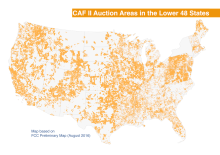
The Federal Communications Commission (FCC) manages the CAF program, which provides billions of dollars in subsidies to Internet service providers for areas where the cost of building networks is prohibitive. Some large providers decided not to accept some of the subsidies during Phase I - about $198 million annually for 10 years. Now, the FCC plans to host an auction so that providers can submit competing proposals on how best to serve these often rural, high-cost areas. (Check out the map of preliminary areas on the FCC website.)

Before the FCC can hold an auction though, the commission needs advice on how best to conduct it and what criteria they should consider. Jon Chambers, former head of the FCC's Office of Strategic Planning and Policy Analysis, outlined his concerns about the current proposed rules in his article, The Risk of Fraudulent Bidding in the FCC Connect America Fund Auction. Listen to his analysis on Episode 268 of the Community Broadband Bits Podcast.

The first round of public comments has passed, but reply comments are due October 18th, 2017. Read the fact sheet and then submit your own comments at FCC.Gov/ecfs/filings for "Proceedings" Docket 17-182 and Docket 10-90.

Deploying In A Reasonable And Timely Fashion? Comment To The FCC

September 21st is the last day individuals and organizations have to submit initial comments on the FCC’s “Inquiry Concerning Deployment of Advanced Telecommunications Capability to All Americans in a Reasonable and Timely Fashion,” Docket 17-199. As of this writing, more than 1,400 filers have submitted comments but the gravity of the policies the FCC is reviewing should have more input from all over the country. So far, people and organizations that have commented are not happy with the ideas of dumbing down the definition of "broadband" and letting mobile and satellite Internet access satisfy connectivity needs in rural America. What do you think? Let the FCC know.

Time and Speeds

The FCC released the Notice of Inquiry (NOI) on August 7th, asking for comments from the public on a broad range of issues. Many experts and organizations quickly zeroed in on a few topics that many thought would never become matters that would ever need to be argued again. Due to the magnitude of the issues to be decided, 13 organizations that work on telecommunications and digital divide policy requested that the agency extend the comment period, originally set for September 7th. Thirty days was just not enough time to address the numerous issues in the NOI.

speed-test.png The agency proposed reversing a policy established by the Obama administration’s FCC which raised the definition of “broadband” to 25 Megabits per second (Mbps) download and 3 Mbps upload. The 2015 change better reflected our forward direction in technology. Chairman Ajit Pai’s leadership has questioned that move and is considering reversing course to a 10 Mbps download/1 Mbps upload definition, which reflects speeds more in line with DSL connections. The 10/1 benchmark is already considered obsolete by policy experts who see DSL connections already overly stressed by multi-device households.

Fiber For All and More - Community Broadband Bits Podcast 271

After a friendly coup in the offices of the Institute for Local Self-Reliance, Hannah has taken the podcast host chair from Christopher for episode 271 of the Community Broadband Bits. Hannah grills Christopher on where he has recently traveled, interesting lessons, and recent news around community broadband. (Christopher mentions a great event in Pittsfield - video available here.)

The conversation starts with a discussion of why recent travels strengthened our belief that full fiber-optic networks are the best approach for the vast majority of America in the long term. Christopher and Hannah discuss the future of low-latency networks and what is more cost-effective over decades rather than just over the first few years.

They go on to discuss their fears of the FCC legitimizing satellite and mobile wireless connectivity as good enough for carrier of last resort in rural regions. The show wraps up with a discussion about One Touch Make Ready in Louisville and Madison's RFP for a fiber network partner. 

This show is 26 minutes long and can be played on this page or via Apple Podcasts or the tool of your choice using this feed

Transcript below. 

We want your feedback and suggestions for the show-please e-mail us or leave a comment below.

Listen to other episodes here or view all episodes in our index. See other podcasts from the Institute for Local Self-Reliance here.

Thanks to Arne Huseby for the music. The song is Warm Duck Shuffle and is licensed under a Creative Commons Attribution (3.0) license.

Ohio Broadband Co-op Releases Feasibility Study RFP

In southwest Ohio, a new broadband cooperative is taking shape and taking steps to bring better connectivity to residents, schools, and businesses in their region. The Greene County Broadband Cooperative recently released a Request for Proposals (RFP) for a consultant to conduct a broadband feasibility study. Responses are due October 27.

A Regional Effort

The organization wants to bring gigabit (1,000 Megabit per second) connections to the communities of Cedarville Township, Clifton Village, and surrounding areas. They are especially concerned about bringing fast, affordable, reliable Internet access to the Cedarcliff School District and students in the area. The cooperative also notes that they hope to expand access to other townships in the eastern areas of the county in the future.

Spectrum Cable, AT&T, and satellite providers offer Internet access to premises within the 39 square miles to be studied. There is a small amount of commercial fiber, but not enough to support the needs of the region. The RFP describes the situation as:

Service speeds provided in the villages and in limited rural areas are 12-50 mega-bits per-second. Much of the service area has either a single DSL provider or satellite Internet service, both of which fail to meet the FCC’s standard of broadband speed. Combined with the data usage caps of wireless and satellite Internet providers, most rural residents have an Internet access that is functionally useless. 

Cedarville and Clifton

The residential population of the area too be studied is approximately 9,700 which does not include an additional 3,700 students who attend Cedarville University. Because the University has its own fiber optic infrastructure, students attending the college don’t have the same connectivity problems as local residents. Of the students attending the local public schools, 64 percent use DSL at home that hampers they ability to complete online homework assignments.

The broadband cooperative recognizes that the area’s economic development prospects depend on better local connectivity. According to the RFP, businesses have left the area or chosen not to expand in Cedarville due to poor Internet access options.

Border To Border Blandin Conference Oct. 25 - 26

The Blandin Foundation will be holding its Border to Border Broadband Conference this October at Madden’s on Gull Lake. This year, the title of the event is “Bridging the Gaps - Expanding the Impact.”

Up North In The Fall

The folks at Blandin looked around the state to find rural communities where local decisions are having a positive effect by improving connectivity. The event will be October 25th - 26th and will include presenters from local government, cooperatives, and the private sector:

  • Rural Alvarado, BEAMCO & Wikstrom Telephone
  • Westbrook & Woodstock Telephone Company
  • Rock County Broadband Alliance
  • Renville County – RSFiber & HBC
  • Palmer Wireless – Big Lake Industrial Park
  • Mille Lacs Energy Cooperative & CTC
  • Fayal & Harris Townships - Mediacom

If you attend the conference, you’ll start the event by choosing between the Broadband 101 or Digital Inclusion preconference sessions. Later, there will be presentations on public-private partnerships, real life benefits to better rural connectivity, and methods for grassroots outreach.

Attendees can also experience the popular Broadband Learning Stations, described as:

…[F]eature stories of partnerships and perseverance that define the Border-to-Border Broadband Development Grant Program participants. All sessions highlight what it takes for community success -- the partnerships, the strong community spirit and perseverance, the long-haul financial commitment, and the positive economic and social impact these investments have and will have on local businesses, households, and community institutions. Come for the community camaraderie and advice; leave better informed and inspired as you seek to reach your own community broadband goals.

Eyes On Minnesota

Rural Connectivity Campaign Issue In Virginia

For years we’ve encouraged voters to make improving connectivity a campaign issue in local, state, and federal elections by pursuing answers from candidates. In this year's Virginia Gubernatorial race, it has now become a topic that both candidates are addressing as a key issue. The Roanoke Times Editors, no strangers to the state's struggles with rural Internet access, recently published an editorial to inform voters that broadband is finally getting some long overdue attention.

Surprised And Pleased

The Times has spent significant resources on broadband reporting in recent years, so it’s no surprise that the editors are savvy to the fact that broadband as a campaign issue is a novel development.

The most important news here is that both candidates say they see a state role in extending broadband to rural Virginia. The times really are a-changing: This is the first governor’s race where broadband has been a big enough issue for candidates to issue policy papers on the subject.

During the last legislative session, the Times covered Delegate Kathy Byron’s bad broadband bill closely. Over the past few years, they’ve pointed out the many disadvantages local communities face when folks suffer from poor connectivity. They've also shined a light on why the state’s economy will deteriorate if Virginia does nothing to improve Internet access in rural areas.

Comparisons

In this editorial, the Times briefly lays out a few differences that the candidates have expressed in their proposals. Both candidates want to expand the state’s fledging Virginia Telecommunications Initiative, modeled on Minnesota’s Border-to-Border Broadband Program, which has also recently inspired Ohio legislators.

Ohio State Lawmakers Look To Minnesota For Broadband Development

Two Ohio State Senators are taking a page from Minnesota’s playbook to expand rural broadband connectivity. Democratic Sen. Joe Schiavoni and Republican Sen. Cliff Hite recently announced that they would be introducing legislation to create a grant program modeled after the Minnesota Border-to-Border Broadband Grant Program.

Putting Money Into It

The program is expected to expand broadband Internet access to approximately 14,000 rural Ohio households per year. State officials estimate that 300,000 homes and 88,500 businesses in rural areas of the state do not have access to broadband connectivity.

In Minnesota, the Department of Employment and Economic Development hosts the Office of Broadband Development, which administrates grant awards and management. The Ohio bill will place the responsibility for the program in the hands of their Development Services Agency (DSA).

Grants will be awarded of up to $5 million for infrastructure projects in unserved and underserved areas; the grants cannot fund more than half the total cost of each project. Recipients can be businesses, non-profits, co-ops or political subdivisions. The bill allocates $50 million per year for broadband development from the state’s Ohio Third Frontier bond revenues.

The Ohio Third Frontier is a state economic development initiative aimed at boosting tech companies that are in early stages and helping diverse startups. The Ohio General Assembly appropriates funds to the program, much like the Office of Broadband Development in Minnesota.

Minnesota Setting The Trend

seal-minnesota.jpg This isn’t the first time politicians have looked longingly at Minnesota’s plan to build more network infrastructure in rural areas. Ralph Northam, Virginia’s Lieutenant Governor, released an economic plan for his state this summer and addressed the need to improve connectivity in rural areas. In his plan, he suggested that the state adopt clear goals “[s]imilar to the legislation Minnesota has passed.”

RS Fiber On Mozilla's All Access Pass Podcast

Mozilla’s All Access Pass with Veronica Belmont explores local broadband initiatives in episode 6. She sends reporter Dominic Girard to speak with folks in Renville and Sibley County, Minnesota, to discuss the RS Fiber Cooperative.

Girard talks with Mark Erickson who spearheaded the project and describes how difficult is was for farmers who needed better connectivity for 21st century agriculture. Jake Rieke, a local farmer, shares the concerns he described with us in episode 198 of the Community Broadband Bits podcast - how awful Internet access could negatively impact his family’s future.

The crew also interviews Angela Siefer from the National Digital Inclusion Alliance (NDIA) who describes the local desires to invest in better connectivity but state barriers that often interrupt those efforts. Angela gets into the ripples those barriers and access to the Internet interrupts the ability for women, people of color, lower-income folks, and the LGBTQ community to participate in civic engagement.

The show also ventures to the way a group of entrepreneurs are using the Internet to help Syrian refugees adjust to a new life. Their program has changed people from refugees to coders sought out by tech companies.

The show examines how access to the Internet - or lack of it - has become a factor that impacts one's life for the better or worse.

Listen to episode 6 of All Access Pass here.

Learn more about the RS Fiber Cooperative from our 2016 indepth report RS Fiber: Fertile Fields for New Rural Internet Cooperative.