
rural

Content tagged with "rural"

Related Topics
Displaying 481 - 490 of 1070

Rio Blanco County To Eliminate Third Layer

Just days ago, voters in more than a dozen Colorado communities chose to opt out of SB 152 the way Rio Blanco County did in 2014. The rural western county has since started connecting residents and businesses to high-quality Internet access via its publicly owned open access fiber optic infrastructure. Due to high demand, they recently announced that they’re making changes in their business plan and taking a more direct role in operations.

Until now, Rio Blanco County has worked with Colorado Fiber Community (CFC) under a three-layered plan in which CFC contracts with the county to perform maintenance and operations on the network that the county owns. Local ISPs LAI and Cimarron use the infrastructure to deliver services to the public and work directly with subscribers. The county has decided to end its agreement with CFC and take over operations and maintenance.

Too Much Good Internet

The popularity of the project created its own problems when the demand for service far outpaced estimates. CFC budgeted $1.5 million to fund connections in a timely manner but quickly depleted those funds. The county had expected a take rate of 40 percent, but this September CFC anticipated a take rate of 75 - 80 percent.

Without additional funding to expedite installations, CFC would have been limited to connecting 10 - 15 premises per month. Such a rate would only meet about ten percent of the expected demand, when considering more than 100 premises had been connected in August.

Rather than dramatically slow the rate of installations, Rio Blanco County Commissioners decided in September that the county would pay for the first $1,160 required to connect each premise. Property owners are responsible for any additional costs. The Commissioners voted to use reserves to fund the remaining drops.

County Commissioner Si Woodruff told the Herald Times earlier this year:

Community Network Inspires More Jobs In Clarksville, Arkansas

Earlier this year, we shared the story of Clarksville, Arkansas, and described how they used supervisory control and data acquisition (SCADA) to make efficiencies in their municipal electric utility. The resulting fiber optic infrastructure reduced energy costs and allowed them to better manage other utilities but also gave Clarksville the opportunity to explore high-quality connectivity for the community. Their investment is paying off and bringing new jobs to Clarksville.

Stepping Up Economic Development

In a recent press release, the Clarksville Regional Economic Development Organization (CREDO) announced that Monro Shoe has entered into a partnership with Clarksville Light & Water (CL&W), the city, and CREDO to expand its production and add 25 new positions. The community’s gigabit fiber optic network played an instrumental role in the expansion. In addition to better connectivity, CL&W will provide an energy audit to help the company cut production costs.

Serving The Clarksville Community

Clarksville’s population is just under 10,000 with Tyson Foods, Haines, and motor control manufacturing processor Balder as some of the largest employers. University of the Ozarks also employs many of the people in Clarksville. CL&W plans to connect the University to the network in the near future.

Community leaders wanted to be sure to use the network to serve all sectors of Clarksville when they pounded out their plans for the network in 2015. They chose to allocate a designated number of strands each for educational facilities, healthcare institutions, public safety needs, and government facilities. The municipal utilities used another segment, and a sizable segment was left open for future economic development use, such as the connectivity arrangement for Munro Shoes. As Clarksville’s network serves more entities we expect to see more positions added to the community; after all, they're just getting started.

Mount Washington Lights Up At Last

After a long and arduous process, the folks in Mount Washington, Massachusetts, were finally able to light up their publicly owned fiber optic network last week. According to resident and Select Board Chair Eleanor Tillinghast, “We are thrilled. We’re going to be the envy of everyone.”

It's Finally Here

As we reported last month, the community was eagerly anticipating the opportunity to finish up the last steps to begin connecting subscribers from the town's 146 premises. Approximately 100 are connected and will take services from local Internet service provider Crocker Communications. In addition to providing Internet access, the ISP will handle billing for the city, provide 24/7 tech support for subscribers, and monitor the network. The infrastructure will be maintained by the company that built it for the city, NextGen Group. Mount Washington owns the infrastructure.

Gigabit connectivity is available, but most subscribers have opted for 500 Megabits per second (Mbps). All speeds are symmetrical, which makes Mount Washington’s network valuable as an economic development tool. Community leaders are already seeing in increase in real estate transactions that they relate to the new network. “People may have ruled Mount Washington out before,” Select Board Member Brian Tobin told the Berkshire Edge. “But we just catapulted ahead of other towns in terms of amenities.” As a potential quiet retreat for New Yorkers located in the Taconic Mountains, Tobin and Tillinghast expect to lure more urbanites who want to work remotely for part of the week. Tobin also has a Manhattan apartment and says that his Internet access speeds in the city are only about 117 Mbps download with slower upload speeds.

A Long Process That's Paid Off

Kit Carson Fibers up New Mexico - Community Broadband Bits Podcast 277

The Kit Carson Electric Cooperative serves rural north central New Mexico and has been an early investor in a fiber-optic network that has brought high quality Internet service to a state largely stuck with 90's era DSL from incumbent CenturyLink. 

Luis Reyes, CEO of Kit Carson, joins us for episode 277 to discuss how the utility is ensuring its members all have high-quality Internet access available and some of the lessons they have learned in building the network. They have seen population growth and a rise in small businesses, especially people who can work from home. 

One of they key lessons is how to manage sign-ups. They have a significant waiting list, from a combination of greater demand than expected and the challenges of managing the home install process. 

Finally, we talk about how Kit Carson is working with another local cooperative to expand that high-quality access in New Mexico.

Read the transcript for this episode here.

We want your feedback and suggestions for the show-please e-mail us or leave a comment below.

This show is 28 minutes long and can be played on this page or via iTunes or the tool of your choice using this feed.

You can download this mp3 file directly from here. Listen to other episodes here or view all episodes in our index.

Thanks to Arne Huseby for the music. The song is Warm Duck Shuffle and is licensed under a Creative Commons Attribution (3.0) license.

Rural Cooperative Breaks Ground For FTTH In Lanesboro, Minnesota

On September 22nd, Fillmore County and local telecommunications cooperative representatives participated in a groundbreaking event to mark the start of building a Fiber-to-the-Home (FTTH) network in the rural town of Lanesboro, Minnesota.

Fiber To The Unserved

Lanesboro is located in Fillmore County about 50 minutes southeast of Rochester. The small rural town covers 1.3 square miles with a population of 755. Forty-one percent of households in Fillmore County are “unserved” as defined by both the Minnesota Office of Broadband Development and the FCC, which defines “broadband” as 25 megabits per second (Mbps) download and 3 Mbps upload. Fillmore County residents and businesses are one small group of a large segment of rural America without access to high-quality connectivity. The FCC reported in 2016 that 39 percent of rural residents don’t have access to broadband, but actual numbers are much higher because incumbent reported mapping tends to overstate the reality. 

Fortunately, rural cooperatives are picking up the slack where national incumbent ISPs are failing to deploy high-quality Internet infrastructure. Local telecommunications cooperative, AcenTek, will build the FTTH infrastructure. The network will connect 431 unserved households, 42 unserved businesses, and one community anchor institution (CAI) in the rural Lanesboro area, including Whalan, Carrolton Township, and Holt Township. The FTTH project is expected to reach speeds of 1 gigabit upload and download.

Funding FTTH

Visualization: Fiber In The Blue Grass State

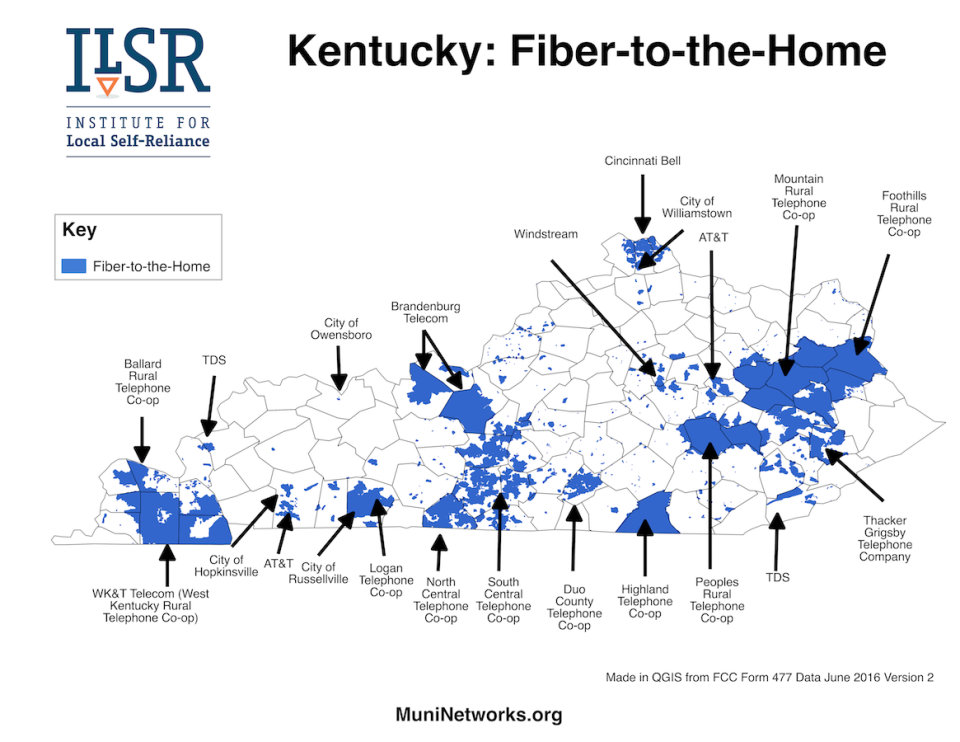
From the rolling Appalachian Mountains to bustling city streets, Kentucky has it all, including gigabit (1,000 Mbps) service from Fiber-to-the-Home (FTTH) networks. That’s right, Kentucky - the state that is often used as shorthand in America politics to talk about coal country and poverty - actually has some of the fastest, most reliable Internet service in the entire country. We put together this map using the latest data sets available from the FCC to highlight how much of rural Kentucky has the gold standard in high-speed Internet service.

Image

Cooperatives Cover Kentucky

This is just a brief snapshot using the June 2016 Federal Communications Commissions (FCC) Form 477 data set. This map shows all the FTTH infrastructure available in Kentucky according to the data submitted by ISPs. This data is reported on the census block level and may overstate coverage. Even so, the data reveals how cooperatives provide high-speed Internet service to much of rural Kentucky.

Webinar On CAF From SHLB: October 26th, 11 a.m. ET

We’ve written about the Connect America Fund (CAF) on multiple occasions and recently alerted interested MuniNetworks.org readers to the FCC’s ongoing efforts to re-examine the CAF Phase II Auction procedures. On October 26th, the Schools, Health & Libraries Broadband Coalition (SHLB) is presenting a free webinar on CAF as part of their Grow2Gig+ Webinar Series.

SHLB will be offering a Universal Service Symposium in Washington, DC, on November 2nd and the information presenting in the webinar will help attendees prepare. Even if you’re not planning to attend the workshop, the webinar will offer information that will be useful if you have any interest in applying for CAF funds or if you are monitoring the FCC’s policies moving forward.

The webinar speakers are Carol Mattey and Rebekah Goodheart; John Windhausen will moderate. SHLB describes the event as:

The Connect America Fund (CAF) is a federal program that provides funding to defray the cost of operating and extending both fixed and mobile broadband networks to serve consumers and small businesses in rural, high-cost areas in the United States. CAF was created by the Federal Communications Commission (FCC) to fulfill the statutory mandate that all Americans have access to communications service that is reasonably comparable to what’s available in urban areas.

Join two former senior FCC officials as they discuss the History of the Connect America Fund, the Phase II  Auction (Performance Standards, Application Process, and Auction Mechanics), as well as Reporting Requirements. 

You can register online at the SHLB website and also review past webinars and check out other events on the calendar. 

Allband All-in For Rural Michigan Internet Access - Community Broadband Bits Podcast 276

After being told by the large telephone incumbent that he could pay a nominal fee in rural Michigan to get phone service, John Reigle built a home. And when the telephone company changed its mind after quoting an outrageous price, he created a cooperative that is building fiber networks in a very rural region of Michigan. 

General Manager Ron Siegel of Allband Communications Cooperative joins us for episode 276 of the Community Broadband Bits podcast. We talk about the realities of connecting the most rural unconnected, while fighting for what meager support is available from state and federal sources. 

Along the way we talk about how the cooperative grew up and where its future lies in an uncertain time for local networks as the federal government showers money on the biggest incumbents that aren't really investing in rural America.

We previously wrote about Allband here.

This show is 22 minutes long and can be played on this page or via Apple Podcasts or the tool of your choice using this feed

Transcript below. 

We want your feedback and suggestions for the show-please e-mail us or leave a comment below.

Listen to other episodes here or view all episodes in our index. See other podcasts from the Institute for Local Self-Reliance here.

Thanks to Arne Huseby for the music. The song is Warm Duck Shuffle and is licensed under a Creative Commons Attribution (3.0) license.

KentuckyWired: Partners, Poles, Problems Plague Project

With the best intentions, Kentucky announced in late 2014 that it would build out a statewide open access fiber optic network to at least one location in each county to encourage high-quality connectivity in both urban and rural communities. Hopes were high as rural residents and businesses that depended on DSL and dial-up envisioned connectivity to finally bring them into the 21st century. After almost three years and multiple issues that have negatively impacted the project, legislators and everyday folks are starting to wonder what's in store for the KentuckyWired project. 

Local Communities Are Best Suited To Deploy Community Networks

There is no one-size-fits-all method of deploying across a state filled with communities and landscapes as diverse as Kentucky. From the urban centers like Louisville and Lexington to the rocky, mountainous terrain in the southeastern Appalachian communities, demographics and geography vary widely. But most lack modern Internet access and local ISPs have found it hard to get affordable backhaul to connect to the rest of the Internet.

There are several municipal networks in Kentucky, some of which have operated for decades. In addition to Glasgow, Paducah, Bowling Green, Frankfort, and others, Owensboro is currently expanding a pilot project that proved popular. As our own Christopher Mitchell discussed at the Appalachia Connectivity Summit, several cooperatives have made major fiber-optic investments in the state.

When it comes to connecting residents and local businesses, we strongly believe local entities are the best choice. Local officials have a better sense of rights-of-way, the challenges of pole attachments, and the many other moving pieces that go into network investment. Projects with local support see fewer barriers - people are more willing to grant easements, for instance. 

Up North Blandin Border to Border Conference Reminder!

Next week’s Border to Border Broadband Conference from the Blandin Foundation promises to be a great opportunity to meet like-minded people with an eye on infrastructure. This year, the event is titled “Bridging the Gaps - Expanding the Impact” and will take place at Madden’s on Gull Lake. If you haven’t already made your plans, now is an excellent time to plan on heading up north to enjoy some fall weather, Minnesota style. 

The folks at Blandin shared more information about the event and we want to pass it on to you:

Minnesota is hosting its annual Border to Border Broadband Conference October 25-26 in beautiful Brainerd Minnesota on Gull Lake.  Come learn about Minnesota's broadband innovative broadband infrastructure grant program that has had a significant impact on broadband deployment in some of the most rural places in Minnesota. 

Blandin Foundation will present new research demonstrating the impact of investment in broadband infrastructure and adoption on five rural Minnesota communities where world-class broadband is meeting smart economic development strategies.

Providers and communities will host eight interactive learning stations showcasing successful rural projects funded through Minnesota’s Border-to-Border grant program.

Pre-conference sessions will include a Broadband 101 Workshop and a Digital Inclusion Showcase:

Laura Withers, Director of Communications, NTCA – The Rural Broadband Association; Roberto Gallardo, Assistant Director, Purdue Center for Regional Development; and Aaron Brown, Iron Range storyteller, blogger (http://minnesotabrown.com/)  and broadband advocate; are among the conference’s featured speakers.

Learn more at the conference website.