
rural

Content tagged with "rural"

Related Topics
Displaying 271 - 280 of 1070

Rustling Up Fixed Wireless Internet Access in the Rural West - Community Broadband Bits Podcast 384
Some of the most rural areas in the country are in the American western states of Wyoming, Nebraska, and Colorado. This week's guest is Matt Larsen, CEO of fixed wireless Internet service provider Vistabeam. His company has made it their mission to deploy affordable, useful Internet access to the people who live in these areas where large national companies have avoided deploying Internet access infrastructure due to low population density. He grew up living on a ranch and understands the challenges of living in a place where it's difficult to get broadband.

In this episode, we're able to learn more about the company and the recent Connect American Fund Phase II (CAF II) award they've obtained to serve more people in the rural west. Matt describes the areas they'll be serving and how they've had to make some changes in order to meet all the administrative requirements of the federal program. He talks about some of the people who will benefit from their service and explains the bid they submitted to win the funding.

Matt also discusses the Lifeline product that Vistabeam will offer to subscribers, which is a requirement as part of accepting the CAF II subsidy. The new offering is less expensive than satellite Internet access, the only option for many people in the areas covered by this project, and yet offers faster, more reliable service. Christopher and Matt also talk about some conclusions of the recent report by Jon Sallet for the Benton Institute on Broadband and Society and Matt shares his opinion as a fixed wireless provider in the field.

You can listen to Christopher's interview with Jon Sallet about the report in episode 381 of the podcast.

This show is 32 minutes long and can be played on this page or via Apple Podcasts or the tool of your choice using this feed

Transcript below. 

We want your feedback and suggestions for the show-please e-mail us or leave a comment below.

Listen to other episodes here or view all episodes in our index. See other podcasts from the Institute for Local Self-Reliance here.

Thanks to Arne Huseby for the music. The song is Warm Duck Shuffle and is licensed under a Creative Commons Attribution (3.0) license.
Rural Indiana Electric Co-op Plans Fiber Deployment in the Heartland

Several rural counties in east central Indiana, where high-quality Internet access isn't readily available, can anticipate changes in the future, thanks to their local electric cooperative. According to WANE.com, Heartland Rural Electric Member Cooperative (REMC) will be embarking on an expansive project to provide high-quality Internet access via 3,000 miles of new fiber optic infrastructure. The network will serve around 20,000 members in four counties.

WANE.com reports:

The [cooperative] borrowed money to fund the project. In addition, Heartland REMC received several multi-million dollar 10-year tax abatements from Huntington, Wabash, and Wells counties for the project.

The total amount for the project is estimated to be $51 million.

“It’s going to be a long payback period,” [CEO Robert] Pearson said, “but the one commitment we had to make and figure out how to do is to make sure it wasn’t put on the backs of our ratepayers. So no rates will ever be raised because of this. We feel like … there are enough people that want this in order to have the support to pay it back.”

Though Heartland REMC will be constructing the lines for the services, they are partnering with TWN Communications to provide and run the new internet service.

But if you’re not a Heartland REMC member, you can still receive the service. Everyone in the county that does not have high-speed internet can get it as long as the lines are in their area.

Pearson told WANE.com:

“It’s a need in the rural areas and no one else will do it....We at Heartland being a cooperative and servicing those members felt like if no one else is going to do it then we need to because high-speed internet in today’s society is crucial.”

Watch the story on the project, which the cooperative expects to finish in three years:

Tupper Lake, New York, Surveys Community for Broadband Future

Located in the far north of New York State and with only around 3,700 residents, Tupper Lake can enjoy the Adirondacks and natural beauty. Spectrum Cable and Verizon offer services in the community, but community leaders are exploring better options. The only way to begin is at the beginning, of course, and their Broadband Committee recently launched a survey for residents and business owners.

According to the Adirondack Daily Enterprise:

The survey will be mailed out to around 120 businesses already near the Development Authority of the North Country’s existing fiber optic line, and residents can fill it out online by visiting tupperlakeny.gov and clicking the “take the survey here” link before Dec. 31.

The 11-question survey is described as an “exploratory first step” in fiber optic expansion. DANC has already brought fiber optic internet access to Tupper Lake schools, the Wild Center nature museum and the Municipal Park, so the initial lines are already in the ground. 

The committee includes volunteers from local businesses, government, and community development organizations.

Fiber optic infrastructure from schools and other community anchor institutions have served as the foundation on which other communities have expanded networks to businesses, municipal facilities, and households. The federal E-rate Program provides funding to schools for telecommunications expenses, including infrastructure deployment, and is based on the percentage of students in a district that qualify for the free and reduced lunch program.

Places such as Ottawa and Chanute in Kansas both developed fiber optic networks for economic development with school fiber as an important foundation. Chanute decide this past summer to extend its publicly owned fiber infrastrucutre to two residential neighborhoods in order to develop a pilot Fiber-to-the-Home (FTTH) pilot project.

Alabama Electric Co-op Says, "It's About Time" for FTTH

Alabama communities with lower population density haven’t attracted big national Internet access providers, but their electric cooperatives are increasingly picking up the slack. In recent months, yet another electric cooperative announced that “it’s about time” for Fiber-to-the-Home (FTTH) for members.

Members are Ready

With over 90 percent of members voting in favor, Joe Wheeler Electric Membership Cooperative (JWEMC) will soon be joining an increasing number of electric cooperatives providing access to broadband. JWEMC’s General Manager, George Kitchens, hopes to have the first customers connected by the fall of 2020 and all members on the network within five years. Kitchens notes that strong support from the community could expedite the timeline. Construction is expected to begin late next summer and the co-op will connect members in both Lawrence County and Morgan County.

“We have studied this internally for over a year,” he said. “We hope to have 18 substations and 1,000 customers hooked up in Year One, 3,800 customers in Year Two and between 3,000 and 5,000 annually Years Three through Five,” said Kitchens

JWEMC has predicted it will need 10,000 subscribers to break even. Currently, folks in rural Lawrence County depend on satellite Internet access, while those who live in the more densely populated areas of Moulton (pop. 3,200) and Town Creek (pop. 1,100) may have access to AT&T DSL or cable Internet access from Charter Communications. Kitchens indicated that the network could be finished in three years, if demand is high and the cooperative can manage a rigorous construction schedule.

Broadband for America’s Future: A Vision for the 2020s

Image

The Benton Institute for Broadband & Society has a reputation for looking at today’s reality with an eye toward tomorrow’s needs. In their report, Broadband for America’s Future: A Vision for the 2020s, Benton Senior Fellow Johnathan Sallet continues that perspective and offers insightful recommendations for a new National Broadband Agenda.

Download the report, Broadband for America’s Future: A Vision for the 2020s here.

Broadband for All Needs a New Approach

As access to high-quality connectivity becomes more critical each day, those without fast, affordable, reliable Internet access lose ground more quickly as time passes. In addition to the opportunities that come with broadband access, lack of adoption translates into lack of technical skills. Innovation isn’t slowing down for folks who don’t have broadband. 

As Sallet notes, access to and adoption of broadband improves our economy, strengthens communities, and empowers American workers. Obtaining that access and expanding that adoption, however, is proving more challenging than it should be.

In his report, the author reviews in detail the barriers that have prevented the U.S. from achieving its goal of ubiquitous access and adoption of broadband. He’s able to make recommendations based on four key policy areas:

Deployment of networks where adequate broadband does not exist;

Competition to increase choices and spur lower prices and better-quality service to their residents;

Affordability and Adoption for those who wish to have broadband in their homes but lack the means or the skills to acquire it; and

Community Anchor Institutions, such as schools and libraries, that increasingly serve their users wherever they are. 

"The Same Fabric of Truth-Seeking"

New Hampshire May Turn to Communications Districts for Rural Broadband

When Vermont passed legislation to establish "communications union districts" in 2015, funding options expanded for regional community network ECFiber. Since then, other states trying to expand access to broadband in rural areas have looked at the success of ECFiber as a possible model. Now, New Hampshire is considering establishing a similar option as a way for local communities to improve local connectivity.

Waiting for Session

Democratic State Senator Jeanne Dietsch from Peterborough has drafted legislation she intends to introduce in the 2020 session. The bill will allow communities to establish "communications districts" to develop broadband infrastructure, similar to the way they band together in order to create sewer districts for necessary infrastructure. The entities are able to finance projects by applying for grants, loans, issuing bonds, and charging user fees, but are not able to tax.

In a recent GovTech article, Dietsch said:

“We modeled it on New Hampshire sewer districts just because that is language that’s already familiar to our legislators, and it’ll be much easier for them to pass it that way than to try to make it look like Vermont.”

The lawmaker was reflecting on difficulties the legislature had passing Senate Bill 103, which allows municipalities to work together for "multi-town bonding projects." Special interest lobbyists, whose job it is to maintain ISP monopolies, leveled their efforts at the bill when it appeared fearing the competition it might bring. Dietsch wants to avoid a similar fight with the communications district proposal, so has carefully crafted the language of the bill.

If passed, the new authority will allow cities to develop the infrastructure in order to work with private sector partners. ECFiber offers fast, affordable, reliable Internet access directly to the public, rather than providing fiber optic infrastructure for Internet access companies to use.

ECFiber

Tri-County Rural Electric Delivering Connectivity, Expanding Partnerships, in Appalachians - Community Broadband Bits Podcast 383

Tri-County Electric Cooperative in north central Pennsylvania has listened to its members' wishes and is developing a Fiber-to-the-Home (FTTH) network for Internet access. While Christopher was at the October Broadband Communities Economic Development event in Alexandria, Virginia, he met up with Craig Eccher, President and CEO of the co-op, to learn more about the project and the cooperative.

Craig describes how the infrastructure was needed for basic electric operations - to improve communication between substations - and that members had also begun to request Internet access from their co-op. When they sought information through a survey, the results were supportive, but cooperative leadership needed to take a creative approach to get members to attend a meeting for discussion about project details. Craig describes how the demographic support surprised and encouraged them and how state and federal funding provided the boost they needed to confirm the project.

The cooperative is redefining partnerships both in the community and in ways that go beyond the co-op's service area. Craig talks about business and member partnerships that will help expand the use of the infrastructure. He also describes how the project has breathed new life into the role of the cooperative within the Appalachian community it serves and how, while happy with the new excitement, it's important to manage expectations.

This show is 24 minutes long and can be played on this page or via Apple Podcasts or the tool of your choice using this feed

Transcript below. 

We want your feedback and suggestions for the show-please e-mail us or leave a comment below.

Listen to other episodes here or view all episodes in our index. See other podcasts from the Institute for Local Self-Reliance here.

Thanks to Arne Huseby for the music. The song is Warm Duck Shuffle and is licensed under a Creative Commons Attribution (3.0) license.

Early ReConnect Grants Go to Local Government, Electric Co-op

The U.S. Department of Agriculture (USDA) recently awarded a $2.85 million grant to Forked Deer Electric Cooperative headquartered in Halls, Tennessee, and $9.75 million to Orangeburg County, South Carolina to develop broadband infrastructure. The awardees will use the ReConnect grants to construct or expand existing Fiber-to-the-Home (FTTH) Internet access to thousands of households, critical community facilities, and educational facilities.

A Reconnect Primer

In 2019, Congress allocated $600 million for the ReConnect Program to help expand high-quality Internet access to rural America. Applicants can apply for a 100 percent grant, 100 percent loan, or a grant-loan combination. The ReConnect Program provides funding to allow for-profit companies, rural cooperatives, local governments, and tribes to deploy broadband infrastructure under specific guidelines. The service area for qualified applicants must be rural communities with 90 - 100 percent of the population considered "underserved," defined as Internet access speeds of 10 Megabits per second (Mbps) download and 1 Mbps upload or lower.

As we reported in September, more than half of the applications submitted came from cooperatives and local governments.

Orangeburg County

Under the American Recovery and Reinvestment Act (ARRA), Orangeburg County was awarded federal stimulus funds in 2010 and added around $4 million of their own money for rural broadband projects. Shortly following the stimulus package award, the state legislature enacted a law discouraging simlar local investment. The law requires local governments to charge rates for broadband Internet services similar rates to those of private companies, even if service could be provided at a lower cost. This law effectively limits local broadband authority and discourages communities from developing publicly owned networks.

Fact Sheet: Frontier Has Failed Rural America

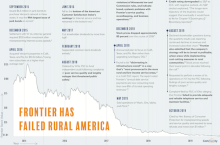
Despite raking in hundreds of millions in government broadband subsidies, Frontier Communications has failed time and time again to bring reliable, high-speed connectivity to the rural communities it serves. Instead of investing in network upgrades, Frontier has neglected its rural infrastructure to the detriment of its subscribers and the company’s own financials, with its worsening service quality paralleling its plummeting stock value.

Our new fact sheet, Frontier Has Failed Rural America, presents evidence of Frontier’s negligence and suggests that rather than continuing to trust Frontier, government officials should look to publicly owned and community-minded providers to connect rural residents, businesses, and institutions.

Download the Frontier Has Failed Rural America fact sheet [pdf].

Subsidies Can’t Fix Frontier

Federal and state government agencies have given Frontier nearly $2 billion to expand and upgrade its rural broadband networks. The company has received approximately $1.7 billion from the Connect America Fund Phase II federal subsidy program and millions more in grants from states like Minnesota and New York.

Even with the subsidies, Frontier ultimately failed to connect rural communities with high-quality broadband. The company has repeatedly chosen not to upgrade rural networks, leaving subscribers with poor, unreliable service that doesn’t fulfill their basic communications needs.

Frontier’s “Systemic Problems”

Our fact sheet, Frontier Has Failed Rural America, features events from the past five years that demonstrate Frontier’s inability to solve the rural broadband problem, including:

Almanac Travels Up North to Examine Access to Fiber in Minnesota

People who live out of urban areas enjoy beautiful scenery, quiet solitude, and fresh air. Traditionally, those qualities have come with sacrifice, which includes high-quality Internet access. Now that rural cooperatives are taking the initiative to develop networks, however, rural areas such as northern Minnesota are better served.

In this short video by the PBS and TPT Almanac team, Kaomi Goetz travels “up north” to visit with folks who live beyond the Twin Cities to see how things are changing and how we still need to make improvements.