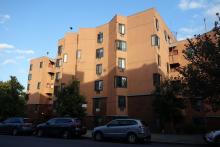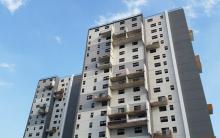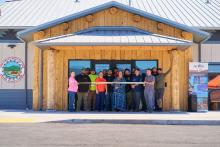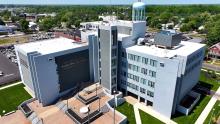

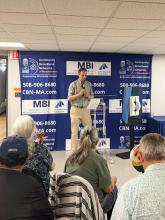
Late last month, officials from the Massachusetts Broadband Institute (MBI) and Community Broadband Networks America (CBN America) — an independently-owned fiber Internet service provider — gathered with dozens of residents at two Southbridge Housing Authority properties to celebrate the expansion of the state's Residential Retrofit Program.
The event marked the latest milestone for a program that, more than two years after its launch, has grown from a $22 million pilot project into a $74 million initiative to rewire some of the Commonwealth's oldest affordable housing stock in order to allow residents living there faster and more reliable access to the Internet.
For the roughly 150 residents at the two Southbridge properties — many of them elderly, on fixed incomes, or living with disabilities — the occasion really hit home.
Diane Servant, board chair of the Southbridge Housing Authority and a resident herself, told the crowd gathered for the celebration what the upgraded wiring will mean for broadband-hungry residents.
“It's going to save you money, and that's always a plus for all of us on very fixed incomes,” Servant said. “Some of the perks are you will be able to do telehealth, talk with your children, talk with your grandchildren. It's just going to be fabulous.”
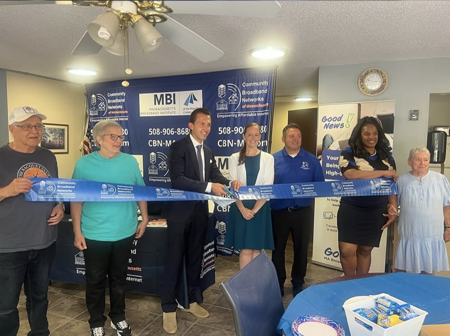
CBN America is handling the fiber build-out at the Southbridge properties, part of a broader push by the provider into southern Worcester County. In total, CBN was awarded $5.7 million in grant program funds to upgrade wiring in buildings across six different communities in the region, bringing all-fiber connections to 1,820 units, MBI officials tell ILSR.
From $22 Million Pilot to $74 Million Statewide Push
The Residential Retrofit Program was announced in April 2024, seeded with $22 million of the $175 million in federal Capital Projects Fund money the state received, courtesy of the federal American Rescue Plan Act.
Since then, that amount has more than tripled. According to Michael Baldino, MBI's Director and General Counsel, the program has now administered five competitive funding rounds, and the full $74 million in Capital Projects Fund money has been awarded across six providers, who are carrying out the retrofit work and offering residential service.
“We think this is a really good complement to our other infrastructure programs,” Baldino tells ILSR, pointing to a problem that Congress and federal policy makers have chosen to put a distant second to the need for new connections to unserved and underserved single-family homes across the country: buildings that are within reach of high-speed service but can't actually deliver service to individual units.
“The barrier in some housing is the wiring can be 50 years or more old. It’s antiquated; the in-building wiring hasn't caught up.”
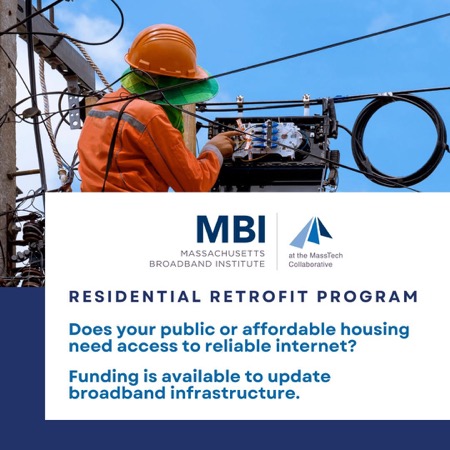
The retrofit program provides the funds needed to upgrade those buildings to modern Category 6 Ethernet or fiber standards so residents can actually use the speeds available just outside their buildings.
A companion effort, the Gap Networks Grant Program — launched by MBI in October 2023 — targets areas where infrastructure gaps remain. Together, the two programs are designed to work in tandem, one filling in last-mile network gaps and the other modernizing what's already inside affordable housing buildings.
MBI also runs a complementary Range Program, backed by an additional $9 million, that funnels money directly to housing operators rather than providers — funding digital navigators, digital skills training, and devices for residents.
Where the Retrofit Program upgrades the wiring, the Range program is meant to ensure residents can actually take advantage of high-speed Internet connectivity.
New Providers, More Competition
One unexpected outcome Baldino highlighted was that the program has attracted new broadband providers into Massachusetts that weren't previously doing business in the state.
The six providers now working under the Retrofit Program are CBN America, Access Plus, Aervivo, Comcast, Greenfield's municipal utility GCET (Greenfield Community Energy and Technology), and Hawk Networks. Baldino noted that CBN, Aervivo, and Hawk Networks did not operate in Massachusetts before the retrofit program brought them in.
That expanded field of providers, combined with more than 99 participating housing operators, has translated into statewide reach. When the program launched in 2024, MBI set out to target 22,000 affordable housing units statewide. That number has since grown substantially, now covering more than 32,000 households across 2,850 properties in over 100 cities and towns, touching every region in the Commonwealth.
The buildings themselves vary widely, from high-rises to townhouse-style developments, and providers have used a mix of approaches, including wireless links between buildings, to get service to every unit, Baldino explained. Regardless of the technology, MBI requires that any connection funded through the program deliver at least 100 Megabits per second (Mbps) symmetrical service — a higher bar than the federal government's 100/20 Mbps standard embedded in the federal BEAD program.
Keeping Costs Down
Baldino said that funding rounds were structured to reward applicants who go beyond simply deploying new wiring. Providers competing for retrofit dollars were encouraged to offer additional resident benefits — free Wi-Fi in common areas, device distribution, and on-site digital literacy classes, all features CBN America is providing in Southbridge.
The program also builds in incentives to tackle affordability directly. Baldino said providers are pushed toward low-cost service offerings and bulk purchasing arrangements that keep monthly bills down for a full decade after construction is complete.
Across the program, that has translated into low-cost offerings generally running $15 to $35 per month, with bulk-purchasing arrangements bringing costs down further, to roughly $10 to $25 per month.
What's Next
Most of the funded projects are now in construction, working toward a hard deadline: the federal Capital Projects Fund dollars underwriting the program must be spent by the end of 2026.
On track to meet that mark, Baldino said the investment is one that will outlast that deadline by decades.
“The legacy of this program is that the infrastructure investments are multigenerational. All of this will future-proof residents for decades to come.”
He added that the impact goes beyond the wiring itself. It's the complementary investments, like digital skills training and device access, that will keep paying off long after the construction crews leave.
MBI plans to keep tracking the program's progress for years to come, and has built a public-facing broadband infrastructure dashboard on its website where residents and the public can follow the rollout of both the Retrofit Program and the Gap Networks Grant Program in real time.
“We think it's important to have a public-facing dashboard for transparency and accountability,” Baldino said.
Header image of MBI official at Southbridge ceremony courtesy of Mass Tech Collaborative Facebook page