
The Hoopa Valley Tribe is celebrating the opening of its new fiber network operations center as the Hoopa Valley Public Utilities District (HVPUD) expands fiber-to-the-home Internet service throughout the Hoopa Valley Reservation and into neighboring communities just outside of its Tribal lands.
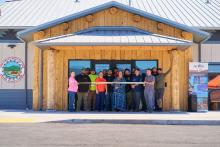
To mark the occasion earlier this summer, more than 50 community members, Tribal leaders, HVPUD staff, and project partners attended the July 17 opening celebration.
At the celebration, Hoopa Valley Tribal Vice Chairman Jordan Hailey hailed the milestone moment:
“This is truly a great day for the Hoopa Valley Tribe, for the department and for the Hoopa people. It makes me proud as a Hoopa Tribal member and a member of this community to see everything that they’ve accomplished.”
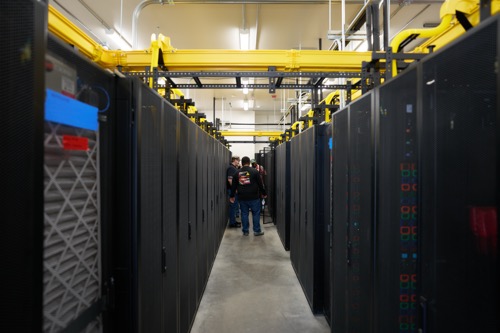
Though the new network operations headquarters is a storage and transport data center, General Manager of HVPUD Linnea Jackson made it clear that it is not a hyperscale/compute AI data center that have sparked controversy and protest in numerous local communities across the nation.
“The (data centers) that are sucking up all those resources — water, land, and energy — those are the AI data centers. Ours is a network hub, not a huge footprint,” Jackson tells ILSR. “We’re talking about servers and rack space for (Tribal) government operations and records, not a demand on our water resources — completely different from a large AI data center.”
Establishing Data Sovereignty
The pride on display at the opening celebration, however, went beyond the servers and racks in the new operations center.
“The Tribe has 60 different departments — fire, medical, police, and (cultural and language) archives. Each building doesn’t have the proper space to host all of their information. With this new center, (the information) will be secure, climate-controlled and house Tribal records in a digital format,” Jackson explained, noting how the Tribe will now be able to establish its own digital sovereignty.
“To host our own network, it allows us to control who has access to that data so it’s not living in the cloud. By owning, operating, and managing our network, we control 100 percent of those access parameters and security configurations.”
In addition to housing the Tribe’s data records, it will serve as the central nervous system for the Tribally-owned and operated Internet service provider, Acorn Connected.
Expanding Inside and Outside Tribal Lands
Having already established a limited wireless network, it was in March of 2023 when the Hoopa Valley Public Utilities District (HVPUD) received a $65 million grant from the National Telecommunications and Information Administration’s (NTIA) $3 billion Tribal Broadband Connectivity Program to fund the construction of a fiber network to serve the entire reservation — a sizeable but necessary sum considering the unique construction costs and terrain in that part of northern California.
Then, in the fall of 2023, the Hoopa Tribe entered into a partnership with the state of California to jointly construct 23 miles of fiber optic middle-mile infrastructure cutting through the reservation, a rural and heavily wooded region in northern California that spans over 89,000 acres and is home to over 2,500 Tribal citizens.
Since then, the Tribe has been building out portions of California’s middle-mile network while simultaneously working to build-out last-mile connections to individual Tribal homes and businesses.
Currently, Acorn Connected’s fiber network is offering service to 200 Tribal households and by next year, HVPUD officials expect to be finished expanding the network to all 1,000 households on the reservation, Jackson said.
And HVPUD doesn’t plan to stop there. It will also soon be offering its fiber Internet service to unserved non-Tribal communities near the reservation in the Willow Creek area and inside Trinity County, which will add “several thousand more” households to the Tribe’s network.
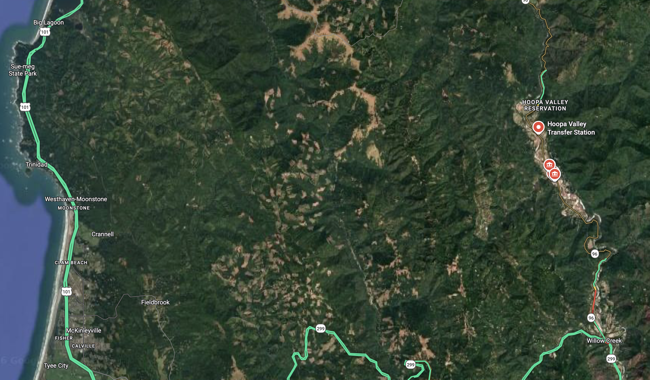
“We have a grant from the CPUC (California Public Utility Commission) under the Last Mile Federal Funding Account that will allow us to build-out portions of Willow Creek, which is an adjacent little town that’s part of our ancestral territory and along Highway 299 in Trinity County,” Jackson said.
Expanding into those areas will extend the network as far as two hours away from the reservation.
“We’re going up the highway along the Trinity river. There’s lots of unserved small towns around there so we will be utilizing the (middle-mile) backbone that has already been created and building off of that infrastructure. We are also entering into IRUs (Indefeasible Right of Use) to serve those last mile locations, which is essentially a fiber leasing agreement,” she said.
Jackson said the entire project, both on-reservation and off, is on track to be completed by December of 2027, which, when finished, will triple Acorn Connected’s current subscription base.
More Access to Spectrum and Funding Still Needed
Still, even as the Tribe builds-out its fiber network, they are still working to protect and expand its access to wireless spectrum (2.5 GHz band, unlicensed spectrum, microwave backhaul spectrum) — a vital component of its communications system in an area increasingly ravaged by wildfires.
Recently, Jackson explained, “there was a Mile Post 16 fire and Mile Post 18 — two different fires. The Mile Post 18 fire was exponentially larger. We had over 2,000 (Tribal and non-Tribal) emergency personnel out there. All of that requires (radio) spectrum for communication because those are areas where there is no cell phone service for emergency personnel who rely on that.”
“Wildfires happen, fiber cuts happen. But, we still need to maintain critical services,” she added.
Reflecting on the Hoopa Tribe and other Tribal nations' growing expertise in building, operating, and managing telecommunication infrastructure, Jackson said, it has demonstrated “Tribal nations’ ability to manage large scale projects.”
What Tribes have historically lacked are federal or private investment funds. And while the demand for federal investment is still lacking for many Tribal governments, Jackson feels fortunate Hoopa has made it this far.
“It’s not a business operation so we are not structured like large telecom companies. We are looking to solve critical issues for our people,” she said. “We can train our own people and manage the network. We just need the resources.”
Header image of ribbon cutting celebration courtesy of Hoopa Valley PUD
Inline image of HVPUD Data Center server racks courtesy of Hoopa Valley PUD
Aerial map of Hoopa Valley Tribe reservation marked with red dots and surrounding area Google Maps screenshot
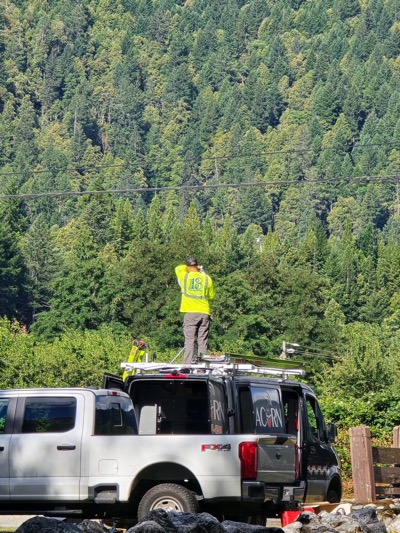
Inline image of Acorn Connected employee standing on work van courtesy of HVPUD Facebook page