
Minnesota electricity cooperative East Central Energy (ECE) is the first broadband provider in the state to secure a Broadband, Equity, Access, and Deployment contract agreement, as state officials begin formally doling out their $652 million share of federal grant money.
According to an announcement from the cooperative, the initial $16.6 million round of BEAD funding will help finance the deployment of affordable high-speed connectivity to approximately 3,750 locations across rural Minnesota. The co-op says it selected Clearfield, Inc. for its fiber network expansion.
“We're proud to be the first broadband provider in Minnesota to secure an executed BEAD agreement,” ECE announced on Facebook. “This is an exciting step forward in our mission to bring reliable, high-speed fiber internet to more homes and businesses.”
In deployed markets, ECE offers subscribers four service tiers to choose from: a symmetrical 100 megabit per second (Mbps) tier for $65 a month; a symmetrical 250 Mbps option for $85 a month; a symmetrical 1 gigabit per second (Gbps) tier for $120 a month; and a symmetrical 2 Gbps option for $190 a month.
The cooperative’s fiber tiers come with no hidden fees, usage surcharges, or long-term contracts, and both the speed and pricing are significantly better than anything offered by regional phone and cable monopolies.
ECE currently provides electricity to 63,000 customers across 14 counties scattered across east-central Minnesota and northwestern Wisconsin. All told, ECE will be receiving an estimated $46.1 million in BEAD funding across four different fiber projects.
"East Central Energy’s execution of Minnesota’s first BEAD program agreement by a broadband provider marks an important milestone in our efforts to expand reliable, high-speed internet access to unserved and underserved communities," said Bree Maki, Executive Director at the State of Minnesota’s Office of Broadband Development.
Like so many U.S. electrical cooperatives, East Central Energy announced in 2023 it would be leveraging its generational understanding of rural electricity deployment to pivot to broadband expansion, connecting roughly 8,400 electricity customers to fiber optic broadband since their expansion began back in the fall of 2023.
The Minnesota Office of Broadband Development’s (OBD) Final Proposal only requested roughly $381 million in BEAD grant funding across 74,739 locations, in part due to some of the unpopular changes implemented by the NTIA. Additional funding from the state’s broader $652 million grant pool is expected to be awarded at a later date.
ECE’s fiber project builds upon the cooperative's long-standing infrastructure footprint, taking advantage of existing rights-of-way and utility poles to lower deployment costs. By integrating smart grid communications with fiber broadband, the co-op aims to improve electric grid reliability alongside expanding residential broadband access.
Across Minnesota, electric cooperatives have increasingly stepped up to fill connectivity gaps where private incumbent providers have traditionally underinvested. The initial round of BEAD funding serves as a critical catalyst for these rural areas, targeting locations that have lacked access to basic broadband thresholds of 100/20 Mbps speeds.
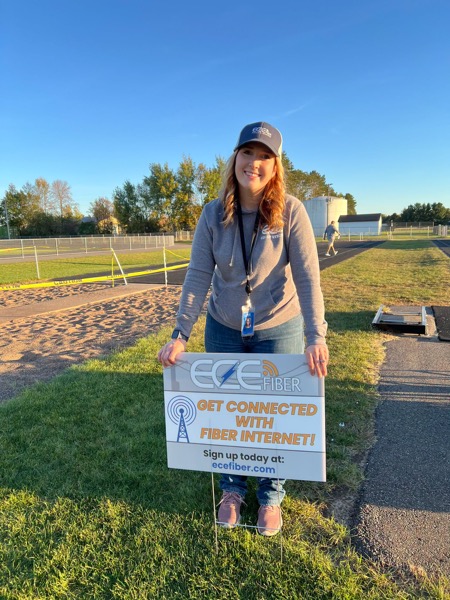
Inline image of ECE Fiber subscriber courtesy of East Central Energy Facebook page