

For years, the conventional playbook for communities stuck with slow, expensive Internet service has been to wait. Wait for the incumbent cable or phone company to upgrade connections, wait for a federal grant, wait for someone else to solve the problem.
Now, a growing number of communities have decided they are done waiting.
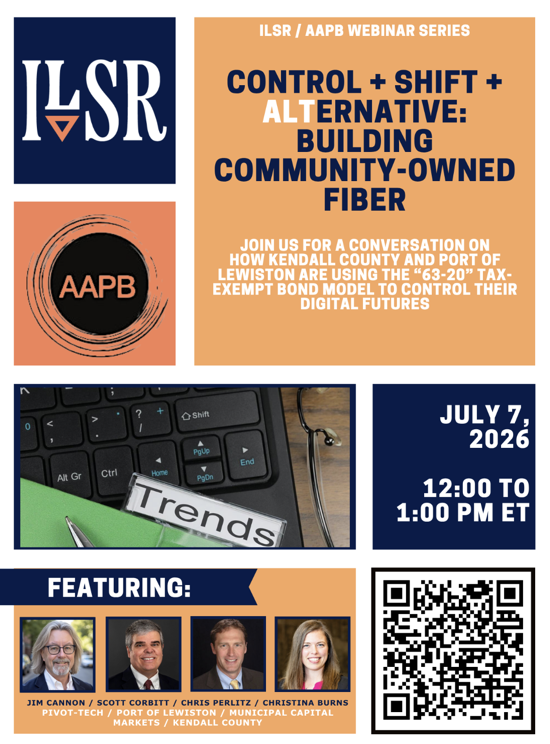
And on July 7 at 12 noon ET, the next installment in a joint webinar series from the American Association for Public Broadband (AAPB) and the Institute for Local Self-Reliance (ILSR) will showcase a new financing model being put into action that allows for communities to control their digital futures.
The free, one-hour live webinar to be broadcast on ILSR's YouTube channel — "Control + Shift + ALTernative: Building Community-Owned Fiber" — will go behind the scenes of two real-world community fiber projects to tease out the practical lessons that other communities can learn from.
Registration for the webinar is now open here.
The webinar will be moderated by Gigi Sohn, one of the country's foremost telecommunications policy experts and head of AAPB, and Sean Gonsalves, Senior Writer and Associate Director for Communications with ILSR's Community Broadband Networks Initiative.
Together they will lead a conversation with four practitioners who have been in the trenches of community broadband development: Jim Cannon, CEO of Pivot-Tech; Scott Corbitt, General Manager of the Port of Lewiston; Christina Burns, Kendall County Administrator; and Chris Perlitz, Managing Director at Municipal Capital Markets Group, Inc.
The conversation will be grounded in two case studies — Kendall County and Lewiston — that illustrate what it actually takes to move a community fiber project from idea to operating network, using a creative “63-20” tax-exempt bond model championed by Pivot-Tech Development, which specializes in public-private partnerships for community-owned broadband networks.
The panelists will walk through the decisions that had to be made early, the structural questions that determined whether projects were able to be financed, the execution challenges that nearly derailed them, and the governance frameworks that protect community control over the long term.
“Communities are no longer waiting for incumbents,” Sohn said. “What we have for this webinar is really a case study in private financing and community control.”
The webinar is designed to be practical and replicable — aimed at local elected officials, municipal administrators, economic development leaders, and community broadband advocates who want to understand not just whether community-owned fiber is possible, but how to actually get it done.
Register for the webinar here.
Watch our previous webinar on connecting Multi-Dwelling Units below:
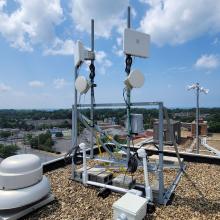
Header image courtesy of Rise Above Research, CC BY-SA 3.0, Attribution-ShareAlike 3.0 Unported