

California residents are engaged in a protracted, ugly battle with telecom giant AT&T over their ability to receive life-saving communications during an emergency.
The battle comes as the telecom monopoly attempts to eliminate most meaningful oversight of the company’s communications networks, actively putting human lives – and state rights – at risk.
At the heart of the standoff is California’s Carrier Of Last Resort (COLR) obligations, which mandate that state residents maintain reliable access to voice calls, 911, toll free calls, deaf and disabled assistance services, customer service support, protection from unwanted charges, operator services, directory help, and flexible billing options.
AT&T lobbyists have worked tirelessly to eliminate such requirements in 20 of its 21 state service territories, falsely claiming the regulations stifled the company’s ability to install next-generation fiber access. In reality, AT&T has long been criticized for cheaping out on fiber investments, and is primarily interested in eliminating any dwindling oversight.
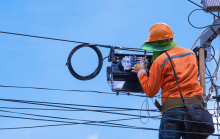
As COLR obligations are eliminated, customers are frequently shoveled from traditional copper-based landlines – which operate even during power outages – to frequently less reliable and significantly more expensive wireless alternatives. In many cases that results in California elderly residents losing access to essential lifesaving services entirely, particularly in areas where cellular connectivity is spotty or unavailable.

AT&T’s decision to shutter its traditional copper-based networks without providing affordable, reliable alternatives could leave millions of Californians out of reach of not just Internet access, but life-saving care. As a result, the CPUC refused AT&T’s request to end its California COLR obligations in 2024, triggering a protracted battle between the state and its biggest telecom.
What’s happening in California offers no limits of warnings for the rest of the country.
AT&T Lawsuits And False Claims
In May, AT&T sued the California Public Utilities Commission (CPUC) over its efforts to protect vulnerable state residents.
AT&T’s complaint falsely claims that the CPUC was stopping it from upgrading state residents to more modern fiber connections, and forcing the company to retain costly and dated copper-based lines.
“California requires AT&T to spend $1 billion each year to maintain a century-old telephone network that almost no one uses,” AT&T lawyers claimed. “The copper wires that once served every home now serve just three percent of households in AT&T’s California territory, with consumers fleeing every day to modern broadband services that are more affordable, reliable, and energy-efficient.”
The CPUC responded by correctly pointing out that AT&T’s lawyers were lying.
“AT&T asserts that California seeks to prohibit or hinder wireline carriers from discontinuing copper facilities and investing in fiber,” CPUC officials said in a June 15 filing. “Indeed, AT&T has been making this argument for years. It is not and has never been true.”
The CPUC’s efforts do not prohibit AT&T from upgrading any of its dated copper DSL and landline assets to fiber. The CPUC has simply endeavored to ensure that customers that lose access to essential communications systems are shoveled off to affordable alternatives of equal or greater quality and reliability.
Currently, roughly 1 million emergency calls are made in California each year over landlines, especially in areas where mobile service is unreliable or unavailable. Many of these landlines are AT&T’s. Abruptly severing these connections without ensuring adequate replacement technology puts public safety and human lives at risk, the CPUC notes.
“A service should not be considered an adequate replacement for the wireline services AT&T now seeks to retire if it costs substantially more than the existing service; requires additional equipment purchases; depends on additional, customer-supplied broadband; fails during commercial power outages without customer-provided backup power; is incompatible with assistive technologies; provides inferior indoor coverage; or results in diminished 911 functionality or reliability,” the CPUC argues.
Activists say AT&T has completely misrepresented what the fight is all about in an effort to ignore state rights and eliminate functional state oversight.

“This is not about copper landlines or maintaining POTS service,” says Lindsey Skolnik, Manager of the California Alliance for Digital Equity (CADE), a community-based coalition focused on advancing digital equity and inclusion across the Golden State. “Although AT&T claims otherwise, the COLR obligation to provide Basic Service is technology neutral. We simply want to ensure that the replacement technology is just as good as what is currently available.”
AT&T has long been accused of “redlining,” or cherry picking next-generation fiber deployment to affluent and less diverse neighborhoods.
Organizations like the National Digital Inclusion Alliance (NDIA) have repeatedly shown that AT&T consistently ignores upgrades and repairs in less diverse and lower-income communities across cities like Detroit and Cleveland. At the same time, studies have shown that ISPs like AT&T also charge low-income and minority communities more money for slower service.
“AT&T is using all their money and political influence to be free to serve only the most profitable neighborhoods, and to leave low-income and rural communities behind,” warns Arturo Juarez, Policy Advisor at NextGen Policy, a founding partner of CADE. “If the company no longer has to abide by COLR universal service principles, service quality requirements, or non-discrimination laws, AT&T would be able to limit who they serve in a way that boosts the company’s bottom line,”
AT&T’s Attack On Public Safety And State Rights Is Multi-Pronged
AT&T’s fight against the CPUC’s accountability is taking place across four different fronts.
AT&T is directly fighting the agency’s proceeding at the CPUC and they’ve filed a lawsuit to prevent the agency from protecting California consumers. It’s believed AT&T is also involved in legislative efforts to strip CPUC of its authority over broadband under the pretense of trying to save California consumers money on their electric bills.
As ILSR has detailed, California Assemblymember Tasha Boerner, a Democrat from Encinitas, unsuccessfully attempted to fast-track legislation that would massively curtail the CPUC’s authority over essential Internet access – not coincidentally as the agency has focused on efforts to make state broadband more affordable.
At the same time, AT&T has successfully petitioned the Trump FCC to try and pre-empt California’s COLR obligations, a direct attack on state rights. During the fight over net neutrality, U.S. courts repeatedly ruled that federal regulators can’t abdicate their responsibility on issues like consumer protection, then turn around and tell states what to do.
But the legal fight over COLR is murkier when it comes to pre-emption.
“The Communications Act creates this scheme where the FCC is supposed to regulate interstate traffic and not touch intrastate traffic and the state is supposed to regulate intrastate traffic and not touch interstate traffic,” says Harold Feld, a telecom policy lawyer at consumer group Public Knowledge.

That can get legally complicated given that modern communications don't adhere to geographic boundaries, creating what Feld calls “jurisdictionally mixed traffic.” The debates haven’t been helped by a complicated series of sometimes logically-incoherent rulings among circuit courts, resulting in a “touchy area of litigation” according to Feld.
“My feeling on this is that the state has a very strong argument, particularly with regard to 911 service, and that wins,” Feld said. But “I wouldn't want to bet money on it,” he added.
The FCC’s intervention has become a political flashpoint in more ways than one. In a recent letter sent to FCC Chairman Brendan Carr, GOP California Governor candidate Steve Hilton urged the agency to reverse course, stating the state was “more than capable of deciding whether our own residents still need landlines as a public-safety backstop.”
“I understand you may not have been personally involved in this particular decision,” Hilton wrote to Carr. “But as Chairman of the FCC, you have the authority and responsibility to correct it.”
What’s happening in California is a very clear warning sign to other states that telecom monopolies envision a future where state rights don’t exist and the country’s elderly and low-income populations are entirely expendable. That reality often gets buried in convoluted policy and legalese, but it remains a life and death battle all the same.
Inline image of AT&T building courtesy of Wikimedia Commons, Creative Commons Attribution-ShareAlike 4.0 International
Inline image of AT&T building in Dallas courtesy of Around the Block Moving, CC BY-NC 4.0, Attribution-NonCommercial 4.0 International
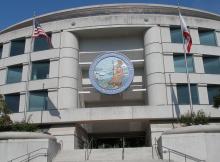
Inline image of California Public Utilities Commission building courtesy of Wikimedia Commons, Attribution-ShareAlike 3.0 Unported
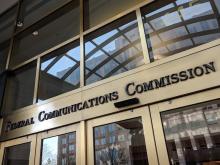
image of FCC front entrance courtesy of Rob Pegoraro on Flickr, Creative Commons, Attribution-NonCommercial-ShareAlike 2.0 Generic
Inline image of FCC Commissioner Brendan Carr courtesy of Broadband Breakfast