
California regulators are locked in a fierce battle with AT&T over state residents' access to life-saving emergency communications.
Officials have accused the telecom giant of actively misleading the public as the state considers stricter rules to make wireless coverage maps more accurate, and providers more accountable for reliability failures.
At the heart of the standoff is California’s Carrier Of Last Resort (COLR) obligations, which mandate that state residents have reliable access to voice calls, 911, deaf and disabled assistance services, customer service support, protection from unwanted charges, and flexible billing options.
AT&T lobbyists have worked tirelessly to eliminate such requirements in 20 of its 21 state service territories, falsely claiming the regulations stifled the company’s ability to install next-generation fiber. In reality, AT&T has long been criticized for cheaping out on fiber investments, and is primarily interested in eliminating already dwindling oversight.

In many areas, AT&T has refused to upgrade aging DSL infrastructure, instead shoveling California residents off to “good enough” wireless service. But AT&T’s wireless service isn’t consistently available, affordable, or reliable – particularly when it comes to providing Californians dependable access to essential 911 infrastructure.
Despite this, more than 80 percent of 911 calls in California are now placed from a wireless device. CPUC data also shows that of the more than 1,000 recent wireless service outages in California, many lasted longer than 24 hours, including 359 that lasted longer than 72 hours.
Holding Wireless Giants Accountable For Unreliable Wireless
In a new blog post over at the California Public Utilities Commission (CPUC) website, Ernesto Falcon, CPUC Program Manager for the Communications and Broadband Policy Branch at the Public Advocates Office, notes how wireless giants like AT&T have a long history of hiding and misrepresenting wireless limits – both in terms of speeds and availability.
Wireless giant coverage maps are notoriously and intentionally unreliable. So the CPUC recently proposed requiring wireless companies to make more detailed and accurate wireless coverage maps available to customers.
“The Public Advocates Office applauds this direction and agrees with the simple premise: If companies already know where service is expected to work, customers deserve to know too,” Falcon notes.
The CPUC’s proposed fix is multi-pronged, requiring that wireless providers doing business in California:
- Restore service within 24 hours when an outage isolates a community.
- Keep networks available 99 percent of the time, measured locally so poor performance in rural communities cannot be masked by stronger performance in more populated areas.
- Answer 80 percent of customer service calls with a live representative within 60 seconds.
- Publish accurate maps that show where a customer can reliably place a voice call.
“Although more detailed coverage information is available in some international markets, including the European Union, U.S. customers still lack easy-to-use information that helps them assess where wireless calls are likely to work reliably,” Falcon states. “The CPUC is poised to help close this gap in consumer transparency.”
AT&T Accused Of Actively Misleading Consumers And Regulators
AT&T has a long history of fighting tooth and nail against government oversight of any kind. But they’ve proven consistently hostile to efforts to improve both fixed and wireless broadband maps.
Improved, more accurate DSL, fiber, cable, and wireless maps would not only highlight spotty AT&T upgrades and investment (despite billions in taxpayer subsidies), it would clearly show the real-world impact of telecom monopolization and muted competition at the hands of relentless industry consolidation.
In a September filing, CPUC notes that both AT&T and Verizon have actively misrepresented their wireless coverage quality in roundtable conversations and formal filings with the agency as it debates stricter rules.
More specifically, the CPUC notes that AT&T misleadingly tried to conflate wireless data propagation and availability (simply having functional 4G or 5G data signal) with wireless call quality in a bid to pretend its wireless voice (and 911) service was more reliably available.

“‘Having service’ is often correlated to the number of bars that customers see on their mobile devices,” the CPUC notes. “While the number of bars on a phone can be helpful in determining if any signal is available for use, it is not useful in determining what that signal can be used to transmit.”
The filing notes that AT&T has also tried to claim that such California reforms aren’t necessary because the FCC has “addressed” nationwide mapping challenges. But the FCC’s updated maps have still received consistent criticism for overstating speeds and coverage, and the agency’s mobile broadband maps haven’t been updated since 2021.
AT&T cut 54,858 jobs between 2017 and late 2020 while increasingly shifting core network construction and maintenance work away from union-represented employees. At the same time, AT&T employs a tangled web of more than 700 distinct contracting companies in a bid to lowball pay and distance itself from legal accountability for substandard service.
A 2020 survey of 1,500 AT&T employees by the Communications Workers Of America (CWA) found that 96 percent of those surveyed reported witnessing contractor-driven quality problems that increased costs, 81 percent reported customer service quality degradation, and 57% cited serious safety risks for workers and the public due to the ramp-up for lower-quality subcontracted labor.
A CPUC vote on California’s proposed wireless mapping and service reforms is expected sometime in December.
“Ultimately, the CPUC should adopt the staff proposal,” Falcon said. “Because wireless companies already develop detailed coverage information, Californians should be able to determine, before they sign a contract and certainly before their landline is disconnected, whether wireless service can meet their critical communication needs. No one should have to discover a gap in coverage when they need to make an emergency call.”
Watch CPUC Workshop on considering updates to the service quality rules for wireless carriers held on Aug. 26, 2026 below:
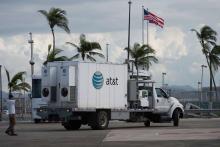
Header image of AT&T truck courtesy of NARA and DVIDS Public Domain Archives
Inline image of cell tower disguised as a tree in Richmond, CA courtesy of Robert So on Pexels