
Vermont CUD

Content tagged with "Vermont CUD"

Related Topics
Displaying 1 - 10 of 18

Data, Drones, and Digital Mascots – Episode 32 of Unbuffered

Unbuffered Logo - Two text bubbles

In this episode of Unbuffered, Chris is joined by Sean Gonsalves and Sascha Meinrath (X-Lab and Penn State University) for a wide-ranging conversation on broadband data, satellite security, and the creeping influence of AI on everyday life.

Together, they start with Vermont’s new VT Speed Check, a partnership with Ookla that asks residents to test early and often as fiber reaches more of the state. Sascha praises the effort but makes the case for open data and open methodologies over proprietary platforms, whose licensing terms can bar researchers from asking hard questions about individual ISPs. 

The group also takes on the federal government’s failure to collect pricing data, the more than $500 million spent on broadband mapping, and an FCC challenge process that lets inaccurate provider claims stand. Chris then argues that today’s higher interest rates are normal rather than extreme, and the panel weighs what that means for municipal fiber and the costs of not building.

Moving to satellite, they discuss reports that Starlink service was cut off for Ukrainian drones and the troubling question of whether one person can degrade military communications. They also cover research linking an ad-tech firm to spyware affecting Starlink devices worldwide, and how big tech scales by eliminating customer service.

Concluding with a What the Tech!? segment, Sean explains “baby schema,” the psychology behind the adorable mascots AI companies use to win trust for agents that need access to your email, calendar, and contacts. 

Sascha describes how mainstream AI tools increasingly restrict access to legal information, why some open-weight models are less restrictive, and how AI customer service has become a war of attrition against users.

This show is 56 minutes long and can be played on this page or via Apple Podcasts or the tool of your choice using this feed. 

You can also check out the video version via YouTube.

Transcript below.

We want your feedback and suggestions for the show-please e-mail us or leave a comment below.

Listen to other episodes in our index. See other podcasts from the Institute for Local Self-Reliance.

Thanks to Whitedrift for the song Operator, licensed Creative Commons Attribution (3.0).

Test Your Speed, and Test It Often: Vermont Launches Statewide Internet Speed Check

Vermonters with a need for speed now have a way to find out exactly how much they are getting.

Earlier this month, the Vermont Community Broadband Board (VCBB) launched VT Speed Check, a new website where Vermont residents and businesses can check their Internet speed and follow the progression of where high-speed Internet access is available across the state as the state’s CUD’s build out new networks.

The site will also help residents fix problems they may be experiencing with their Internet connections.

In partnership with Ookla — a leading connectivity intelligence and performance metrics company — the new website includes a speed test to determine just how fast (or not) household Internet connections are, a map that anonymously aggregates speed test results, tools to help residents learn how their Internet connection working, and troubleshooting tips to fix problems.

“Taking speed tests is so important,” VCBB Executive Director Christine Hallquist said in announcing the launch. “It’s about transparency and accountability for the individual and the state.”

“Vermonters can run a speed test and troubleshoot problems they’re having with their Internet, and we’ll be able to see results on a bigger scale to help us pinpoint areas that are having challenges and need more focus from us. We are asking all Vermonters to visit VT Speed Check, test your speed, and test it often.”

How It Works

To run the test, residents first have to go to the VT Speed Check website and download the speed test app on their computer.

Vermont’s Community Broadband Model, Starlink, and the Future of Search - Episode 10 of Unbuffered

Unbuffered Logo - Two text bubbles

In this episode of Unbuffered, Chris and Sean Gonsalves talk about Vermont’s push for universal connectivity, the future of Starlink and SpaceX, and major changes coming to Google Search.

They begin with Vermont and the state’s unique approach to broadband expansion through Communication Union Districts. Sean shares reporting on how Vermont is using local leadership, apprenticeship programs, community networks, and federal funding to bring fiber connectivity to the most rural state in the nation. You can find Sean's story about Vermont Closing In on Universal Broadband Access here.

Chris reflects on the long history behind these efforts, including earlier fights over wireless towers, Burlington Telecom, and the emergence of EC Fiber as a model for community broadband. 

Together, they discuss why Vermont’s approach “wasn’t inevitable,” and why local power and community organizing matter when building long-term infrastructure.

From there, the conversation turns to Starlink, SpaceX, and the future of the Universal Service Fund. Chris and Sean discuss Starlink’s rapid growth, SpaceX’s position on universal service, and concerns about replacing locally rooted providers with a monopoly platform that may not be able to serve everyone equally well. 

They also talk about rural connectivity, customer service, satellite capacity, and what happens when essential communications infrastructure is treated only as a market problem.

The episode closes with a “What the Tech!?!” segment focused on Google’s latest AI-powered search changes. Chris and Sean reflect on what it could mean for the future of the Internet, online content, platform economics, and the growing role of AI in everyday life. 

Along the way, they discuss “enshittification,” the pressure to monetize AI, and concerns about making human-created content harder to find online. 

This show is 30 minutes long and can be played on this page or via Apple Podcasts or the tool of your choice using this feed. 

You can also check out the video version via YouTube.

Transcript below.

We want your feedback and suggestions for the show-please e-mail us or leave a comment below.

Listen to other episodes (formerly Community Broadband Bits) or view all episodes in our index. See other podcasts from the Institute for Local Self-Reliance.

Thanks to Whitedrift for the song Operator, licensed Creative Commons Attribution (3.0).

Vermont Closes In on Universal Broadband Access as Federal Dollars, Local Innovation, and Workforce Training Converge

In the marathon to bring universal high-speed Internet service to the most rural state in the nation, Vermont is heading into the last-mile stretch of the race with the finish line in sight.

In February, the Vermont Community Broadband Board (VCBB) announced that the National Telecommunications and Information Administration (NTIA) overseeing the federal Broadband Equity, Access, and Deployment (BEAD) program, had approved Vermont’s Final Proposal, unlocking $93 million of the state's nearly $229 million federal allocation.

After years of painstaking planning, public input, and navigating bureaucratic hurdles, it marked a pivotal moment – with the state's selected grant recipients cleared to begin deploying mostly fiber to the communities that have long been waiting for high-speed connectivity after decades of neglect from the Big Cable and Telecom providers.

“This is a major milestone for many of our rural towns and a once-in-a-generation opportunity to strengthen and revitalize communities,” Gov. Phil Scott said in a statement, crediting NTIA, Vermont's congressional delegation, and the VCBB for shepherding the state's plan.

Image
Vermont State House building on a sunny day after snowfall

U.S. Sen. Bernie Sanders, never one to mince words, spoke to both the significance and the frustration of the moment. “Affordable, high-speed [I]nternet is a vitally important resource in every corner of the country. It is foundational to modern life,” he said. 

Bill Would Reauthorize And Expand ReConnect To Include Communications Union Districts

U.S. Senators Peter Welch (D-Vt.) and Roger Marshall (R-Kan.) have introduced a bill that would not only reauthorize the USDA’s ReConnect Loan and Grant program.

As part of the reauthorization, the proposed legislation aims to improve and expand the program so that Communications Union Districts (CUDs) would be eligible for federal broadband subsidies.

According to the announcement, the reauthorization would set a baseline of symmetrical 100 megabits per second (Mbps) connections for broadband grants, up from the program’s dated current standard of 25/3 Mbps.

The bill also clarifies that the USDA can make grants, loans, or grant-loan combinations under ReConnect, and claims to “improve coordination and communication among stakeholders at the federal level.”

“The last few years have shown all of us how important high-speed broadband is to our communities. From online school and remote work to telemedicine, a good connection is essential,” Senator Welch said of the reauthorization. 

“Many rural communities don’t have access to broadband at all, let alone the higher speeds needed to participate in today’s digital economy.”

The duo are quick to point out that over a third of Americans lack access to one or no broadband provider, and more than 45 million Americans lack fixed terrestrial 100 megabit per second (Mbps) downstream broadband, the Federal Communications Commission’s (FCC) minimum standard for broadband access.

DV Fiber and Vermont’s Bold Broadband Model - Episode 625 of the Community Broadband Bits Podcast

In this episode of the podcast, Chris interviews Steven John, Chair of the governing board of DV Fiber, Vermont’s Deerfield Valley Communications Union District. They discuss Vermont's innovative approach to broadband access through Communications Union Districts (CUDs)—municipally led collaborations designed to provide universal, high-speed Internet. Steven highlights the unique challenges of delivering fiber to Vermont's rural communities, including navigating tough terrain, limited labor resources, and old infrastructure.

They explore the success of DV Fiber, which has connected hundreds of customers while adhering to a mission of affordability and accessibility. Topics include partnerships with local companies, lessons learned from electrification history, the resilience of fiber networks, and strategies for overcoming competitive pressures. This conversation provides a valuable look at how public governance and private expertise can merge to achieve universal broadband, even in the most challenging areas.

This show is 33 minutes long and can be played on this page or via Apple Podcasts or the tool of your choice using this feed.

Transcript below.

We want your feedback and suggestions for the show-please e-mail us or leave a comment below.

Listen to other episodes or view all episodes in our index. See other podcasts from the Institute for Local Self-Reliance.

Thanks to Arne Huseby for the music. The song is Warm Duck Shuffle and is licensed under a Creative Commons Attribution (3.0) license

$25 Million Lamoille County, Vermont Fiber Build Gets Underway

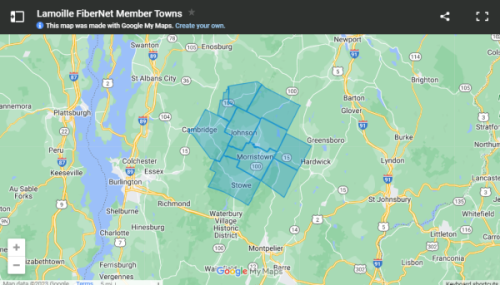
Last October, Vermont CUD (Communications Utility District) Lamoille FiberNet greenlit a $25 million public partnership with Consolidated Communications. The goal: to finally bring affordable fiber broadband access to 4,170 locals in Lamoille County. Eight months later and locals say network construction is finally getting underway.

According to the Lamoille County News And Citizen, Consolidated trucks have started to appear in towns like Stowe, Johnson, Eden, Cambridge, Belvidere and Waterville as Phase 1 of the network build gets underway.

Consolidated crews plan to deploy more than 400 miles of fiber this summer, providing locals with speeds up to 10 gigabits per second (Gbps).

Image
Lamoille CUD map

“It’s been a Herculean effort for more than three years, so we’re all very excited to see the trucks rolling this summer,” Lamoille FiberNet Executive Director Lisa Birmingham told the outlet.

Vermont's Community-Driven Broadband for All - Episode 606 of the Community Broadband Bits Podcast

In this episode of the podcast, Chris and Ry engage in an insightful discussion with Ellie de Villiers, Executive Director of Maple Broadband in Vermont. They explore the unique Communications Union District (CUD) model that Vermont has adopted to bridge the broadband infrastructure gap, especially in underserved areas.

Ellie shares her personal connection to Vermont and describes the local lifestyle before diving into the history and structure of Maple Broadband. The conversation highlights the strategic partnership between Maple Broadband and Waitsfield and Champlain Valley Telecom (WCVT), detailing how this collaboration aims to enhance broadband access in Addison County.

The episode also delves into the impact of the COVID-19 pandemic on broadband needs, the challenges of building infrastructure in rural areas, and the importance of community involvement. Ellie explains the phases of construction, the funding mechanisms, and the hurdles they faced, such as make-ready work and pole attachment issues.

The discussion wraps up with a look at future plans, including potential uses of BEAD funding and the ongoing evolution of Maple Broadband's strategy to provide high-quality, affordable internet to its community.

This show is 42 minutes long and can be played on this page or via Apple Podcasts or the tool of your choice using this feed.

Transcript below.

We want your feedback and suggestions for the show-please e-mail us or leave a comment below.

Listen to other episodes or view all episodes in our index. See other podcasts from the Institute for Local Self-Reliance.

Thanks to Arne Huseby for the music. The song is Warm Duck Shuffle and is licensed under a Creative Commons Attribution (3.0) license

New Documentary Showcases Vermont's Unique Community Broadband Approach

A new documentary, produced by the Vermont production company Well Told Films and the Vermont Community Broadband Board (VCBB), tells the uplifting story of how community-minded Vermonters came together to solve a common challenge: the lack of high-speed Internet connectivity across the Green Mountain State.

“Connected: Vermont’s Grassroots Effort for Rural Broadband” recently premiered at the Capitol Theater in Montpelier, giving viewers a front-row seat at how hundreds of volunteers (and later state leaders) rallied around the emergence of Communications Union Districts (CUDs) as the state's primary vehicle to bring high-quality Internet service to every resident and business in one of the most rural states in the nation.

The 35-minute film brings to life the story of how a community-based solution to solving the digital divide in Vermont came to be, while showcasing all of the progress that's been made since ECFiber, the state's first CUD, was established in 2007.

It begins with the celebration of ECFiber completing its fiber-to-the-home (FTTH) network last year, an event at which U.S. Sen. Peter Welch succinctly summarized why the community broadband movement in Vermont was, and is, necessary:

"All this started with what at the time was really a radical idea – that if we in rural Vermont were going to depend on the big telecommunication companies to wire our homes to get us Internet, we'd be waiting until our grandchildren had grandchildren."

AAPB and Benton Publish New Handbook: ‘How To Build A Public Broadband Network’

More cities and towns across the U.S. are exploring municipal broadband as an increasingly attractive and effective approach to bring ubiquitous, and affordable, high-speed Internet to its residents and businesses.

Now, a new handbook has been published that is tailored to guide local officials in navigating the logistical, technical, financial, and political challenges along the way.

Hot off the presses this week comes “Own Your Internet: How To Build A Public Broadband Network” – a project of the American Association for Public Broadband (AAPB), published in partnership with the Benton Institute for Broadband & Society.

Image
AAPB handbook cover

“This handbook is a key part of AAPB's strategy to double the number of public networks in the next five years, supporting communities in leveraging these networks for economic development, smart city initiatives, and attracting new residents," AAPB Executive Director Gigi Sohn said in announcing the handbook release.

Benton Executive Director Adrianne B. Furniss said the collaboration in publishing the guide made sense because “every community has a stake in this broadband moment—and they must have the tools they need to decide how they will meet their connectivity needs. We trust that this handbook is one of many tools communities will use to assess their situation and plan for a connected future.”