muni

Content tagged with "muni"

Displaying 391 - 400 of 977

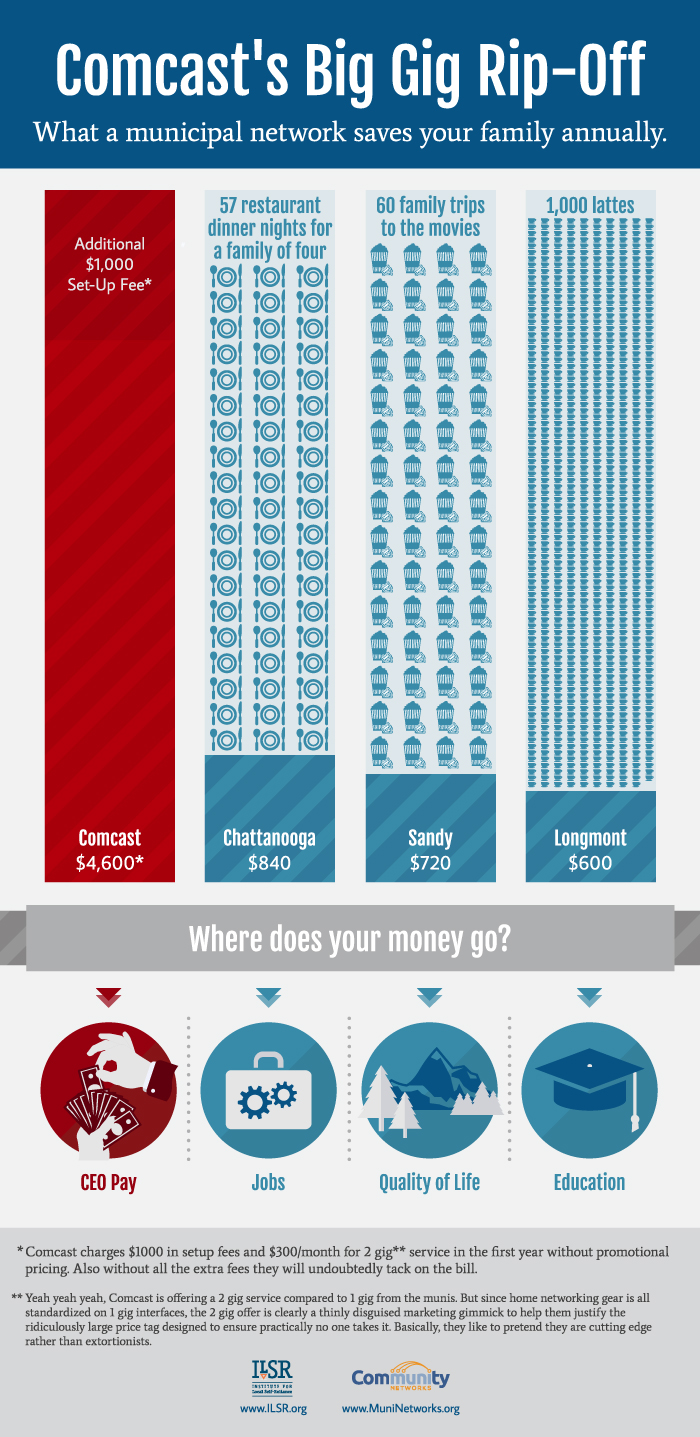
Comcast's Big Gig Rip-Off

For some five years now, many have been talking about gigabit Internet access speeds. After arguing for years that no one needed higher capacity connections, Comcast has finally unveiled its new fiber optic option. And as Tech Dirt notes, it is marketed as being twice as fast but costs 4x as much (even more in the first year!). We decided to compare the Comcast offering to muni fiber gigabit options. Comcast's Big Gig Rip-Off For more information on the great offer from Sandy, see the video we just released about their approach.
Kentucky City Transfers Ownership of Network, Still Under Local Control

The city of Franklin, KY transferred ownership of its fiber optic network to the Franklin Electric Plant Board (EPB) for $2.5 million. The Franklin City Commission unanimously approved a resolution for the transfer of ownership at the June 8th meeting. The network, although no longer maintained by the city, is still under local control. The EPB is an extension of city government, but has its own board of directors. Pleased with the city’s decision, Mayor Ronnie Clark stated:

"Broadband is now the new utility, and who better to deliver those services than the local infrastructure experts, EPB. They have the manpower and the equipment, as well as the community's confidence in providing reliable utility service and exceptional local customer support."

The city developed the 32-mile fiber optic network to encourage economic development by providing broadband to local businesses. The network attracted to new businesses including a distribution center from Tractor Supply Company. Currently, the network supports Internet connectivity to more than 40 business and industry customers in Franklin. The EPB hopes to continue to expand the services: 

"This network will be an excellent fit for us operationally, and will enable us to expand our role in serving our customers with the most robust broadband services available. We have big plans to add new services and grow our broadband customer base," said General Manager of EPB Bill Borders.

Lafayette Celebrates 10 Year Anniversary of "Yes" to Network

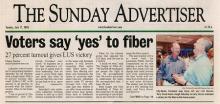
In June, 2005, voters in Lafayette chose to invest in a municipal FTTH network, now known as the only municipal gigabit network in the state, LUS Fiber. To celebrate the milestone, City-Parish President Joey Durel has declared July LUS Fiber Month. Current customers' Internet access has been boosted up to gigabit speed at no extra charge for July and the city will celebrate with a series of events this week. The entire community is invited to participate onsite but most of the events will be broadcast live so if you are not there, you can be part of the celebration. See the list of events below.

In the past ten years, the network has attracted thousands of new jobs, created better educational opportunities, and helped bridge the digital divide. Just last fall, three high tech companies committed to bringing approximately 1,300 new jobs to the "Silicon Bayou." The presence of the network, the University of Louisiana's local top-ranked computer science program, and its quality grads were two more key factors for choosing Lafayette. In April, Standard & Poor gave LUS Fiber an A+ bond rating based on the system's "sustained strong fixed charge coverage and liquidity levels, and the communication system’s improved cash flow."

The July issue of the local Independent tells the story of the network. According to Terry Huval, Director of LUS Fiber, the self-reliant streak has always been part of Lafayette's culture - in 1996 the city celebrated its 100th year vote to create its own electric and water system. The Independent article describes that culture as it permeated the vision shared by City-Parish President Joey Durel and  Huval.

NoaNet Touches Every County in Washington State - Community Broadband Bits Episode 159

The Northwest Open Access Network in Washington has a long history of expanding high quality Internet access into rural areas and now reaches into every county in the state. NoaNet is a nonprofit organization originally formed by local governments and now operating over 2,000 miles of fiber. 

This week we talk with Dave Spencer, NoaNet Chief Operating Officer, about the history of NoaNet, how it has impacted the state, and what the future holds for this organization. We also discuss the NoaNet expansion enabled by the federal broadband stimulus, how their open access fiber network has led to improved wireless connections in many rural areas, and what it takes for a nonprofit organization to thrive in an industry that can be very competitive despite often having very few competitors. 

Our previous stories about NoaNet are available here

This show is 20 minutes long and can be played on this page or via Apple Podcasts or the tool of your choice using this feed.

Transcript below.

We want your feedback and suggestions for the show-please e-mail us or leave a comment below.

Listen to other episodes here or view all episodes in our index. See other podcasts from the Institute for Local Self-Reliance here.

Thanks to bkfm-b-side for the music, licensed using Creative Commons. The song is "Raise Your Hands."

LUS Fiber "Ask Me Anything" July 14th 1:30 p.m. CDT

The community of Lafayette voted 10 years ago this month to create its own municipal FTTH network. In doing so, they created a standard that other communities have tried to emulate. On Tuesday, July 14th at 1:30 p.m. CDT, City-Parish President Joey Durel and LUS Fiber Director Terry Huval will host a Reddit Ask Me Anything about the initiative.

This is a great opportunity to learn about the community's vision, mobilization efforts, and the way it overcame challenges to create a highly successful municipal fiber network.

Prepare your questions and join the conversation at http://reddit.com/r/iama

Here is your video invitation from Terry Huval:

Call Center Central: Morristown, Tennessee?

The city of Morristown, Tennessee received more positive economic news recently when Sykes Enterprises, a global company that operates in more than 20 countries, announced plans to open a call center in an abandoned big-box store and connect to the city’s municipal network, FiberNet. Sykes estimates that the call center will employ up to 500 workers over the next three years, the large majority of which will come from the Morristown community. 

In Morristown, Sykes will join Oddello Industries, a furniture manufacturer, and the Molecular Pathology Laboratory Network, a personalized health firm – other companies that have cited the fiber network as an important part of their decision to locate facilities in the city of 30,000 people. 

According to the president of the Morristown Chamber of Commerce, Marshall Ramsey, the existence of FiberNet played a role in attracting the 50,000-plus employee firm to Tennessee: 

For Morristown to be able to have a local provider and a secondary provider in AT&T with a gig gives us that redundancy that most companies can’t get elsewhere in the country. 

FiberNet is operated by Morristown Utility Systems, the publicly owned electric and water utility. It began offering gigabit Internet speeds in 2012, though it has served local businesses since 2006. 

This is the second time in two months WBIR – Morristown’s NBC network – has run a story about FiberNet. In May, the station covered the way in which the municipal fiber network has stimulated economic development by increasing competition between service providers. When FiberNet upgraded its network to provide gigabit speeds, the incumbent telephone company in Morristown, AT&T, responded with some upgrades of its own. Morristown is one of a select few cities to have multiple gigabit-offerings, along with neighboring Chattanooga, Tennessee.  

Holyoke: A Massachusetts Municipal Light Plant Seizes Internet Access Business Opportunities

Image

Fifteen years ago, Holyoke Gas & Electric  (HG&E) began its incremental fiber deployment to meet the need for better connectivity in the community. Since then, they have invested savings created by initial and subsequent investments. Over the years, HG&E expanded their services, becoming the ISP for several local business customers in two nearby communities. HG&E also established a regional interconnection agreement and it is now an ISP for municipal agencies in a third community 30 miles away.

The Berkman Center's most recent report, report, "Holyoke: A Massachusetts Municipal Light Plant Seizes Internet Access Business Opportunities,” documents their story.

From the Abstract:

The Holyoke Gas & Electric Department’s telecom division competes with Comcast and Charter and serves 300 business customers and numerous public buildings. It has shown steady growth in revenues, and $500,000 in net earnings over the past decade. It also saves the city at least $300,000 a year on various Internet access and networking services. HG&E's telecom division is also now providing a variety of services to three other municipalities. Finally, the utility is considering a residential high-speed Internet access offering, something the muni in neighboring Westfield is piloting later this year. HG&E’s success in a competitive environment was achieved without any debt issuance, tax, or subsidy from electricity or gas ratepayers.

Key Findings:

Gig City Sandy: Home of the $60 Gig

Located at the foot of Mount Hood in Oregon, Sandy's municipally-owned full fiber network offers gigabit Internet service for under $60 to every resident in the city. Sandy is one of the few municipal FTTH networks that has been built without having a municipal electric department.

The Institute for Local Self-Reliance released this short video this week about the city’s approach—it should be a model for others who want faster Internet, but remain paralyzed by the big telecom monopoly stranglehold.

City managers, frustrated that they couldn't even get a DSL line in to City Hall started off by building their own wireless and DSL network, beginning in 2001. Today, 60% of the community has already subscribed to the Fiber-to-the-Home network, or is on a waiting list. View the video below, or on YouTube here.

Be sure to check out our report on Sandy, SandyNet Goes Gig: A Model for Anytown, USA.

Seattle reporters interview Chris Mitchell about broadband feasibility study

With the release of the city of Seattle's community broadband feasibility study, media outlets turned to ILSR and our own Christopher Mitchell for context, and to help uncover what can be done to help improve connectivity for all Seattleites. 

The same week, Christopher was invited to the city by Upgrade Seattle to help launch their initiative. Below are some selected publicity highlights from Seattle. 

KUOW's "The Record" with Ross Reynolds. How can Seattle get affordable broadband Internet  

KEXP's "Mind Over Matters" with Mike McCormick. Video is below. "What is Seattle's Next Step?" You can also listen to the Audio version here.

GovTech: Colin Wood interviewed Chris for his June 12 article Muni Broadband Goes Mainstream.

“You don’t just want better Internet access,” Mitchell said. “You want to know for whom and at what cost. Is your problem connecting low-income populations? That requires different thinking than if you’re just trying to attract some high-tech businesses to your town.”

CrossCut.com: Amelia Havenec covered the lunch & learn conversation between Chris and Upgrade Seattle organizer Hollis Wong-Wear. Following setbacks, municipal broadband supporters continue urging action

“The focus should be on the people who are not connected, the people who are left behind,” Mitchell responded. “Low income people pay $10 a month for Comcast. But you can only connect one device per household. To make sure everybody has a basic connection at home, there’s a $5 million budget to bring one-gigabit, fiber-to-the-premises internet access to tens of thousands of single-family homes in Beacon Hill, Central District, and Queen Anne. With all the transportation planning right now, it’s a good time to identify a fiber conduit in the ground.”

KeepBTLocal Working on Plan to Purchase BT

Burlingtonians love their municipal network. We have reported in the past that, prior to the sale of the network to Blue Water LLC, a group of locals organized to create the KeepBTLocal cooperative. Recently, the organization reaffirmed its commitment to purchase the network when it goes up for sale, a condition of the Blue Water LLC transaction.

A customer satisfaction survey in April revealed that BT customers are more than twice as satisfied with their provider as those obtaining service from competitors. The VTDigger reported survey results:

· 87% customer satisfaction with BT’s Customer Service;

· 24% of customers chose BT’s services after being recommended by a friend or family member; and

· General impression of BT by non-BT customers saw a 10% “positive” increase over their 2014 impression.

The survey also reported that customers with other providers were 40% satisfied with their service.

BT offers 150 Mbps for $55 per month and gigabit service for $85 per month or $70 per month with a 12 month contract. All speeds are symmetrical.

It has been a long road for BT after prior city leadership covered up years' worth of cost overruns creating serious financial difficulties for the community. Eventually, CitiBank filed suit to recover the $33 million Burlington owed. The two settled and Burlington eventually transferred ownership to Blue Water with the city still leasing. The ultimate goal for the city is to sell the network. Enter KeepBTLocal.

According to a June VTDigger article, the coop has been working with a former telecommunications industry executive now working as a consultant. They are developing business and acquisition plans to purchase the network when it goes up for sale within the next few years.

Andy Mortoll, Chair of the Board of KeepBTLocal told VTDigger: