
muni

Content tagged with "muni"

Displaying 211 - 220 of 977

Community Fiber Network Diversifying Economy in Louisiana

Acadiana, the southern region of Louisiana, is seeing a resurgence of industry thanks in large part to it publicly owned fast, affordable, reliable network. Years ago, the city of Lafayette, Louisiana, built the LUS Fiber network to connect homes and business.

Now, LUS Fiber is helping to diversify Acadiana’s economy, which once almost exclusively relied on the oil industry. Fiber networks offer much potential for economic development. 

“The State of Business” in the Silicon Bayou

The October-November issue of the Acadiana Profile at MyNewOrleans.com ran an article on the changing landscape of Acadiana’s businesses. Author Kimberly Singletary provides an overview of three growing industries: technology, manufacturing, and healthcare. All three need access to reliable, high-speed connections.

Singletary spoke with One Acadiana, an economic development organization in Lafayette:

“We’ve had a long history of innovation in IT and software,” says Jason El Koubi, CEO of One Acadiana. “But it's still very much an emerging field.”

Due to what El Koubi describes as “almost a grassroots movement in cultivating IT over the years,” the Acadiana region enjoys a robust offering of internet services resulting in a competitive, cheap and extremely fast LUS Fiber network.

LUS Fiber offers affordable, high-speed connectivity to several software developers that have made Acadiana their new home. The network offers speeds of up to 2 Gigabits (2,000 Megabits per second). In 2014, LUS Fiber attracted three companies, bringing almost 1,000 jobs to the “Silicon Bayou.” Another company, Waitr, an Uber-like food delivery service, is planning to add an operations center to Lafayette, which will bring another 100 jobs to the community.

More Than Tech: Industries Need Connectivity
Madison Starts Muni Fiber Effort, Considers Citywide Effort - Community Broadband Bits Podcast 227

The second-largest city in Wisconsin and the home of the University of Wisconsin, Madison, is pursuing a path-breaking municipal Fiber-to-the-Home (FTTH) strategy. They have already started by deploying fiber to several low-income neighborhoods and working with local ISP ResTech to offer services.

Madison CIO Paul Kronberger joins us for Community Broadband Bits episode 227 to discuss their plan. We start by discussing how they decided to deploy FTTH as a digital divide strategy. Like more and more of the communities considering this approach, Madison does not have a municipal electric utility.

We also discuss how Madison plans to deal with the state law that limits municipal fiber network investments and why Madison has decided to work with a private provider even though the city will retain ownership of the network. Read more of Madison coverage here.

This show is 18 minutes long and can be played on this page or via Apple Podcasts or the tool of your choice using this feed

Transcript below. 

We want your feedback and suggestions for the show-please e-mail us or leave a comment below.

Listen to other episodes here or view all episodes in our index. See other podcasts from the Institute for Local Self-Reliance here.

Thanks to mojo monkeys for the music, licensed using Creative Commons. The song is "Bodacious."


FCC's New Privacy Rules Irk Big ISPs, Munis Mellow

Consumers should be able to expect a certain amount of privacy and recent rules adopted by the FCC are a step in the right direction. That step has also revealed some key differences between profit-driven national Internet service providers, smaller ISPs, and municipal networks. The different attitudes correspond with the different cultures, proving once again that small ISPs and munis have more than just profit in mind.

On October 27th, the FCC adopted an Order to allow ISP customers to determine how their data will be collected and used. According to the FCC, they made the decision in response to public comments about the concern for personal data protection.

The New Rules

Over the past few years, consumers have become savvy to the fact that ISPs have access to personal data and that they often sell that data to other companies for marketing purposes. Under Section 222 of Title II of the Communications Act, telecommunications carriers are bound to protect their subscribers’ private information. Because those rule are designed to change as technology changes, says the FCC and Congress, this same authority applies to private data collected by ISPs. 

The FCC decided to divide the permission of use of personal information based on type, categorizing information into “sensitive” and “non-sensitive.”

Sensitive information will require ISPs to obtain “opt-in” consent from subscribers, which will allow them to use and and share this type of information:

logo-xmission.jpg
  • Precise geo-location 
  • Children’s information
  • Health information 
  • Financial information
  • Social Security numbers
  • Web browsing history
  • App usage history
  • The content of communication 

Non-sensitive information would include all other information and customers would need to "opt-out" in order to prevent their ISPs from collecting such data. Examples of non-sensitive personal information include service tier information.

El Paso County, CO, Commissioner Urges "Yes" On Local Authority

This has been a “loud” general election. The candidates, the campaign ads, and the supporters have all blasted their messages to voters in every state, drowning out some initiatives that are equally important. In Colorado, 26 local governments are asking voters to decide whether or not to opt out of SB 152, the state’s restrictive law passed in 2005 that looted local telecommunications authority.

In addition to seven counties, 19 municipalities have the issue on the ballot. Most of them use similar language from years past, when dozens of Colorado local governments presented the same question to voters.

El Paso County

There are about 664,000 people in the county, with approximately 456,000 living in the county seat of Colorado Springs. Rural residents and businesses typically struggle to obtain Internet access. County Question 1A reads:

Without increasing taxes, shall El Paso County have the authority to provide, or to facilitate or partner or coordinate with service providers for the provision of, “advanced (high-speed internet) service,” “cable television service,” and “telecommunications service,” either directly, indirectly, or by contract, to residential, commercial, nonprofit, government or other subscribers, and to acquire, operate and maintain any facility for the purpose of providing such services, restoring local authority and flexibility that was taken away by Title 29, Article 27, Part 1 of the Colorado Revised Statutes? 

Recently, El Paso County Board of Commissioners chairwoman Sallie Clarke published a guest column in the Colorado Springs Business Journal and the Gazette urging voters to support the measure. She noted that, even thought the initiative is important to the community, the local press has been quiet about the measure. With media filled by the Clinton/Trump race, there is little room for anything else, but she spells out why El Paso County needs to opt out of SB 152.

Staying Competitive

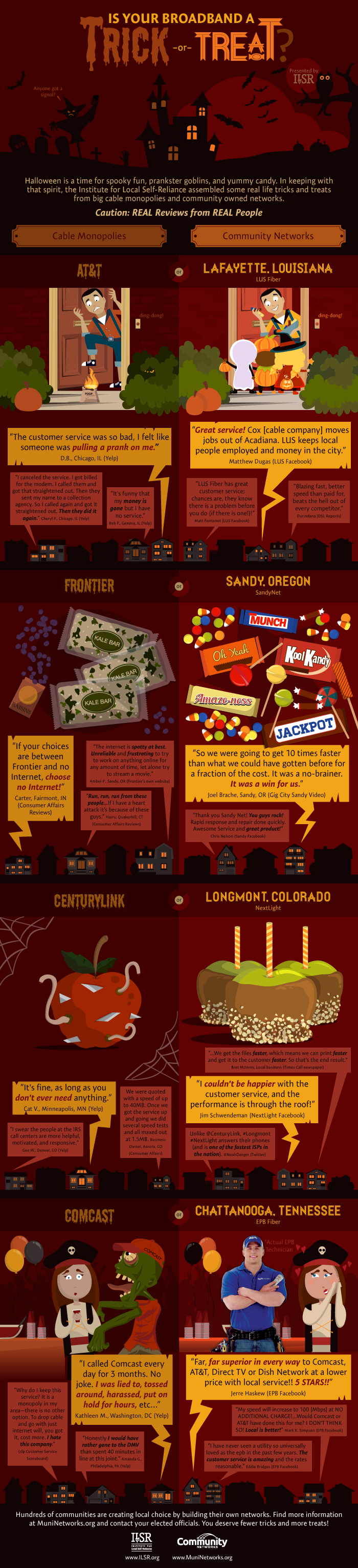
Haunted Halloween Weekend: Broadband Trick Or Treat

Are you spending the Halloween weekend watching scary movies on Netflix? Researching pagan rituals online? Scouring the web for last minute costume ideas? If you are don't have decent Internet access, even those simple tasks can be downright horrifying.

If you are trapped as a cable monopoly zombie, you understand the difference between Broadband Tricks or Treats. We created this graphic last year to celebrate the spooky differences between community networks and cable monopolies and it's too good to bury in a shallow grave! Here it is again...back from the (un)dead!

Trick or Treat - Subscriber reviews edition!

View a larger version of this graphic here [pdf]. Stay up to date on community networks with our newsletter!

Google Fiber Pauses - But No One Else Should

Google Fiber has finally announced its plans for the future after weeks of dramatic speculation that it will lay off half its workforce and give up on fiber-optics entirely. Google has now confirmed our expectations: they are pausing new Google Fiber cities, continuing to expand within those where they have a presence, and focusing on approaches that will offer a better return on investment in the short term.

Nothing Worth Doing Is Easy

In short, Google has found it more difficult than they anticipated to deploy rapidly and at low cost. And in discussions with various people, we think it can be summed up in this way: building fiber-optic networks is challenging and incumbents have an arsenal of dirty tricks to make it even more so, especially by slowing down access to poles.

That said, Google is not abandoning its efforts to drive better Internet access across the country. In the short term, people living in modern apartment buildings and condos will be the greatest beneficiary as Google takes the Webpass model and expands it to more cities. But those that hoped (or feared) Google would rapidly build Fiber-to-the-Home (FTTH) across the country are likely disappointed (or slightly relieved, if they happen to be big incumbent providers). 

This is a good moment to talk about the lessons learned from Google Fiber and what we think communities should be thinking about. 

Let's start by noting something we have often said: Google Fiber and its larger "access" approach have been incredibly beneficial for everyone except the big monopolists. Its investments led to far more media coverage of Internet access issues and made local leaders better understand what would be possible after we dismantle the cable broadband monopoly. 

Benoit Felton, a sharp international telecommunications analyst wrote a very good summary of Google Fiber titled Salvaging Google Fiber's Achievements. Some of my thoughts below overlap his - but his piece touches on matters I won’t address, so please check out his analysis.

I want to focus on a few key points.

Fresno Looking For Partners: RFQ Responses Due Nov. 30th

Fresno, California, is looking for one or more partners to bring Gigabit connectivity to the entire community. City leaders recently released a Request for Qualifications (RFQ) to send out the call for interested entities. Letters of interest are due on November 14th and statements of qualifications are due by November 30th.

Leaving No One Behind

According to the RFQ, the community is experiencing growth in the tech sector and want to support the tide by improving Internet infrastructure throughout the community. In addition to serving new businesses for economic development, the network will connect community anchor institutions such as schools, hospitals, and libraries. 

As part of their goals, Fresno states explicitly that they want to ensure low-income families and individuals will be able to afford high-quality Internet access. In an article in the Fresno Bee, city leaders sate that they envision rates for some residents at around $10 per month for either a wired or fixed wireless connection.

Using Existing Assets

Blair Levin In Wilson For Nov. 4 Event On Greenlight

A North Carolina regional tech news publication will host a program on Greenlight, the publicly owned and built fiber optic network of Wilson, North Carolina (pop. 50,000) whose gigabit Internet service has helped transform the community’s economy. 

WRAL TechWire’s next Executive Exchange event titled “Building a gigabit ecosystem” will look at how Wilson built its fiber optic system, "turning the one-time tobacco town into North Carolina’s first Internet ecosystem." The event begins at 8 a.m. Friday, Nov. 4 at the Edna Boykin Cultural Center; broadband expert Blair Levin is scheduled to give the keynote address. Levin is former chief of staff at the Federal Communications Commission.

Levin has also been a guest on the Community Broadband Bits podcast, visiting us for episode #132 to discuss private vs. public ownership and episode #37 to talk about GigU.

Besides Levin’s keynote speech, the TechWire program also will include a live "fireside chat" about Greenlight with Wilson City Manager Grant Goings and panel discussions.

You can find out more about the program and reserve a spot online.

Wilson To Offer Greenlight To Pinetops At No Charge

The town of Pinetops, North Carolina, has a six-month reprieve.

On October 20, the Wilson City Council voted to continue to provide telephone and Internet access to customers outside of Wilson County, which includes Pinetops, for an additional six months at no charge. As we reported earlier, the City Council had been backed into a corner by state law, which would force them to discontinue Wilson’s municipal Greenlight service, or risk losing their exemption entirely.

In August, the Sixth Circuit for the U.S. Court of Appeals reversed the FCC decision to preempt North Carolina’s state law that prevented Greenlight from serving nearby Pinetops. When Hurricane Matthew struck Pinetops, however, the Wilson community could not fathom piling yet another burden - lack of high-quality Internet access - on the struggling rural community.

"We Cannot Imagine..."

After examining the law and reaching out to state leaders, Wilson’s elected officials chose to provide services at no charge while state legislators work to change the current harmful state law. Once again, a community that offers publicly owned connectivity proves that there is more to the venture than profit. From a Wilson press release:

"Our broadband utility has always been about bringing critical infrastructure to people, improving lives and communities,” said Grant Goings, Wilson City Manager. “We cannot imagine being forced to disconnect people and businesses that need our services. We are thankful that, in partnership with our phone service provider, we have identified a way to keep folks connected while Rep. Martin and Sen. Brown work to fix this broken State law."

Ammon Wins NSF Grant To Pursue Networking Technologies for Public Safety

The city of Ammon, Idaho, continues to garner more recognition and opportunities from its unfolding municipal fiber network.

In a recent news release, Ammon officials announced the city received approximately $600,000 from the National Science Foundation (NSF) to partner with the University of Utah. They will research and develop a series of next-generation networking technologies supporting public safety. 

Pursuing SafeEdge

Called SafeEdge, the nearly initiative will give Ammon residents connected to the city's network the opportunity to participate in the initiative to develop applications such as broadband public emergency alerts. 

Ammon officials said a major focus of the research will be to evaluate the “feasibility of mixing public safety applications with other applications and services,” such as consumer streaming and data sharing, remote classroom access, and dynamic access to judicial functions, including remote arraignments and access to legal representation.

The city added “It is expected that this open access/multiservice approach will improve the economic feasibility of deploying broadband services in small and rural communities by allowing a variety of services to be deployed across the same infrastructure, while at the same time ensuring that public safety applications can function in this environment.”

Three-year Project

The National Science Foundation and US Ignite, an initiative promoting U.S. leadership in developing and implementing next-generation gigabit applications that can be used for social good, are providing nearly $600,000 in funding over a three-year period for the Ammon project. About $235,000 of that funding will go to Ammon as sub awardee, the city said. The project period runs from Oct. 1, 2016 to September 30, 2019.

Other Honors