
gigabit

Content tagged with "gigabit"

Related Topics
Displaying 271 - 280 of 393

SandyNet Now Offering Gigabit FTTH in Oregon

Back in September, SandyNet announced that its FTTH gigabit network was officially up and running. The utility will continue to expand and eventually bring the network to all 4,000 households. Light Reading recently spoke with Joe Knapp, Sandy's IT Director and general manager of the broadband utility about the new offering. With a population of 10,000, Sandy is in Oregon between Portland and Mount Hood.

The network is completely underground. Sandy is one of many communities that have developed smart conduit policies, reducing the cost and preparing the environment for deployment over a period of years.

You can listen to our discussion with Knapp on Sandy's conduit policy in Episode 17 of the Community Broadband Bits podcast. We also spoke with City Manager Scott Lazenby about Sandy's conduit policies during Episode 48.

Like many other communities we study, Sandy invested in connectivity out of necessity. Knapp told Light Reading:

"We started out because we couldn't get a DSL line at city hall," says Joe Knapp, IT director for the City of Sandy and general manager of SandyNet. The utility first built a 900MHz wireless network, then WiFi, then a wireless mesh network to connect residents to broadband, he says. "That became so popular that we took about 40% of the market with wireless, but that was a hard thing to sustain."

The journey to FTTH was not an easy one:

"We started to realize that a lot of communities are doing this," Knapp says. "It took three years of beating my head against the wall to finally get it to happen."

Gigabit speeds are something to boast about, but Knapp says SandyNet will not go to extremes to push them:

"As a muni network, we view this as trying to benefit the community. I tell them to try the 100-Meg service first -- we're actually not pushing the gig that hard."

Hagerstown, Maryland Issues RFI for Gigabit Network

Hagerstown, population 40,000, recently released a Request for Information to field ideas to develop existing infrastructure for residents and local businesses.

According to the press release:

"The interest in our City and the potential shown for our market from industry professionals working with municipal broadband initiatives has been very promising. We look forward to moving ahead in collaboration with private partners to bring affordable technology to Hagerstown," says Mayor Dave Gysberts.

The RFI identifies five goals:

Goal 1: Create a 1 GB and/or greater fiber network in a targeted commercial corridor known as “City Center Hagerstown” to foster innovation, drive job creation, and stimulate economic growth

Goal 2: Establish free wireless networks in parks and public spaces across the City, with primary focus on the following areas: City Park, Pangborn Park, Hellane Park, Wheaton Park, and Fairgrounds Park.

Goal 3: Evaluate the opportunity to expand wired/wireless services to areas beyond our City Center urban core to include underserviced residential areas, business parks, and/or target commercial areas.

Goal 4: Provide connectivity opportunities from the proposed fiber paths for the existing City Police camera surveillance system including expansion into other developing areas of the City.

Goal 5: Establish a presence within the community in the form of co‐location facility and/or business branch office space in which to conduct business.

According to the RFI, the city is seeking entities that will finance the majority of the network themselves or identify sources of funding. View the full RFI on the city website.

Ting to Offer Fiber Internet Service in Charlottesville

Comcast may be an ISP Goliath, but a new David will soon move to Charlottesville. Tucows Inc., recently announced that it plans to begin serving as an ISP in the area and will eventually expand to other markets.

In a Motherboard article, CEO Elliot Noss said:

"At the simplest level, we'll be offering a lot more product for the same price, and a much better customer experience. We want to become like a mini Google fiber."

The company began in the 1990s and is known for registering and selling premium domain names and hosting corporate emails accounts. Two years ago they ventured into wireless cell service and were immediately praised for their top notch customer service and no-frills billing. Tucows promises to fill the customer service gap left by incumbent Comcast, one of the most hated companies in America.

Tucows will operate its Internet service under its cellular brand, Ting. It will take over existing fiber infrastructure owned by Blue Ridge InternetWorks and will begin serving customers as early as the first quarter of 2015. Ting hopes to be able to charge less than $100 per month for gigabit fiber service. Comcast charges $90 per month for 50 Mbps and CenturyLink charges $40 per month for 10 Mbps in Charlottesville.

As far as "fast lanes" go? From the Motherboard article:

Noss said that the company is dedicated to net neutrality as a "sensible business practice" and said "it's our responsibility to make sure content like Netflix is fast on our network. We're not looking for content providers to pay us in a double-sided fashion."

Ting reaffirms that philosophy on the Ting Blog:

Tucows believes very strongly in the open Internet. Up until now, there wasn’t a whole lot we could do but educate, agitate and contribute. Getting into fixed access, owning our own pipe, is an opportunity for us to practice what we preach when it comes to the open Internet and net neutrality.

Chattanooga Public Library Now Hosts GigLab

Entrepreneurs in Chattanooga now have a new space where they can try to answer the question, "What does one do with a gig?" The Chattanooga Public Library officially opened its GigLab in November. 

The public space offers gigabit access in a lab environment so developers can take their ideas to the next level. The lab is supported by the Mozilla fund and the National Science Foundation. A recent Chattanooga.com article reports that:

The general public will now have access to enterprise level gigabit connected hardware, as well as a variety of short session and hands on courses regarding networking as a whole, and other gigabit focused projects.

Sean Brewer, one of the GigLab founders, writes on the blog:

The hope for The GigLab is to be a place where people can experiment, build prototypes, or just learn how to use hardware that they wouldn’t have access to. I am helping start a group that will be working through “Parallel and Concurrent Programming in Haskell”. The book has an entire section devoted to GPU computing, and I am excited that we will have access to this hardware at The GigLab to explore. Education removes the magic of the mysterious. I feel The GigLab can do that for high-performance computation.

LightTUBe Lowers the Price of a Gig; Increases Speeds for Free AGAIN

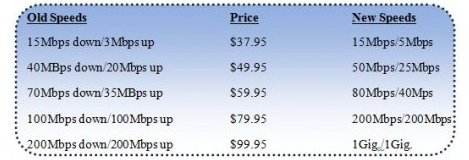
The Tullahoma Utilities Board (TUB) began offering gigabit service in 2013 through its municipal FTTH network, LightTUBe. In a recent press release the TUB announced it has lowered the price of residential gig service to $99.95 per month

In addition to slashing the price for the highest tier, TUB increased all other Internet speeds at no additional cost. This is the sixth time since its 2008 deployment that LightTUBe customers have enjoyed a free speed increase. From the LightTUBe website:

New LightTUBe Prices

Brian Skelton, TUB General Manager, said in the press release:

“We’ve grown our Internet business in such a way that we can offer Gigabit speeds at a more affordable price.” 

Skelton has said in the past that the decision to offer Gigabit Internet was an easy one. 

“We want to make Tullahoma a much more desirable location for technology companies to locate, due to our ultra-high speed Internet and our highly skilled workforce,” he explained in spring of 2013. “Tullahoma is light-years ahead of most cities in the United States with the ability to offer these incredibly fast Internet speeds.”

LightTUBe has brought jobs to the community, increased the efficiency of the electric utility through a smart metering program, and implemented a "TV Everywhere" option for customers. Even thought the network is restricted by state law, it has remained financially stable while keeping rates in check.

Chanute Receives State OK to Bond for FTTH Deployment

The Kansas Corporation Commission (KCC) will allow the city of Chanute move forward with its plan to serve residents and local businesses with its municipal network reports the Wichita Eagle. KCC staff had recommended that the community, which has built out a network over the course of decades, receive KCC approval. 

In keeping with an antiquated 1947 state law, K.S.A. 10-123, the city needed KCC approval to issue the revenue bonds. In keeping with the statutory requirements, the KCC found that the expansion is necessary and appropriate for the city, its consumers and investors. The KCC also also determined that the expansion will not duplicate an existing utility service.

In its filing [PDF], Chanute indicated that its network is an essential part of the local economy and the community's future:

Chanute is a rural community, and like all rural communities, access to broadband is fundamental to the well-being of its citizens and even to the survival of the community itself. Chanute does not need to convince the Commission of the importance of having access to a high- speed broadband network. The Commission is well aware of that need. The investments contemplated for Chanute's broadband network are necessary and appropriate to allow Chanute to meet that need in its territory.

As the city points out, incumbents AT&T and Cable One, do not offer anything close to the level of service of the planned gigabit FTTH network. As we cover in our 2012 report on Chanute, AT&T and Cable One seem to have no interest in serving the community beyond minimum expectations. It was the need for better services that inspired the city to build out its infrastructure and offer services to local businesses.

Indianola Municipal Utilities to Offer Gig Service

Indianola Municipal Utilities (IMU) announced in a December 1st press release that they will be offering gigabit service in 2015. IMU will also be expanding their FTTH network to an additional 150 premises this winter in the central part of Indianola.

IMU's service partner, MCG, has established the Build My Neighborhood site, which allows Indianolans to inform IMU where they want to see service expanded to next.

IMU and several local partners, including MCG, recently began the IMU Partners Program. According to the press release, the program provides marketing opportunities, common use of network facilities, outreach to the community, and assistance with business development. Member businesses receive advertising on the IMU TV channel and streaming video site, access to outreach STEM events at local schools, and hosting for tech-related events. 

Indianola Municipal Utilities use the network as a long term economic development tool, regularly cooperating with local partners to support entrepreneurs. In 2013, we shared the story of the Indianola + Simpson College Entrepreneurial Development Initiative (EMERGE). The college program relies on IMU for high capacity connectivity to support new high tech ventures. Simpson College and IMU have also developed an incubator to encourage high tech business growth through mentorship.

From the press release:

“Recent reports show that gigabit availability has become an important factor in economic growth, job creation, and property values” states IMU General Manager Todd Kielkopf. “Indianola’s technology investment in connectivity, collaborations, and content delivery is paying dividends”

The full press release is available below.

DubLINK Network Supports Economic Development, Health Care, and Supercomputing

Award-winning supercomputing apps, medical research, economic development, and quantum computing advances. What do they all have in common? They all depend on the DubLINK network running underneath Dublin, Ohio, a suburb on the Northwest edge of Columbus. The city of 43,000 people has 125 miles of fiber optics in the ground, both within its own boundaries and in the form of fiber purchased by the city within metro and regional networks. 

DubLINK began in 1999 as a public private partnership with the Fishel company to build an institutional network. In the wake of the 1996 Telecommunications Act, Dublin worried that a recent massive investment of $70 million in streetscaping would be undone as competing providers dug up newly paved streets to install fiber optics. To avoid this, the City signed a franchise agreement with Fishel to install a multi-conduit system, with the city receiving some conduit for its own use.  

Using 1.25” conduits installed in the city’s existing sewer system, the network runs for 25 miles underneath Dublin’s business district and connects six city buildings, who use their own lit fiber for data and voice services, eliminating expense leased line fees. This has allowed the city to save approximately $400,000 per year for the last 12 years in connectivity and information technology expenses.

In 2004, Dublin spent $3.5 million to purchase 96 strands running 100 additional miles through Columbus FiberNet, bringing the total length of the DubLink network to its current 125 miles. FiberNet is a duct system that runs throughout a significant portion of central Ohio, including Columbus and its surrounding suburbs.

Sebewaing Bringing Better Connectivity to Residents, Businesses Via Fiber in Michigan

If you live in Sebewaing, you can now purchase FTTH connectivity from Sebewaing Light and Water (SLW) via their municipal network. Earlier this week, we discussed the network with Sebewaing Light and Water Superindendent Melanie McCoy.

The first village in Michigan to offer gigabit service issued its RFP in summer 2013. Like many other small communities, the 1,700 inhabitants in Sebewaing were limited to dial-up. T1 service (1.5 Mbps)  was available to businesses but lines cost from $1,000 - $1,500.

Commercial connectivity via the new infrastructure now begins at $75 for symmetrical 50 Mbps service. SLW also offers symmetrical 100 Mbps for $130 and advertises customized packages if those options are not adequate. SLW will also waive the $125 installation fee if a business signs up before the end of the year.

Residents also receive free standard installation if they sign up before the end of 2014. They can pay as little as $35 per month for symmetrical 30 Mbps service, $55 per month for 50 Mbps symmetrical, or $105 per month for 100 Mbps symmetrical service. 1 Gbps/100 Mbps service costs $160 per month.

SLW has already signed up a commercial gig customer. The Bay Shore Methodist Camp & Family Ministries holds events that often cater to hundreds of children and adults. They need a high capacity connection for Wi-Fi to serve a large number of devices.

Sebewaing's original plan was to build an open access network but after careful consideration and legal analysis, it decided to provide retail services. SLW purchases bandwidth only from Air Advantage, a wireless provider specializing in the "thumb" of Michigan. The utility also offers voice services via the network.

Michigan's First Gigabit Village - Community Broadband Bits Episode 126

The small village of Sebewaing has become the first gigabit village in the state of Michigan. Superintendent of Sebewaing Light and Water utility Melanie McCoy joins us to discuss the project on episode 126 of the Community Broadband Bits podcast. With approximately 1,800 people, Sebewaing has cracked the code for a small local government to deliver gigabit services to the community. 

In the show, we discuss previous telecommunications investments by the village and how they financed the gigabit fiber deployment. We also discuss how Michigan law, designed to discourage municipal networks, delayed the project and increased the costs as well as the annoyance to many residents who long ago became impatient with how long it took to begin turning on the Internet service. Read our full coverage of Sebewaing here. 

This show is 14 minutes long and can be played on this page or via Apple Podcasts or the tool of your choice using this feed.

Transcript below.

We want your feedback and suggestions for the show-please e-mail us or leave a comment below.

Listen to other episodes here or view all episodes in our index. See other podcasts from the Institute for Local Self-Reliance here.

Thanks to Dickey F for the music, licensed using Creative Commons. The song is "Florida Mama."