

KGNU From Boulder Interviews Chris for Independent Colorado Radio

KGNU from Boulder recently interviewed Chris on It's the Economy. This 27 minute interview is a crash course in all the intertwined topics that have the telecom policy crowd buzzing.
Host Gavin Dahl asked Chris about SB 152, the 2005 Colorado statute that constricted local authority and has prevented communities in that state from investing in telecommunications infrastructure. As many of our readers know, the Colorado communities of Longmont, Montrose, and Centennial, have held elections to reclaim that authority under that statute's exepmtion. The two also discussed legislative activities in Kansas and Utah inspired by big cable and telecommunications lobbyists.
The conversation also delved into gigabit networks, network neutrality, the Comcast/Time Warner mergers, legislative influence, the Coalition for Local Internet Choice, and FCC Chairman Tom Wheeler's recent statement about local authority.
In short, this interview packs a tall amount of information into a short amount of time - highly recommended!
You could also read a transcript of the interview here.




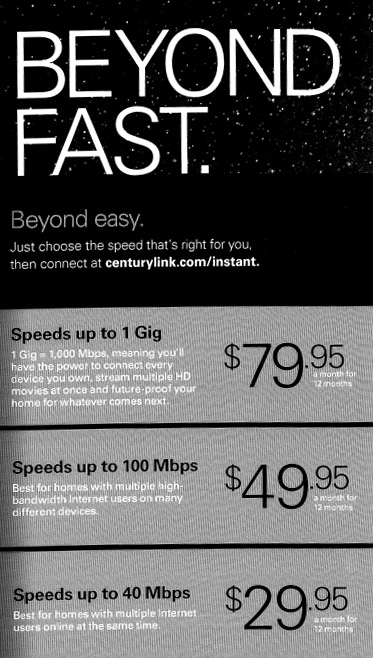 The promotional sheet claims CenturyLink will offer speeds "up to" 1 Gig for $79.95/month for 12 months. 100 Mbps runs $49.95 and 40 Mbps is $29.95 - each for 12 months. No mention of upload speeds but CenturyLink has demonstrated a real aversion to symmetry so users can expect far slower upstream than what modern municipal networks and Google fiber deliver.
The standard operating procedure in apartment buildings will be for CenturyLink to try to lock up the internal wiring to buildings and deny it to competitors. FCC rules make exclusive agreements with landlords unenforceable, but there are a host of tricks that incumbents use to prevent any competition and landlords getting a kickback often have little reason to encourage competition.
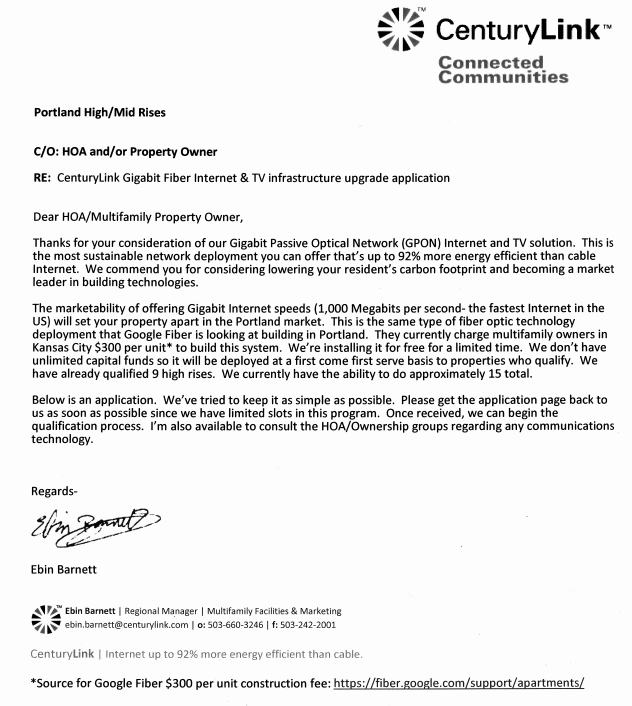
The CenturyLink copy notes that its fiber optic GPON option is "up to" more than 92 percent energy efficient than cable modem Internet access. I have to wonder how it compares to DSL energy efficiency and whether that number holds up better than the "up to" 12 Mbps claims they make on DSL circuits that seldom peak at 5 Mbps.
At any rate, it is more than we can expect in the many communities CenturyLink is serving where there the local government have done nothing to spur competition by investing in publicly owned assets that could form a municipal network or be used to entice independent service providers to enter the market. In particular, I would be curious where else CenturyLink is rolling out fiber to buildings without any upfront charges.
The promotional sheet claims CenturyLink will offer speeds "up to" 1 Gig for $79.95/month for 12 months. 100 Mbps runs $49.95 and 40 Mbps is $29.95 - each for 12 months. No mention of upload speeds but CenturyLink has demonstrated a real aversion to symmetry so users can expect far slower upstream than what modern municipal networks and Google fiber deliver.
The standard operating procedure in apartment buildings will be for CenturyLink to try to lock up the internal wiring to buildings and deny it to competitors. FCC rules make exclusive agreements with landlords unenforceable, but there are a host of tricks that incumbents use to prevent any competition and landlords getting a kickback often have little reason to encourage competition.
The CenturyLink copy notes that its fiber optic GPON option is "up to" more than 92 percent energy efficient than cable modem Internet access. I have to wonder how it compares to DSL energy efficiency and whether that number holds up better than the "up to" 12 Mbps claims they make on DSL circuits that seldom peak at 5 Mbps.
At any rate, it is more than we can expect in the many communities CenturyLink is serving where there the local government have done nothing to spur competition by investing in publicly owned assets that could form a municipal network or be used to entice independent service providers to enter the market. In particular, I would be curious where else CenturyLink is rolling out fiber to buildings without any upfront charges.


 "We had to choose an area that could offer a low cost of doing business, while delivering an infrastructure better than that of other states and countries," wrote Mr. Kalinoski, a three-time, award nominee for his special effects contributions to Black Swan and LOST, the Final Season.

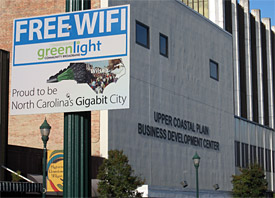 And it has, even for young entrepreneurs elsewhere in the state. For a tech entrepreneur like Dan Holt from Wake Forest, renting space at this Wilson-based incubator lets him be part of the future, and to experience the possible which is impossible at his home in Wake Forest only 30 miles away. Dan is a self-described techie for a local Raleigh defense subcontractor but he likes to be known as founder of the Wake Forest Fiber Optic Initiative.