
FTTH

Content tagged with "FTTH"

Fiber to the Home
Displaying 21 - 30 of 1315

Alton, Illinois Altonworks Partnership Eyes Citywide Fiber

Alton, Illinois officials say they’ve struck an expanded agreement with AltonWorks, a company built specifically to revitalize the city and deal with residents’ longstanding frustration at the lack of affordable, next-generation broadband access.

Altonworks was created in 2018 by local attorney John Simmons as a “social impact development company,” tasked with revitalizing the city of 25,000. The provider was created on the back of a $20 million grant authorized by the Illinois Department of Commerce and Economic Opportunity (DCEO).

“This project’s impact extends way beyond Alton,” DCEO Assistant Director Cameron Joost recently said at the project’s unveiling

“It’s a model for communities across Illinois approaching broadband infrastructure with vision, partnership, and commitment to equity.”

Altonworks is partnering with i3 Broadband, which broke ground on a new $25 million FiberNet project. FiberNet is projected to reach 94 percent of the city's residents with fiber broadband speeds up to 10 gigabits per second (Gbps). The $25 million fiber build is slated to be completed sometime in 2027.

Image
A street line with low rise brick facade buildings in Alton's historic district

The deployment comes to a community where broadband access is primarily dominated by entrenched incumbent telecom giants like Charter Communications and AT&T. A lack of real competition has resulted in spotty access, slow speeds, high prices, and substandard customer service.

Chicopee Electric Light, Sertex Renew Partnership To Expand Affordable Fiber Access

Chicopee Electric Light (CEL) has chosen Sertex Broadband Solutions to help the Massachusetts-based municipal utility expand access to affordable fiber across the city of 55,000. The agreement is an extension of a 2019 deal with Sertex to help the utility launch residential broadband services under the Crossroads Fiber brand.

Frustrated by a lack of affordable broadband access, the city tabbed Magellan Advisors in 2015 to conduct a feasibility study into city-provided broadband access. 

After a survey showed a majority of city residents would support such an initiative, Chicopee Electric Light launched Crossroads Fiber in the summer of 2019 in a small pilot area.

Since then, the utility has been expanding access steadily to the rest of the city – joining a growing roster of city-owned utilities that are responding to broadband market failure by taking matters into their own hands.

Gateway Cities Fiber Project Rolls On, Aims To Revolutionize California Broadband

Two dozen California cities are making progress bringing affordable fiber to 16,500 new locations in the Golden State. The collaborative middle mile project, dubbed the Gateway Cities Council of Governments' (GCCOG) Gateway Cities Fiber Optic Network Project, could revolutionize connectivity for a broad swath of Californians long stuck on the wrong side of the digital divide.

While the project should be transformative, questions remain if the project will reach the full potential of its original 2021 vision after some significant revisions were made to California’s expansion plans in the summer of 2023.  

The $104 million broadband infrastructure project is leveraging money from the California Department of Technology’s Middle Mile Broadband Initiative and the California Public Utilities Commission’s Last Mile Federal Funding Account Grant Program (FFA).

Both are part of a broader $6 billion California “Broadband For All” initiative aimed at boosting broadband competition and driving down broadband access costs statewide. The initiative in turn was enabled by 2021 federal infrastructure and COVID relief legislation resulting in a generational flood of historic broadband subsidies.

All told, the $104 million Gateway Cities Fiber Optic Network Project aims to connect 24 cities, 4,254 unserved locations, and as many as 16,500 locations with 74 miles of next-generation gigabit-capable fiber. The network will also bring faster fiber connectivity to 72 anchor institutions and public safety entities scattered across Southeast California.

IN OUR VIEW: Decoding The Possible Meaning of “Reforms” to the Tribal Broadband Connectivity Program

In the last two months of the Biden administration, nearly $500 million in grants were announced to support Tribal broadband projects. From Alaska to Virginia, 55 Tribal nations were poised to improve Internet access and advance digital sovereignty in their communities.

As President Trump took office, more than a hundred applicants still awaited word on their proposals, with nearly $500 million still available in the Tribal Broadband Connectivity Program (TBCP).

Then, silence. Ten months of silence.

In early November, Senators Maria Cantwell (D-Wash.) and Brian Schatz (D-Hawaii) sent a letter to NTIA officials asking about the TBCP. The program was established with two appropriations totaling nearly $3 billion. The first round of TBCP grants rolled out throughout 2022 and 2023, totalling nearly $100 million in use and adoption funding and over $1.7 billion in planning or infrastructure funding.

Image
Sen. Maria Cantwell stands behind a microphone and podium with her hands raised in the air, palms upward

The $500 million announced at the end of the Biden administration was part of round two of the program, for which applications were due in March 2024. With about $1 billion available, only about half of the funding in round two had been allocated.

What was happening, the Senators asked, with the rest of that funding? There were other questions too.

Chattanooga’s Municipal Fiber Network Has Delivered $5.3 Billion in Community Benefits, New Study Finds

For years, it’s been known as “America’s first Gig City,” thanks to its city-owned fiber network. 

That same infrastructure has positioned Chattanooga to potentially become the nation’s first “Quantum City,” according to a new economic impact analysis showing EPB Fiber and the utility's smart-grid systems has generated $5.3 billion in net community benefits for Hamilton County since 2011. 

The city is now poised to enter the Quantum realm.

The research builds on an earlier 10‑year return‑on‑investment analysis – published in August 2020 – that showed the city’s publicly-owned fiber network had delivered $2.69 billion in value over its first decade. 

The new follow-up study – From Gig City to Quantum City: The Value of Fiber Optic Infrastructure in Hamilton County, TN 2011-2035 – expands the time horizon and finds that over 15 years the total community benefit has grown to $5.3 billion, illuminating how the long‑term value of municipal broadband can really pay-off.

A Massive Economic Boost

Image
A table shows data from the study explained in the accompanying story

Conducted by researchers at the University of Tennessee at Chattanooga, the study finds that the municipal fiber network has dramatically reshaped the regional economy, supporting 10,420 jobs from 2011 to 2024 – about 31 percent of all net new jobs created locally over the past decade.

The return on investment has been extraordinary: the network has delivered 6.4 times the value of its original $396 million investment, the study indicates.

Traverse City, Michigan Finalizes Citywide Fiber Expansion

Traverse City, Michigan’s public, community-owned utility, Traverse City Light and Power (TCL&P), is putting the finishing touches on its $14 million plan to deliver affordable fiber to the community of 15,424. With build out estimates significantly lower than initial projections, the utility is finalizing an additional $1 million in loans to fund the recently started expansion project.

Already named last month to the 2025 Broadband Communities Top 100 list, a recent update by the city notes that the utility is currently extending the network to the Base of Old Mission Peninsula, Hastings, Parsons, Munson, and Barlow. 

Complete citywide deployment is expected by the Spring of 2026, though the city says it maintains a “stretch goal” of completing the entirety of the “rapid deployment” by this fall.

In deployed markets, locals have three speed and pricing options: a symmetrical 1 gigabit per second (Gbps) tier for $90 a month; a symmetrical 500 megabit per second (Mbps) option for $70 a month; and a symmetrical 200 Mbps option for $60 a month.

Image
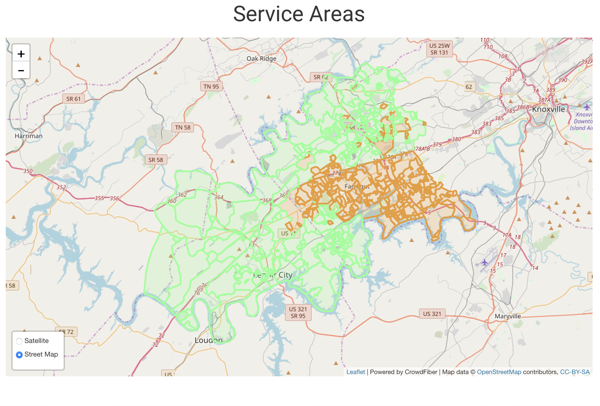
Traverse City Fiber map

None of the options come with long-term contracts, hidden fees, or usage caps. All three broadband tiers can be bundled with phone service for an additional $10 a month.

Like countless U.S. communities, Traverse City locals were tired by expensive, spotty, substandard broadband access being provided by regional telecom monopolies. In Traverse City that usually means a monopoly on broadband access by Charter Spectrum, peppered with some scattered Brightspeed (formerly Lumen and Centurylink) DSL and fiber lines.

Antelope Valley, California Eyes $24 Million Fiber Expansion

Antelope Valley, California officials are hoping to leverage California’s historic recent round of broadband grant programs to deliver affordable fiber access to a significant swath of long-underserved southern California desert communities.

According to Antelope Valley officials, they’ve applied for a $24.3 million California Advanced Services Fund (CASF) Broadband Infrastructure grant to help them deliver symmetrical 10 Gigabit Passive Optical Network (XGS-PON) technology to 988 total households, most of which would be seeing affordable fiber access for the first time ever.

A breakdown of the project included in the application submitted by the Antelope Valley Union High School District to the California Public Utilities Commission (CPUC), indicates that the proposed project seeks to connect to the California State Middle Mile route at two points currently being negotiated in collaboration with state Middle Mile Authorities.

“The award will not be determined until approximately quarter two of next year,” Antelope Valley Union High School District Superintendent Greg Nehen tells ILSR.

Image
Antelope Valley fiber project map

The Antelope Valley Broadband Project would be constructed with 100 percent underground fiber installation, with all fiber-optic cables placed in buried conduit within public rights-of-way, using underground microducts, handholes, and splice enclosures. No aerial deployment is planned for this project, according to project leaders.

Fort Collins Connexion Unveils New SmartHome Network Management Tools

Fort Collins, Colorado’s popular Connexion municipal broadband network has unveiled SmartHome, a new network management app that can help the ISPs customers better manage the security and bandwidth-consumption of their home networks.

SmartHome lets users see every connected device, set parental controls, prioritize bandwidth for work or entertainment, and guard against online threats through integrated security services like ExperienceIQ and ProtectIQ. The expanded new functionality is being bundled with the ISPs Enhanced 2-Gig and Premier 10-Gig plans.

Connexion currently offers locals three tiers of fiber service: a symmetrical 1 gigabit per second (Gbps) option for $70 a month; a symmetrical 2 Gbps option for $100 a month; and a symmetrical 10 Gbps offering for $200 per month.

Image
Fort Collins Connexion HQ

Fort Collins, Colorado has repeatedly won awards for being a trailblazer in the municipal fiber space, and local subscribers continue to take notice. The city-owned and operated Connexion network operation just announced it has passed the 20,000 subscriber mark, after nabbing a significant new wave of state and federal funding for expansion early last year.

Fort Collins began thinking about a citywide fiber deployment as early as 2012. By 2015, locals had voted to exempt the city from a counterproductive state law restricting communities from building their own broadband networks.

Webinar Redux: Why Cities Can’t Afford to Wait on Smart Infrastructure

Two city utility managers, an economist, and a fiber technologist walk into a virtual webinar …

And what followed was a deep dive into why delaying investment in smart city infrastructure is increasingly costly.

The hour-long livestream event  – co-hosted by the Institute for Local Self-Reliance (ILSR) Community Broadband Networks initiative and the American Association for Public Broadband (AAPB) – brought together municipal utility managers, an economist, and a leading fiber technologist to explore how cities can future-proof themselves with digital infrastructure.

Guests who appeared on “Building Smarter Cities and the Cost of Doing Nothing” today emphasized how “smart cities” are built on fiber networks and what city investments in the gold-standard of Internet connectivity can do to boost economic development while improving the quality of life for local residents and businesses.

They highlighted the real costs of inaction, pointing to slower economic growth and lost municipal revenue opportunities as something many cities or towns overlook when thinking about local infrastructure.

Image
Screenshot of the panelists talking during the webinar

The webinar featured Huntsville Utilities VP of Engineering Stacy Cantrell who provided key insights into the public-private partnership Huntsville Utilities struck with Google Fiber and what it has meant to “Rocket City.”

Another virtual case study was provided by Brieana Reed-Harmel, Broadband Manager for Pulse Fiber, discussing how the city’s fiber network is propelling economic revitalization efforts in Loveland and how the success of the network is now being extended into neighboring communities.

Jemez Pueblo’s JNET Project Celebrated for Expanding High-Speed Internet to Rural Tribal Homes

At the New Mexico Infrastructure Finance Conference last week, the Pueblo of Jemez Tribal community was honored with a Project Excellence Award for its broadband project, building out a fiber network to reach more than 670 unserved or underserved households, Tribal departments, programs, and businesses.

In presenting the award, Jeff Lopez, Director of the New Mexico Office of Broadband Access and Expansion (OBAE), highlighted the transformative work the Tribe has been doing since it received an $8.6 million grant for the $15 million project, courtesy of the American Rescue Plan Act (ARPA) in Nov. 2023.

In accepting the award on behalf of the work being done by the tribally-owned and operated Internet service provider known as JNET, Governor George Shendo Jr. of Jemez Pueblo, said in a statement:

“We are honored to be recognized by the Department of Finance and Administration for its inaugural broadband Project Excellence Award. We are excited to fully realize all the opportunities our broadband project will bring to current and future generations in Jemez and the surrounding communities.”

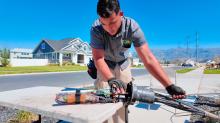
Since January of 2024, JNET has been constructing its fiber-to-the home (FTTH) network, building-out more than 45 miles of fiber to date. More than 40 homes have already been lit up for service with the project expected to be finished in 2026.