
bonds

Content tagged with "bonds"

Related Topics
Displaying 61 - 70 of 74

Washington State Law Change Transformed Fiber Project in Poulsbo

The story has been updated to fix errors. The original story described the project as a partnership but we have since learned it is a project of the Kitsap Public Utility District that is encouraged by the City.

We reported on Poulsbo, Washington, last fall after the community began a wireless pilot project providing a free high-capacity wireless mesh network throughout downtown. Kitsap Public Utility District is running the project, with encouragement from the City. An interview with Poulsbo City Council member Ed Stern filled in more details on this local project.

A wireless mesh pilot project was not the original plan. The public utility district had been investing in a fiber optic network to reduce costs for local government and provide better broadband for schools and hospitals. Stern and other city leaders also recognized that encouraging telecommuting would keep local dollars in the community. Poulsbo is very close to Seattle and city leadership hoped to draw employees from Seattle offices and encourage economic development. They offered a high quality of life and knew better broadband would draw more employers to Poulsbo.

The partners installed a fiber backbone throughout the city and had planned to expand last mile connections in the near future. Poulsbo also codified changes in conduit policy with new ordinances to better manage public rights-of-way. The code requires private providers to first use existing city conduit and the city reserves the right to lease it to them. This policy prevents unnecessary wear and tear and traffic disruption on local streets.

However, the state legislature erected barriers that derailed the full project by revoking PUD authority to offer direct retail services. To this day, public utility districts are required to wholesale access, which rarely creates enough revenue to justify the initial cost of building networks. Community leaders knew that wholesale-only models carry more risk because they split an already tight revenue stream. With the change in state law, the community re-evaluated the fiber network plan. 

Longmont to Vote a 3rd Time on Fiber Network

The Longmont community will soon have the chance to decide how quickly they want ubiquitous FTTH. On July 23rd, the City Council unanimously approved a proposal to ask voters in a referendum if they want to bond for funds to speed up construction of the LPC fiber network. Absent bond financing, the network will expand much more slowly over many years.

Readers will remember the 2011 referendum to allow the electric utility to offer broadband services to the people and businesses of Longmont. At the time, Comcast spent over $300,000 via the Colorado Cable Telecommunications Association to fund an unsuccessful Vote No astroturf campaign. The community approved the measure with 60% of the vote. There was an earlier referendum in 2009 that ended in a victory for Comcast following a successful astroturf campaign. Records showed a similar infusion of cash to sway the vote. 

In the recent meeting, some Council Members expressed concern over the city bonding to invest in the telecom business. The Longmont Times Call reported on the meeting:

"We're again a government playing in the private world of capitalism," [Councilman Brian] Bagley said. "What if we don't know what we're doing?"

City Manager Harold Dominguez noted that even if voters approved a bond, the city could still take on a partner. If it passes, he said, the city would have a pretty good idea of how big a piece of the market it could get. And implementation wasn't a huge risk, he said, because the city already knew it could provide the service; it had been doing so for itself, the school district and a few other large users for years.

"Based on the information we've received, yes, we can do it," Dominguez said.

Monticello Moves Closer to Settlement with Bondholders

It has been about a year since we checked in on FiberNet Monticello, a city-owned FTTH network about 40 miles northwest of Minneapolis. At that time, the network was generating insufficient revenue to meet debt payments, the private company operating the network (HBC) was stepping down, and Gigabit Squared was kicking the tires. Since then, Gigabit Squared and Monticello decided against a partnership and the City ceased making payments to bondholders. Previously, the City had covered the difference between revenues and debt payments by borrowing from the City's liquor store fund, a municipal enterprise fund. Monticello had financed the network with unbacked revenue bonds, meaning investors understood from the start that the full faith and credit of taxpayers would not "make them whole" in the event that the network did not create the revenues necessary to pay back the bond. Because Monticello chose that financing method, it had to pay a higher interest rate - those who buy bonds understand the differences in risk with different types of bonds and rates. However, the City has been negotiating with bondholders for a settlement to avoid potential lawsuits over the telecom utility and because this is a typically what how these situations are worked out. Bondholders will "take a haircut" in the parlance of finance rather than risk a total loss. Last week, Monticello City Council approved a $5.75 million proposed settlement in addition to the remaining funds left in the reserve fund, totaling approximately $8 million from an outstanding bond of $26 million. Final resolution may take many more months, but the major arguments seem to be worked out. This means that Monticello will own and continue to operate FiberNet Monticello. It also means that rather than having a network financed by revenue bonds, the network will have benefited from City funds from the liquor store and will almost certainly be re-financed with other City funds.

Princeton, Massachusetts, Considering Building Own Fiber Network

We recently reached out to Princeton, Massachusetts, after reading several local news articles about the city's ambition to improve broadband in the community. Phyllis Booth of the Landmark has been covering the story. Community leaders recently mailed survey cards to every residence in town and put the survey online to provide ample opportunity for feedback.

With survey results complied, the answer from respondents was an overwhelming, "Yes! We want better Internet!" The Princeton Broadband Committee has since made the results available in a series of visuals that express the community's experiences with speed, customer satisfaction, desirable applications, and other respondent concerns. Detailed survey results are available for review [PDF].

The results come as no surprise to Stan Moss, Board of Selectmen Member who is also on the Broadband Committee. "Everybody has tried everything," says Stan when he describes the survey outcome. The community of 3,300 has access to DSL in about 49% of households and other choices are satellite, dial-up, and wireless. According to Moss, Princeton DSL customers averaged a D+. From the Landmark article:

“Once we invest in the fiber it’s pretty good. It’s not costly to upgrade in the future, it’s reliable once it’s in place,” said [Broadband Committee Member John] Kowaleski. “If the town doesn’t do this, no one will,” he added. The town has contacted Verizon and Charter and “we’re not even on their plan,’’ said Kowaleski. “Princeton has insurmountable challenges. It isn’t profitable for Verizon or any other company to provide the infrastructure to give us the service,” said Kowaleski.

Moss says he receives calls on a regular basis from residents who want to know when the city is going to provide FTTH. Most of those calls come from people who work from home or have school age children.

Cedar Falls Utility Gets High Bond Rating from Moody's

We have long been impressed with Cedar Falls Utilities (CFU) in Iowa. They built an incredibly successful municipal cable network that has now been upgraded to a FTTH network. CFU transfers $1.6 million into the town's general fund every year, reminding us that community owned networks often pay far more in taxes than the national cable and telephone companies. Last week, Moody's Investor Service gave an investor-grade A-3 rating to revenue debt from CFU, another sign of its strong success.
Moody's rating report noted the utility's large market share, competitive pricing and product offerings, expansive fiber optic network, long-term financial planning and conservative budgeting practices as reasons for the continued strong rating of the utility's revenue debt.
CFU also compiles the community savings resulting from each of its services by comparing its rates to nearby communities (see most recent comparison [pdf]). The benefits total $7.7 million each year, almost $500 per family. This includes a $200 difference in cable TV bills and a $130 difference in Internet service.

Carl Junction, Missouri, Plans Community Owned Fiber Network

Carl Junction, Missouri, is moving ahead with plans to build a fiber network.

Steve Lawver, City Administrator, tells us that funding for the $5.2 - $5.6 million project will most likely come through a lease program from the Missouri Public Utility Alliance (MPUA). Lawver tells us that funding will involve private placement non-taxable bonds, available to members of MPUA.

The network, which will be entirely fiber to the premises, will serve local government, schools, businesses, and residents. In an email, Lawver notes that:

We, as many rural communities, have found that the incumbent providers that are serving us have no plans for the improvement or expansion of their system here in our city.  With little else to do we decided to build it ourselves and find a service provider that is responsive and customer oriented.

The City began pursuing the network some time ago. Last September, TSI Global presented information at a City Council meeting after completing 75% of a feasibility study. In a Joplin Globe article, Andra Bryan Stefanoni described data they gathered on available service in the Carl Junction area:

Mediacom users can download data at 20 megabits per second and upload at 2 megabits per second for $30 a month. AT&T users can download at 6 megabits per second and upload at 1 megabit per second for $20 a month. Zing fixed wireless users can download 3 megabits per second and upload at 1.5 megabits per second for $99 a month.

At that same September meeting, Stefanoni noted that residents commented on the project. While not all of the comments favored pursuing broadband infrastructure investment, most of the speakers at that meeting commented on poor choices:

New Hampshire Legislation Would Spur Internet Network Investment

New Hamsphire FastRoads is making significant strides in connecting residents, businesses, and community anchor institutions in the southwestern section of the state. FastRoads is funded by a combination of American Recovery and Reinvestment Act (ARRA) grants, private donations, and funds from local communities.

While the network is certainly making progress and scheduled for completion this summer, it has been constrained by state laws that limit the use of bonding. As a result, many local communities that would like to benefit from connections with Fast Roads will not able to take advantage of its presence in this largely rural area of the state.

We recently spoke with Carole Monroe, Executive Director of New Hampshire Fast Roads, in a Broadband Bits podcast interview. She told us about a bill in the New Hampshire General Court this year that would remove restrictions that limit how local governments can finance network investments.

In past years, New Hampshire legislators took up several bills that would remove the restriction preventing local communities from using bonds to finance broadband infrastructure. Every year, lobbyists from large ISPs manage to push those bills into oblivion. This year, HB 286 seeks to strike the restrictive language.

The bill is getting attention from local media, the New Hampshire SentinelSource. An editorial, published soon after the bill was introduced summarizes the problem:

In areas where companies determine that investing in expansion isn’t worthwhile, municipalities often find their hands tied because state law does not allow communities to take out municipal bonds for broadband access if there’s a private company operating in the community. That means if a town has even a small pocket of coverage by a telecommunication company, it can’t get funding to pay for expansion to the rest of its residents and businesses.

Franklin Municipal FiberNET Spurs Economic Development, Serves Government, in Kentucky

Franklin, Kentucky expects to see more positive economic growth when it launches its new fiber optic network. According to an article in the Bowling Green Daily News, the south central community is ready for the upgrade:

“We are super excited about it,” said James McCaslin, associate vice president of academic affairs and director of Franklin-Simpson Center. “It will be like going from 1970 to 2013 with the flip of a switch.”

We contacted Tammie Carey, Fiber Services Manager for Franklin Municipal FiberNET, and she was good enough to answer some questions. She told us that 32 miles of aerial fiber are strung in three loops around the city to ensure redundancy. She expects the network to launch near the end of January for local businesses, though the utility has already been serving one business as detailed below.

The decision was based solely on a desire to boost economic development, a sentiment echoed in the Daily News article:

It’s hard to recruit industry now if you don’t have (fiber optics),” said Dennis Griffin, industrial recruiter for Simpson County. “A lot of industries, particularly in this area, are satellite plants connected to their corporate offices, somewhere else in the United States. They all need to be connected by fiber.

“So if you don’t have that, it’s hard to compete with communities that do,” Griffin said. “Ten years ago, you could get by with T-1 lines – now most industries are just expecting that you have fiber."

Apparently, City officials contacted AT&T and Comcast several years ago and asked them to install fiber to the Franklin industrial parks. When they refused, City Leaders began pondering the possibility of a municipal fiber network. Tammie tells us about the decision in an email:

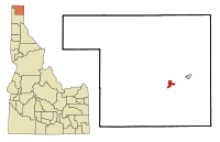
Bonners Ferry, Idaho, Considers Publicly Owned Fiber

Bonners Ferry, with around 2,500 residents in Northern Idaho, realized three years ago that fiber would only find their community if they installed it themselves.

“We are a little isolated up here…We don’t have the density that would attract this kind of thing.”

Mike Sloan, Bonners Ferry Economic Development Council Director, went on to describe the situation in a recent Bonners Ferry Herald article. Even though some BTOP and BIP federal stimulus project awards came to Idaho, none of them made it to Bonners Ferry. Nevertheless, Sloan and other community leaders knew the infrastructure would be crucial to the economic well-being of the region. The project has been in the works for the past three years. Sloan went on to tell reporter Cori Flowers:

Sloan said fiber optic isn’t just a means for easier internet surfing, it’s absolutely essential to economic progress. “Any area that doesn’t have this is at a distinct disadvantage,” Sloan said. “If we ever want to attract businesses to our area, we need this.”

In order to fund the build-out, Bonners Ferry plans to create a revenue bond, with anticipated revenue from the network designated to repay the bond. With the participation of several other area regional communities, leaders are optimistic. The network will travel along electrical lines and will end at the Canadian border.

The project, still in its planning phase, will be reviewed by the Panhandle Area Council, the City of Bonners Ferry, and municipal legal counsel before moving forward.

Maryland County Builds Wireless Network on Fiber Stimulus Project

Harford County, in northeast Maryland, is planning to bond for an $8 million wireless network to service local government, public safety, education, health care, and both commercial and residential needs. It will be called the Harford County Metro Area Network - HMAN. The current plan envisions a free tier as well as a low-cost tier intended for residential access. The network builds on fiber connections built with stimulus dollars, likely the OneMaryland network that touches every county in the state. This project will make those connections available to far more people and businesses. But the Baltimore Sun is asking some difficult questions - including whether it makes sense to use long-term bonds for wireless networks, where the technology may change significantly in a few short years. The problem for Harford County is that while the wireless technology may change rapidly, the private sector is not meeting their needs and they need better access to communications now. We are generally skeptical of solutions that envision wireless as the sole delivery mechanism for broadband to the home or business, given the much higher capacity and reliability of fiber-optic connections, but as long as the County is already building a network needed to ensure public safety departments and other local government mobile needs are met, it may certainly make sense to spend a little extra to offer residential and business access.