
bonds

Content tagged with "bonds"

Related Topics
Displaying 51 - 60 of 74

UTOPIA at a Crossroads: Part 1

This is the first of a three part series, in which we examine the current state of the UTOPIA network, how it got there, and the choices it faces going forward.

At the end of a month of public meetings, hearings, and city council votes, just over half of the cities that make up UTOPIA have chosen to take the next step in their negotiations with the Macquarie Group. The massive Australian investment bank has put forward an offer to become a partner in the troubled network in exchange for a $300 million capital infusion to finish the long-stalled FTTH buildout.

Of the 11 member cities that have debt obligations for the network, six (comprising about 60% of all 163,000 addresses in the UTOPIA area) have voted to proceed to “Milestone 2,” which means digging into details and starting serious negotiations on the terms of a potential public-private partnership. Macquarie outlined their opening proposal in their Milestone 1 report in April.

Macquarie has about $145 billion in assets globally, and is no stranger to large scale infrastructure projects. Their Infrastructure and Real Assets division has stakes in Mexican real estate, Taiwanese broadband networks, Kenyan wind power, and a New Jersey toll bridge, to name just a few. For their UTOPIA investment, they would be working with Alcatel Lucent and Fujitsu, highly capable international IT companies. So there’s some serious corporate firepower across the negotiating table from the UTOPIA cities - and in this case, that’s not actually a bad thing.

Harford County Network Goes Live in Maryland

Harford County, a mixed suburban and rural area in northeast Maryland, flipped the switch in late May on its Harford Metro Area Network (HMAN). The network includes 160 miles of fiber bringing high speed broadband to 150 sites, including all area schools, fire stations, libraries, and county and municipal buildings.

The project required $13.8 million in general obligation bonds from the county's capital improvement budget to construct four main fiber optic loops, with lateral connections leading to local anchor institutions. Not all planned facilities are connected yet, but construction will continue throughout the summer, as will the development of a business plan to determine how best to offer connections to local businesses and residences. Connections in the more rural northern area of the county will be wireless, due to the higher cost of building out to each home in lower density areas.

County Director of Information and Communication Technology Ted Pibil estimated that the county will save approximately $1 million per year by owning its own network, allowing it to cut ties with Verizon and Comcast. All of Harford County’s 54 public schools will see benefits as well, with increases in bandwidth of 50-100 times.

Harford County Sheriff Jesse Bane emphasized the public safety benefits of having a reliable communications network built with multiple contingencies in mind:

"This is going to provide the sheriff’s office with redundancy. That’s something we do not have at this time. It is something we have always considered a very precarious situation to be in… this will move us forward.”

While HMAN is funded entirely by county bonding, it builds on the backbone infrastructure of the OneMaryland Network, a stimulus-funded project that connects every county in the state. The press conference announcing the start of network operations can be seen here.

In Kansas, Chanute Explores FTTH Options

Last December, we reported on Chanute's decision to move forward with plans for a FTTH network. The community has a fiber and wireless network in place that serves utilities, public facilities such as libraries and schools, and several businesses. The network also provides free Wi-Fi across the community. As we discussed in our 2012 case study, Chanute developed its network incrementally over two decades with no borrowing or bonding.

In a City Commission work session on May 5, officials reviewed several options for an FTTH network. In a nutshell, the City is contemplating their involvement in the operation of the future network.

Utilities Director Larry Gates presented several options, reported the Chanute Tribune. Two choices stood out for the working group members:

Scenario C calls for the build out of city provided fiber optic-to-home broadband internet services. Service drops would only be provided to homes that want the internet services.

Under Scenario C, the initial investment would be about $10,926,842 to build the fiber core. The city would need $9,468,033 in funding to complete the project. The project would become cash-flow positive in two years, one month. It would take five years, nine months to pay back financing for the project. The 20-year net present value for the entire system would be an estimated $40,623,151.

Scenario D calls for a build out of the fiber optic-to-the-home system for private communications companies to pay a fee to the city to lease the network and provide services to residential customers. The city would seek private companies for voice, video and internet services.

Under Scenario D, the initial investment would be about $13,906,416 to complete the build out. The city would need $9,468,033 in funding to complete the project. The project would become cash-flow positive in one year, seven months. It would take eight years, 10 months to pay back financing for the project. The -20 year net present value for the entire system would be an estimated $25,667,301.

GovTech Reports on Broadband Legislation in Five States

Broadband is a topic of interest in several state legislative chambers this session. In a recent Government Technology article, Brian Heaton focused on five states where community broadband is particularly contentious. In some cases, legislators want to expand opportunities while others seek to limit local authority.

We introduced you to the Kansas anti-competition bill in January. The bill was pulled back this year but could be back next year. When the business community learned about the potential effects of SB 304, they expressed their dismay. From the article:

Eleven companies and trade organizations – including Google – signed a letter opposing SB 304 as a “job-killer” that restricts communications services expansion in the U.S.

Minnesota's leaders introduced legislation to expand broadband. Efforts include financial investment earmarked for infrastructure:

Senate File 2056 – referred to as the Border-to-Border Infrastructure Program – would take $100 million from the state's general fund to be applied to broadband projects. A companion bill in the House, HF 2615 was also introduced.

As we reported, there is bipartisan support for the bill in the House, but the Senate and Governor have not prioritized SF 2056.

New Hampshire's legislature wants to open up bonding authority for local communities that need help:

High Speed in the Blue Grass State: Russellville's Gig

The Logan Journal recently reported that the Russellville Electric Plant Board (EPB) now offers gigabit service to local businesses. The article notes that Net Index, an online tool to measure download and upload speeds, recognizes EPB as the first Gig city in Kentucky. To learn more about the community and its network, we talked with Robert White, General Manager of EPB.

The community of 7,000 is the county seat of south central's Logan County. Russellville is located in the center of several other larger communities: Nashville, Bowling Green, Hopkinsville, and Clarksville, Tennessee. Manufacturing has been a large part of the local economy for generations, but community leaders recognize the vulnerability of a narrow economic base. In order to encourage a versatile economy, Russellville invested in its telecommunications utility.

The community wants to encourage small business while simultaneously providing manufacturers the connectivity they need. Leadership sees the ability to remain competitive directly tied to their network. In addition to the economic development opportunities a fiber network can provide, communities like Russellville rely on electricity revenue from large consumers. Retaining the large electric consumers that also provide jobs in the community is a must.

Russellville's electric utility created a strong advantage when it was time to venture into telecommunications. EPB had already established a strong relationship with its Russellville customers, says White, and locals felt they could trust their municipal electric provider.

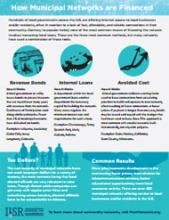
Fact Sheet on Financing Municipal Networks

We are adding a new fact sheet to our growing collection with the new, Financing Municipal Networks Fact Sheet. Many have assumed that municipal networks are funded with taxpayer dollars, but this is not true in the overwhelming number of cases. When a community decides it needs to establish its own publicly owned network infrastructure, one of the biggest challenges is financing the investment. Each community is unique but three main methods of financing are most popular. This fact sheet offers a quick look at these common approaches and provides real-world examples. Download the Fact Sheet [pdf]

HB 286 Refined for New Hampshire Legislature

We caught up with Carole Monroe from New Hampshire FastRoads to get an update on what is happening in the legislature this sesssion. We reported last spring on HB 286, intended to allow local communities more decision making power. The bill did not advance last session, but new language may breath new hope into the proposal.

If the bill passes, it will remove restrictions that prevent local governments from bonding to finance broadband infrastructure. This and similar bills have been introduced in the past, but large incumbent providers always seem to stop them.

Monroe tells us that this session the bill clarifies the definition of "open access network." The bill also changes language regarding "unserved and underserved" areas. Now the bill requires municipalities to include areas without "adequate" broadband if they choose to finance through bonds. "Adequate" in the bill language relies on the FCC definition of broadband as it changes over time, currently 4 Mbps download and 1 Mbps upload. The change does not restrict building in all areas as long as some areas without "adequate" coverage are included.

The new language also clarifies that municipal networks built only for government purposes do not have to be part of the open access model. Past versions of the bill questioned application of the open access model to municipal I-Nets.

While some of the language of the bill has changed, the fundamental goals remain the same. Local communities need to make the decision to bond. In order to do so, state barriers must be removed. Current state law only allows bonding for broadband infrastructure under strict criteria which only apply in a fraction of the state. 

Monroe reiterates that the bill intention is also to create a more competitive environment. She noted that the area is already benefitting from a competitive spirit. Broadband pricing proposals to community anchor institutions show significantly lower rates per Mbps. Service level agreements are more favorable to community anchor institutions since the creation of FastRoads.

Election Day 2013 Community Owned Network Referendum Roundup

Starting with the good news, voters in Colorado overwhelmingly supported municipal network intiatives. Longmont voted 2:1 in favor of bonding to fast track network expansion. We have covered this issue in great depth recently. Read all of our coverage of Longmont here. The local paper covered the referendum results in this story:
2B's passage means approval for the city to issue $45.3 million in bonds to build out the city's 17-mile fiber optic loop within three years. Longmont Power & Communications has estimated that the payback time on the bond will be 11 years. If revenues from commercial and residential customers fall short, LPC's electric service revenues will be used to make up the shortfall, LPC staffers have told the Longmont City Council.
South in Centennial, voters supported restoring local authority to build a network by a 3:1 margin. We most recently wrote about this referendum here. In Seattle, the mayor that campaigned on a citywide fiber network and backed off it but created a partnership with Gigabit Squared to bring gigabit fiber to 12 neighborhoods lost in his bid for reelection to the candidate that that was strongly supported with Comcast donations. However, the election does not appear to have turned on broadband issues:
McGinn’s fate was forecast two years ago, when voters slapped back his efforts to obstruct the Highway 99 tunnel project, opting to move ahead with the long-debated project. McGinn’s anti-tunnel agitating was viewed as a reversal from his 2009 election-eve pledge not to stand in the project’s way.
We continue to be disappointed in the lack of serious discussion in many races about how local governments can make meaningful improvements in Internet access for residents and businesses.

As Emmetsburg Plans to Vote on Muni Network, Mediacom Misinforms

The Iowa community of 4,000 will take up Public Measure D on November 5th. Voters will decided whether to approve a $3.5 million bond issue to cover approximately half the cost to build a FTTH system. Incumbent Mediacom is distributing flyers throughout the community urging a "no" vote. Community leaders are doing their best to combat Mediacom's propaganda by educating the voters.

We reported about the community's 1998 vote to establish a municipal cable communications or television system. The city did not act on the vote at the time because the project was cost prohibitive. The estimated cost of the project is now about $3 million less than it was in the late 1990s. Emmetsburg wants to seize the opportunity by joining The Community Agency (TCA), a coalition of municipalities in the region that collectively own a hybrid fiber coaxial cable network. Emmetsburg would join with a full fiber network.

The town currently provides natural gas, water and wastewater services through its municipal utility.

In a flyer [pdf] aimed at convincing locals to vote no, Mediacom brags that "Customers in Emmetsburg get the same services as those in larger cities..." Unfortunately, Mediacom's service in larger cities is also awful and more suited to the late 1990's than the modern digital economy. Consumer Reports has rated Mediacom among the absolute worst Internet providers in the United States.

Public Question D reads:

Longmont Prepares to Vote on Fiber Bonds - Community Broadband Bits Episode #68

As Longmont prepares to vote on November 5, we are paying special attention to question 2B, which will authorize the city utility to issue revenue bonds to finance the FTTH network already being built. The successful referendum from 2011 gave the City authority to build the network and this referendum, if successful, will finance a rapid expansion rather than the present incremental approach that will take decades. We have a double interview today, with Vince Jordan rejoining the show from Longmont Power and Communications. He previously spoke with us on episode 10 but today he just gives us the facts about the network and scenarios of what will happen depending on how the city votes. The second interview is with George Oliver, co-founder of the grassroots group Friends of Fiber that is advocating for people to vote yes on question 2B. George explains the benefits of passing this debt, namely that area residents and businesses will gain access to a world class networks without increasing any taxes. Friends of Fiber is on Twitter and Facebook. Read our other stories on Longmont here. Read the transcript from this show here. We want your feedback and suggestions for the show - please e-mail us or leave a comment below. Also, feel free to suggest other guests, topics, or questions you want us to address. This show is 30 minutes long and can be played below on this page or via iTunes or via the tool of your choice using this feed. Listen to previous episodes here. You can can download this Mp3 file directly from here. Find more episodes in our podcast index. Thanks to Break the Bans for the music, licensed using Creative Commons.