
Connecting Everyone - We Can Do It
Help us remind people what we can do when we truly commit to a goal. Share this image or +1 it.
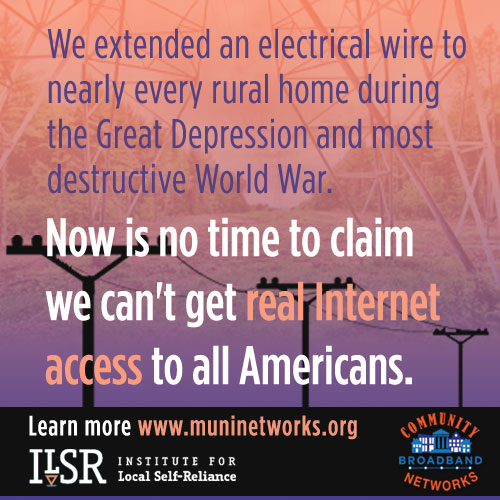

Fast, affordable Internet access for all.
Help us remind people what we can do when we truly commit to a goal. Share this image or +1 it.

The Massachusetts Broadband Initiative's (MBI) MassBroadband 123 network is becoming a reality. On March 28th, MBI lit up the first 35-mile stretch, linking Sandisfield, traveling through Otis, and connecting at the Springfield Technical Community College Technology Park hub. The inaugural connection was the first in a series of build outs that are scheduled to be completed by July 2013 [PDF of map and schedule].
MassBroadband 123 is the middle mile open access network snaking its way across central and western Massachusetts. The project, funded with $40 million in state bond proceeds and $45.4 million in stimulus funding, is scheduled to bring the 1,200 mile network to the anchor institutions in approximately 120 communities. While MassBroadband 123 will not offer last-mile connectivity to residents, it will bring the possibility to many rural areas that have little or no options today. Communities with their own networks, like Leverett, will be able to connect with MassBroadband 123. Hopes are that the open access nature of the network will inspire private providers to offer more last-mile connections.
MassLive.com reported on the first use of the network by school children in rural Otis. Kids at Farmington River Elementary School connected in Spanish with kids from Columbia and learned about physics from the NASA Goddard Space Fight Center in Maryland:
“It was really excellent,” said Mary G. Turo, principal of Farmington River Elementary, in a phone interview.
...
“We are a little isolated,” Turo said. “Having the capability to bring the outside world to us, you cannot put a price on it. We want our kids to be ready for the future. In order to be ready to for the future they have to know what is going on outside their hometown .”
Judith Dumont, director of MBI, compares the expansion of the network to government efforts to expand electricity in the 1930s. From the article:
Flash back to May 5, 1998 and the community of Emmetsburg, Iowa. This town of just under 4,000 people voted to establish a municipal cable communications or television system. It has taken fifteen years, but Emmetsburg is on the verge of joining the many other Iowa communities with municipal networks. Jane Whitmore of the Emmetsburg News reported on April 2 that the City Council adopted Ordinance #577, establishing the Board of Trustees of the Emmetsburg Municipal Communications Utility.
Emmetsburg will be joining four other local communities as part of The Community Agency (TCA), a coalition of cities in northwest Iowa that collectively own a hybrid fiber coaxial cable network. TCA began as a cable television system in 2000 and now offers Internet, telephone, and limited wireless Internet in O'Brien County. Emmetsburg will build a FTTH network as part of TCA.
Talks to join TCA began last summer; City Administrator John Bird commented for the article:
"It's important for our readers to know that when the Board (of Trustees) started talking about this late last summer, their reasons for wanting to get into this (communications utility) are noble. Their goals, their objectives are noble from an industrial and economic development standpoint," Bird noted.
He continued, "They believe that we're at a gross disadvantage, considering today's global economy. In the global market, people can work from their home in Emmetsburg, Iowa, for a corporation located anywhere in the world, or higher tech industries who really need quality, high speed broadband. We're at a disadvantage."
DJ Weber, General Manager of TCA, noted the lack of interest from the incumbents to invest in the area. He also commented on how the existence of municipal networks often lower rates and improve service for all customers due to increased competition.
Emmetsburg currently provides sewer, water, and gas to residents. The network will be financed with municipal revenue bonds, but the other utilities will also contribute some revenue toward it as each will benefit from benefits such as remote meter reading.

Spencer Municipal Utilities (SMU) of Spencer, Iowa, will be replacing old copper cable with fiber this summer. According to the Daily Reporter, customers can expect the upgrade with no increase in rates. From the article:
"Just like internet service has evolved from dial up to DSL and cable modem, fiber will give customers the next level of service to continue to improve the way they live, work and play here in Spencer," Amanda Gloyd, SMU marketing and community relations manager," said.
"We want to keep our customers on the cutting edge," she said.
Plans are to upgrade around 700 customers in one section of town during this first phase at a cost of around $2 million.
"This project is all paid for with cash in the bank," [General Manager Steve] Pick said. "This is an investment in the system."
SMU has offered telecommunications services to customers since 2000 and supplies water, electric, cable tv, Internet, telephone, and wireless service in the town of about 11,000. Rates for Internet range from $20 to $225 per month with cable tv analog Basic service as low as $14 and Basic Plus at $46. As options are added, monthly fees increase.
We see regular upgrades in service with little or no increase in price from many municipal networks. Comparatively, increases in price with little or no increase in service is a typical business decision from the private sector. Unlike AT&T, CenturyLink, or Time Warner Cable, municipal networks like SMU consider customers to be shareholders, and do what is best for the community at large.
We spoke with Curtis Dean of the Iowa Association of Municipal Utilities for episode 13 of the Community Broadband Bits podcast. He told us about the tradition in Iowa for self-reliance and its manifestation in the telecommunications industry.

Municipal broadband networks have been gaining traction across the country. It's easy to see why: In many rural and low-income communities, privately offered broadband services are nonexistent. In its 2012 Broadband Progress Report the Federal Communications Commission counted nearly 20 million Americans (the vast majority living in rural areas) beyond the reach of broadband.
The Free Press' Timothy Karr's words are supported by the growing number of pins on our Community Network Map. We connect with places nearly every day where municipal networks fill the cavernous gaps left by the massive corporations. Large cable and telecom providers do not hide their aversion to servicing rural areas, yet year after year their lobbying dollars persuade state politicians to introduce bills to stop the development of municipal networks. Karr reviewed recent efforts to use state laws to stifle community owned networks in a Huffington Post article.
As readers will recall, this year's front lines were in Atlanta, where HB 282 failed. We hope that loss may indicate a turning point in advancing municipal network barriers because the bill lost on a 94-70 vote with bipartisan opposition. If it had succeeded, Georgia would have been number 20 on a list of states that, thanks to ALEC and big corporate sponsors like AT&T, Comcast, Verizon, and Time Warner Cable, have decided to leave their citizenry begging for the private market to come their way.
Time and again, the supporting argument goes like this:
"A vote 'yes' for this bill means that you support free markets and free enterprise," [Rep Hamilton, the Chief Author of HB 282] said [on the House Floor].
A 'no' vote means that you want more federal dollars to prop up cities, Hamilton said.
But Karr points out that some policy makers are starting to question that argument, with good reason. From his article:

We recently reached out to Princeton, Massachusetts, after reading several local news articles about the city's ambition to improve broadband in the community. Phyllis Booth of the Landmark has been covering the story. Community leaders recently mailed survey cards to every residence in town and put the survey online to provide ample opportunity for feedback.
With survey results complied, the answer from respondents was an overwhelming, "Yes! We want better Internet!" The Princeton Broadband Committee has since made the results available in a series of visuals that express the community's experiences with speed, customer satisfaction, desirable applications, and other respondent concerns. Detailed survey results are available for review [PDF].
The results come as no surprise to Stan Moss, Board of Selectmen Member who is also on the Broadband Committee. "Everybody has tried everything," says Stan when he describes the survey outcome. The community of 3,300 has access to DSL in about 49% of households and other choices are satellite, dial-up, and wireless. According to Moss, Princeton DSL customers averaged a D+. From the Landmark article:
“Once we invest in the fiber it’s pretty good. It’s not costly to upgrade in the future, it’s reliable once it’s in place,” said [Broadband Committee Member John] Kowaleski. “If the town doesn’t do this, no one will,” he added. The town has contacted Verizon and Charter and “we’re not even on their plan,’’ said Kowaleski. “Princeton has insurmountable challenges. It isn’t profitable for Verizon or any other company to provide the infrastructure to give us the service,” said Kowaleski.
Moss says he receives calls on a regular basis from residents who want to know when the city is going to provide FTTH. Most of those calls come from people who work from home or have school age children.
Mike Scott, City Manager of Moultrie in Georgia, joins us for Episode #39 of the Community Broadband Bits podcast to share the origins of the Community Network Services (CNS) network that joins four towns in four counties in rural southwest Georgia. In this interview, Mike Scott shares some of the benefits of the network for local schools and community savings. Built originally because the existing cable and telephone companies would not invest in their communities, CNS has proved itself an incredibly valuable community investment. CNS is credited with creating over 6,000 jobs in the communities it serves, a tremendous boon for the communities that joined together to create this network. During our interview (below), we note a video they created to show off some of the benefits of this network. Here it is: Read the transcript from this podcast here. We want your feedback and suggestions for the show - please e-mail us or leave a comment below. Also, feel free to suggest other guests, topics, or questions you want us to address. This show is 20 minutes long and can be played below on this page or subscribe via iTunes or via the tool of your choice using this feed. Search for us in iTunes and leave a positive comment! Listen to previous episodes here. You can can download this Mp3 file directly from here. Find more episodes in our podcast index. Thanks to D. Charles Speer & the Helix for the music, licensed using Creative Commons.

Located in the southwestern corner of Missouri, Nixa has joined the growing list of local communities fed up with slow Internet access. A recent Rance Birger News-Leader article, describes the frustration of local tech CEO, Jeremy Bartley. He is not the only business leader in Nixa who is not willing to accept the Internet status quo. Bartley is part of an organized effort to investigate the possibility of a municipal fiber network.
The group has the ear of the City Council and the Mayor, who have put city staff on the project. From the article:
“I personally would like for staff to contact a city that’s relatively our size, and talk to somebody that started from scratch to where they’re successful, and how much it really cost them to do what they did,” [Mayor Sam] Clifton said.
“They may also have some insight on to other issues that arose when they did that as far as legalities and such,” Councilman Aron Peterson said.
Nixa has its own electric utility, which can often facilitate development of a municipal network. The first step is a survey, which will be distributed in March utility bills and is already available online.
Depending on the survey results, which should be available in April, the next step would be a preliminary design.
Like many other communities, Nixa has been left behind by the big national cable and telephone corporations. Community leaders understand why and want to proceed with caution. From the article:
City Administrator Brian Bingle acknowledged that private businesses haven’t shown interest in running fiber in Nixa.
“If the private sector could make money off it, they’d be doing it already, and we all know that,” Bingle said. “We’re looking into something that, one, there is a demand for it, two, that we can get ourselves reimbursed for it."
Nixans who are spearheading the project also see the current and future value of a community owned network:
“One of the goals of my company is to bring other tech companies to Nixa, because it’s the future of businesses, it’s the businesses that are going to create the most income for a city. Tech is the future of all jobs,” Bartley said.

Leverett, Massachusetts' broadband initiative has moved to the next phase in bringing fiber to residents. The town selectboard recently decided on a bidder to build the community owned network. G4S designed the network and also works with the Massachusetts Broadband Institute (MBI) as it brings a middle mile fiber network to towns across the western half of the state [PDF of service area].
An article in The Recorder alerted us to the development. Readers will recall that Leverett townspeople voted to ok a modest property tax increase as a way to help finance the ftth build out. From the article:
Indeed, after years of trying to convince private business to develop and offer high-speed telecommunication service in rural western Massachusetts, Leverett’s first-of-its kind network is being built with the help of a $40 million state bond, $47 million in federal stimulus funding and the town’s willingness to borrow to build infrastructure to attract service.
D’Errico said the cost of the project should be lower than $300 a year per median $278,000 property owner over 20 years.
...
...D’Errico said the $300 annual tax addition for the median value property is likely far lower than what residents are paying for their telephone, satellite dishes and cable service connections, and that having the town own the infrastructure likely means that the service contracts should also be a fraction of what they would cost otherwise.
Before construction can start, utility poles will need to be made ready for placement of the fiber optic cable. While this stage of the prep work is expected to take up to six months, hanging the cable would only take about three months.
Blair Levin is Executive Director of Gig.U. Prior to that, he was in charge of developing the National Broadband Plan and long before that was Chief of Staff for the FCC during the Clinton Presidency. He's had a lot of experience in telecommunications policy but here we focus on what can be done to move America's communities forward. I asked Blair to join us for the show so I could ask him some hard questions about the Gig.U initiative, including the difficulty of achieving universal service and the tradeoffs around allowing entities not rooted in the community to own (and set the rules for) essential infrastructure. I also challenge Blair's preference for "private sector" investment, asking him what exactly that means. I hope our discussion is helpful in understanding the tradeoffs communities must make in choosing exactly how to improve Internet access locally. Though Blair and I disagree in some ways, I think we clearly illuminate why we disagree so the listener can make up his/her own mind. If you have some questions left unanswered or points you wish were made, note them in the comments below and we'll ask him to join us again. Read the transcript from our discussion here. We want your feedback and suggestions for the show - please e-mail us or leave a comment below. Also, feel free to suggest other guests, topics, or questions you want us to address. This show is 35 minutes long and can be played below on this page or subscribe via iTunes or via the tool of your choice using this feed. Search for us in iTunes and leave a positive comment! Listen to previous episodes here. You can can download this Mp3 file directly from here. Find more episodes in our podcast index. Thanks to D. Charles Speer & the Helix for the music, licensed using Creative Commons.