
rural

Content tagged with "rural"

Related Topics
Displaying 1 - 10 of 1070

Decatur County Electric Cooperative Leads Charge as Indiana's BEAD Rollout Begins

Indiana Cooperatives are once again at the front of the pack as the state prepares to dramatically expand affordable fiber access on the back of $483 million in Broadband, Equity, Access, and Deployment (BEAD) broadband grants.

The first round of bead funding is expected to connect an estimated 123,000 Indiana households and businesses that currently have either substandard Internet access, or no access at all. All told, the state’s BEAD deployment plan is slated to expand affordable fiber access to 91 of Indiana's 92 counties.

Last June, the Decatur County Rural Electric Membership Corporation (DCREMC) was the first of the state’s 24 BEAD grant awardees to sign a contract with the Indiana Broadband Office.

The cooperative’s $7.1 million BEAD award will help extend fiber service to roughly 2,800 additional homes and businesses across the rural and sparsely populated communities across Decatur County, including Greensburg, Napoleon, Millhousen, and St. Paul. Most of the construction is expected to be finished before year’s end.

Image
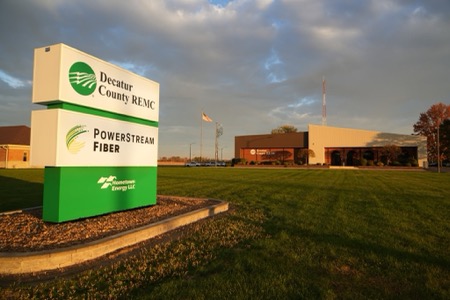
Decatur County Elec Coop building and sign

Decatur County REMC expanded into fiber Internet access in January of 2025 under the Power Stream Fiber brand. Power Stream Fiber currently offers three tiers of service: a symmetrical 500 megabit per second (Mbps) offering for $65 a month; a symmetrical 1 gigabit per second (Gbps) tier for $80 a month; and a symmetrical 2 Gbps service option for $110 a month.

Technology Without Guardrails - Episode 19 of Unbuffered

Unbuffered Logo - Two text bubbles

In this episode of Unbuffered, Chris is joined again by Sascha Meinrath, Palmer Chair of Telecommunications at Penn State University and Director of X-Lab, for a wide-ranging conversation about privacy, artificial intelligence, and "The Cost of Inaction" in Pennsylvania.

Chris and Sascha begin by discussing the future of the Foreign Intelligence Surveillance Act (FISA), examining the ongoing debate over government surveillance, constitutional protections, and what renewed surveillance authorities could mean for privacy and civil liberties.

The conversation then turns to AI, where they explore the rapid development of new technologies, the growing role of AI in surveillance, and the need for stronger safeguards to protect personal privacy. They discuss the work of the Center for Agentic AI Research, the opportunities AI presents, and the risks of deploying increasingly powerful systems without meaningful oversight.

Finally, Chris and Sascha examine the broader state of broadband policy through the lens of Pennsylvania's The Cost of Inaction report. They discuss the consequences of delayed broadband investment, the importance of competition and local accountability, and why community-driven solutions continue to play a critical role in expanding reliable, affordable Internet access.

Throughout the episode, Chris and Sascha connect today's debates over surveillance, AI, and broadband with broader questions about accountability, local decision-making, and how technology should serve the public interest.

This show is 59 minutes long and can be played on this page or via Apple Podcasts or the tool of your choice using this feed

You can also check out the video version via YouTube.

Transcript below.

We want your feedback and suggestions for the show-please e-mail us or leave a comment below.

Listen to other episodes (formerly Community Broadband Bits) or view all episodes in our index. See other podcasts from the Institute for Local Self-Reliance.

Thanks to Whitedrift for the song Operator, licensed Creative Commons Attribution (3.0).

California Greenlights Another $18.2 Million For Affordable Broadband

California and the California Public Utilities Commission (CPUC) continue to heavily invest in state efforts to expand affordable Internet access, and bolster digital equity, inclusion, and education programs to ensure freshly-connected communities are able to make the most of it.

According to a new announcement by the CPUC, the agency has freshly approved $14.7 million in California Advanced Services Fund (CASF) Broadband Infrastructure Grant Account funding for four fiber-optic broadband projects in rural Northern California.

The agency says it approved another $3.4 million in CASF Rural and Urban Regional Broadband Consortia grants supporting broadband planning and coordination efforts across 16 counties, and nearly $200,000 in Digital Divide Grant Program funding to expand access to technology, devices, and digital literacy training in underserved communities.

The state’s latest $18.2 million in digital literacy and access grants are one small part of California’s landmark $6 billion Broadband for All Initiative, which prioritized closing the digital divide in all of California’s 58 counties, and recently culminated in the launch of the state’s new $3.2 billion Middle-Mile Broadband Initiative (MMBI).

The CPUC states that its $14.7 million in CASF broadband infrastructure grants will be doled out to Plumas-Sierra Telecommunications – a wholly owned subsidiary of Plumas-Sierra Rural Electric Cooperative (PSREC) for four projects around the Golden State. Plumas-Sierra Telecommunications will own the finished networks across all four projects:

Too Easy to Reach Orbit? - Episode 16 of Unbuffered

Unbuffered Logo - Two text bubbles

In this episode of Unbuffered, Chris is joined again by Douglas Dawson for a conversation about the challenges and opportunities shaping the future of broadband.

Chris and Doug begin by discussing the latest developments in the National Digital Inclusion Alliance's lawsuit against the Trump administration over the Digital Equity Act, examining what the case could mean for digital equity efforts and the communities working to expand access, affordability, and digital skills.

From there, they turn to the results of a recent survey examining how rural Americans use the Internet, exploring what it reveals about changing consumer habits, growing bandwidth demands, and the ways AI and other emerging technologies are reshaping how people connect online.

The conversation then shifts to the practical realities of building broadband networks, including the rising cost of Fiber construction, permitting delays, make-ready work, and why better pole inventories could significantly reduce deployment costs and speed up network expansion.

Chris and Doug also take a closer look at the Federal Communications Commission's evolving approach to satellite broadband, discussing recent regulatory changes, what they could mean for the industry, and whether the agency's approach strikes the right balance as more companies look to launch satellite broadband services. They also explore how satellite fits alongside Fiber and other technologies as communities work to expand reliable Internet access.

Throughout the episode, Chris and Doug connect today's policy debates with broader questions about technology, infrastructure, and what it will take to ensure communities have reliable, affordable Internet in the years ahead.

This show is 48 minutes long and can be played on this page or via Apple Podcasts or the tool of your choice using this feed

You can also check out the video version via YouTube.

Transcript below.

We want your feedback and suggestions for the show-please e-mail us or leave a comment below.

Listen to other episodes (formerly Community Broadband Bits) or view all episodes in our index. See other podcasts from the Institute for Local Self-Reliance.

Thanks to Whitedrift for the song Operator, licensed Creative Commons Attribution (3.0).
Rural Cooperatives Frustrated With NTIA BEAD Changes

Rural cooperatives have been the backbone of modern efforts to bring affordable next-generation fiber to long-neglected rural U.S. communities. 

So it’s important to listen to them when they warn that Trump administration NTIA changes to U.S. telecom subsidy programs are going to have a profoundly-negative impact on efforts to expand fast, affordable Internet access.

Earlier this month rural electric and broadband cooperatives gathered in Washington, DC, for the 5th annual Broadband Leadership Summit

The topic du jour was broadly unpopular changes made by the NTIA to the Broadband, Equity, Deployment, and Access program (BEAD) created by the 2021 infrastructure bill.

As ILSR has repeatedly explored, NTIA BEAD changes reduced oversight of deployment, lowered quality standards, stripped away requirements that the resulting taxpayer Internet access be affordable and equitably deployed, and redirected billions of dollars away from affordable fiber to the low-Earth orbit space ambitions of billionaires Jeff Bezos and Elon Musk.

That’s not sitting well with the cooperatives doing the heavy and costly lifting to bring affordable access into long-neglected rural communities.

Glades Electric Cooperative Completes New Fiber Network

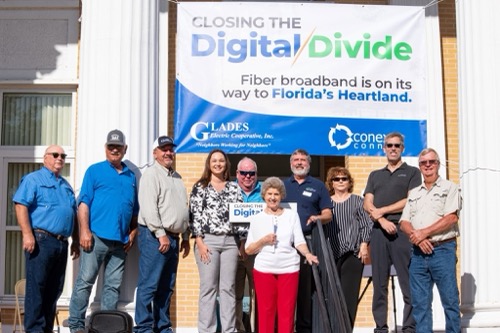
Moore Haven, Florida-based Glades Electric Cooperative has completed a long-planned fiber broadband network into largely unserved parts of the Sunshine State. The 1,600-mile network, built in conjunction with Conexon Connect, now spans Glades, Hendry, Highlands and Okeechobee counties, and the vast majority of the cooperative’s electrical footprint.

Like so many U.S. cooperatives, Glades Electric, founded in 1945, is leveraging a long history with rural electrification to inform its fiber broadband expansion plans and bring connectivity to those long-stranded by market failure and a lack of Internet access competition.

Also like most U.S cooperatives, the upgrades not only bring affordable Internet access, they aid in monitoring and repairing the existing electrical network.

“In addition to closing the digital divide for our cooperative members, we are pleased to update and expand our communications to our substations, corporate offices, grid connected devices and beyond, as a result of our project and long-term partnership with Conexon Connect,” said Michael Roberge, Glades Electric Cooperative CEO

For many rural Florida subscribers getting fiber for the first time, the speeds and pricing are better than what’s seen in many urban markets.

Image
Nearly a dozen Glades Electric Cooperative and Conexon officials stand in front of a sign that says "Closing the Digital Divide"

Conexon offers locals four fiber pricing tiers: an “Essentials” plan offering 200 megabits per second (Mbps) symmetrical for $59.95 per month; a “Premier” plan delivers up to 1 gigabit per second (Gbps) symmetrical for $79.95 per month; an “Ultimate” plan offering symmetrical 2 Gbps for $99.95 per month; and the top-tier “Elite” symmetrical 5 Gbps plan with variable pricing.

ILSR Launches Latest Tribal Internet Networks Census Update

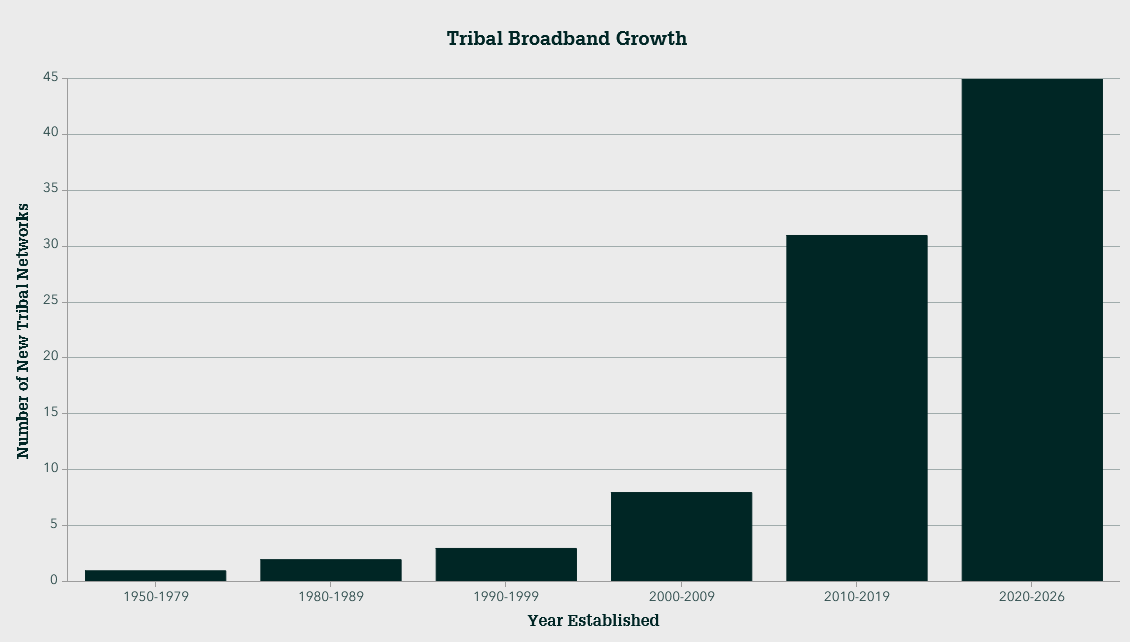
The Institute for Local Self-Reliance today released its comprehensive 2026 census of Tribal Internet networks, finding that the number of active Tribal-owned and operated broadband networks has doubled since ILSR first conducted this research in 2020 while offering a new way to interact with these networks’ stories.

Across the country, nearly 90 Tribal nations are actively providing Internet access to their communities. These Tribes own the wires or the wireless equipment that guarantee community members can stay connected to loved ones, continue their education remotely, check in with their doctors without driving an hour each way, and stay engaged in the social civic life of their communities.

This number underscores a period of massive growth in the last ten years among Tribal broadband owners. 

Image
Tribal Network Growth

Nor is that growth over. Our research also located about 50 Tribal nations that are building or have received funding to build networks, and another few dozen that have expressed interest in bringing Internet access to their communities. Over the next decade, the ranks of Tribal broadband owners may well double again.
 

California Activates Nation’s Largest Middle-Mile Network, Connecting Tribal, Rural Areas

*The following story by Broadband Breakfast Reporter Kelcie Lee was originally published here.

California just activated the nation’s largest open-access middle-mile network, bringing it one step further in closing the digital divide. 

On Thursday, the California Department of Technology (CDT) announced that after five years of planning, building, and promising access, the state’s $3.2 billion Middle-Mile Broadband Initiative (MMBI) is now operational. The high-speed network connected the last mile to the state’s first customer, the Bishop Paiute Tribe, a Native American community in Inyo County. 

This connection represents a key resource for places across the country that have been historically underserved or unserved, including rural and tribal areas. California Gov. Gavin Newsom said the MMBI plans to construct 8,000 miles of fiber across the state, and he hopes to get more than 5,300 miles completely built out by the end of 2026.  

California’s MMBI milestone was celebrated by a ceremonial signing between CDT and Bishop Paiute Tribe leadership as well as a live network light up demo. As the switch was flipped, students and children were seen using computers with their new internet service.

Bois Forte Band Begins Construction on $20 Million Tribal Fiber Project

The Bois Forte Band of Chippewa (also referred to as Ojibwe) has officially begun construction on a foundational fiber optic broadband expansion project in northern Minnesota that is poised to bridge the digital divide for thousands of Tribal residents.

The ambitious undertaking is supported by a significant $20 million grant awarded under the 2021 Tribal Broadband Connectivity Program, marking a major step forward in modernizing infrastructure for the sovereign nation.

The massive project aims to overhaul the existing connectivity landscape across the Bois Forte Reservation.

Image
A graphic illustrates the status of the tribe's fiber network construction

Once completed, the new network will deliver a high-speed, future-proof up to 10 gigabit per second (Gbps) fiber-to-the-home network to over 2,097 largely-underserved Native American households, businesses, and community anchor institutions.

Many Tribal nations were skipped over by past fiber deployments either due to outright hostility to Tribal interests, or a disinterest in the work required to align for-profit deployments with the needs and wishes of what is often multiple Tribal territories.

For Bois Forte, this new fiber network is expected to have a transformative impact across several key sectors, fundamentally improving community access to vital services:

Telecom's Plumbing Problem: Routing, Regulation, and What Comes Next - Episode 669 of the Community Broadband Bits Podcast

Community Broadband Bits

In this episode of the podcast, Chris sits down with telecom veteran Richard Shockey to unpack one of the biggest shifts happening quietly inside America’s communications networks: the death of the Public Switched Telephone Network (PSTN). 

Shockey explains why the traditional phone system is collapsing, how the FCC has failed to prepare the country for an all-IP future, and what this means for 911, rural access, and the millions of Americans still dependent on copper networks.

They dive into corporate consolidation, the disappearance of regulatory oversight, the national security risks of unmanaged VoIP systems, and why carriers are allowed to walk away from universal service obligations without a plan to replace them. 

Shockey makes the case that policymakers are sleepwalking into a telecommunications crisis — and communities need to push for resilience, public oversight, and real investment before the cliff becomes unavoidable.

This show is 60 minutes long and can be played on this page or via Apple Podcasts or the tool of your choice using this feed.

You can also check out the video version via YouTube.

Transcript below.

We want your feedback and suggestions for the show-please e-mail us or leave a comment below.

Listen to other episodes or view all episodes in our index. See other podcasts from the Institute for Local Self-Reliance.

Thanks to Arne Huseby for the music. The song is Warm Duck Shuffle and is licensed under a Creative Commons Attribution (3.0) license