
DVFiber

Content tagged with "DVFiber"

Related Topics
Displaying 1 - 4 of 4

Vermont Closes In on Universal Broadband Access as Federal Dollars, Local Innovation, and Workforce Training Converge

In the marathon to bring universal high-speed Internet service to the most rural state in the nation, Vermont is heading into the last-mile stretch of the race with the finish line in sight.

In February, the Vermont Community Broadband Board (VCBB) announced that the National Telecommunications and Information Administration (NTIA) overseeing the federal Broadband Equity, Access, and Deployment (BEAD) program, had approved Vermont’s Final Proposal, unlocking $93 million of the state's nearly $229 million federal allocation.

After years of painstaking planning, public input, and navigating bureaucratic hurdles, it marked a pivotal moment – with the state's selected grant recipients cleared to begin deploying mostly fiber to the communities that have long been waiting for high-speed connectivity after decades of neglect from the Big Cable and Telecom providers.

“This is a major milestone for many of our rural towns and a once-in-a-generation opportunity to strengthen and revitalize communities,” Gov. Phil Scott said in a statement, crediting NTIA, Vermont's congressional delegation, and the VCBB for shepherding the state's plan.

Image
Vermont State House building on a sunny day after snowfall

U.S. Sen. Bernie Sanders, never one to mince words, spoke to both the significance and the frustration of the moment. “Affordable, high-speed [I]nternet is a vitally important resource in every corner of the country. It is foundational to modern life,” he said. 
DV Fiber and Vermont’s Bold Broadband Model - Episode 625 of the Community Broadband Bits Podcast

In this episode of the podcast, Chris interviews Steven John, Chair of the governing board of DV Fiber, Vermont’s Deerfield Valley Communications Union District. They discuss Vermont's innovative approach to broadband access through Communications Union Districts (CUDs)—municipally led collaborations designed to provide universal, high-speed Internet. Steven highlights the unique challenges of delivering fiber to Vermont's rural communities, including navigating tough terrain, limited labor resources, and old infrastructure.

They explore the success of DV Fiber, which has connected hundreds of customers while adhering to a mission of affordability and accessibility. Topics include partnerships with local companies, lessons learned from electrification history, the resilience of fiber networks, and strategies for overcoming competitive pressures. This conversation provides a valuable look at how public governance and private expertise can merge to achieve universal broadband, even in the most challenging areas.

This show is 33 minutes long and can be played on this page or via Apple Podcasts or the tool of your choice using this feed.

Transcript below.

We want your feedback and suggestions for the show-please e-mail us or leave a comment below.

Listen to other episodes or view all episodes in our index. See other podcasts from the Institute for Local Self-Reliance.

Thanks to Arne Huseby for the music. The song is Warm Duck Shuffle and is licensed under a Creative Commons Attribution (3.0) license

Neighborly Networks: Vermont's Approach to Community Broadband

Image
Neighborly Networks report

In partnership with the Benton Institute for Broadband and Society, today ILSR releases a new report examining how the state of Vermont is supercharging its telecommunications infrastructure efforts to reach the unconnected by puttings its weight behind community broadband-driven efforts.

The report - Neighborly Networks: Vermont's Approach to Community Broadband [pdf] - traces the emergence of a unique public-public partnership arrangement that first appeared in the Green Mountain State in 2008. The Communications Union Districts (CUD) model first emerged more than a decade and a half ago among a coalition of towns in the eastern part of the state long-ignored by for-profit Internet Service Providers. There, a collection of community broadband champions came together to prove that the solution to the broken marketplace lay internal to east-central Vermont. ECFiber, a publicly owned, nonprofit ISP was borne of that effort, and began bringing affordable, fast, reliable service to households in the region.

Image
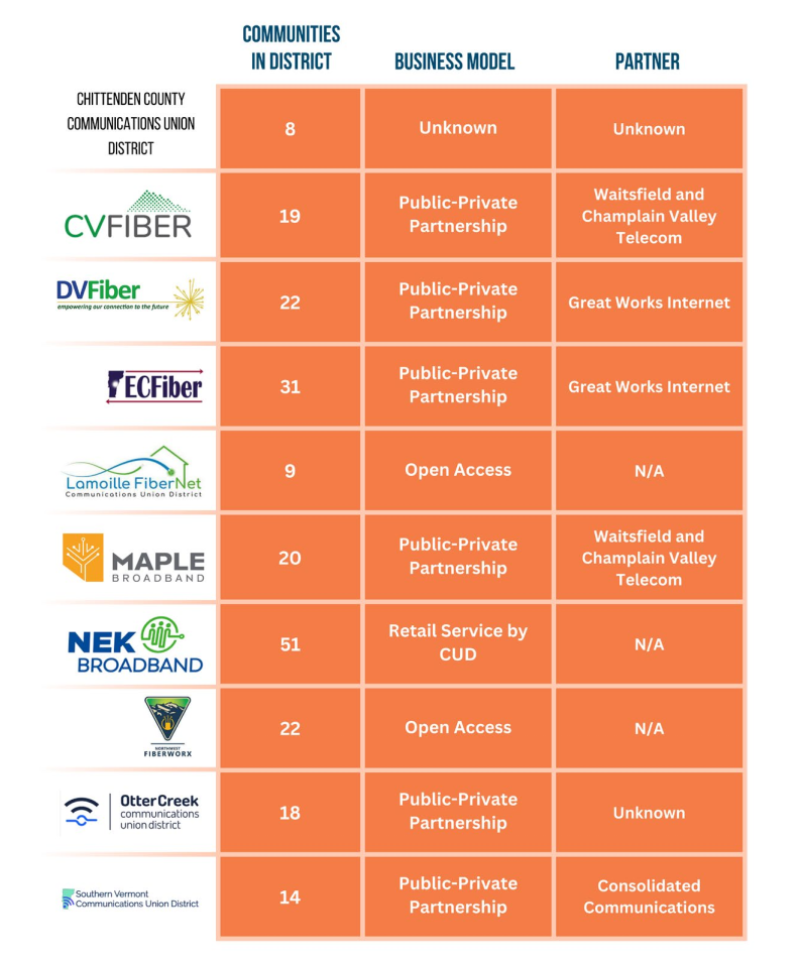
CUD models

Ten years later, when the state began formulating a plan for the future of Internet access, the progress made by and lessons learned from ECFiber drove a landmark shift in public policy in the state. Volunteers emerged, towns voted, and CUDs were placed at the center of Vermont’s effort to bridge the infrastructure gap in the state. Today, there are ten CUDs covering 216 towns across the state, and Vermont’s leaders have put the lion’s share of public funds behind the communications union district model.

New Report: Neighborly Networks - Vermont's Approach to Community Broadband

In partnership with the Benton Institute for Broadband and Society, today ILSR releases a new report examining how the state of Vermont is supercharging its telecommunications infrastructure efforts to reach the unconnected by puttings its weight behind community broadband-driven efforts.

The report - Neighborly Networks: Vermont's Approach to Community Broadband [pdf] - traces the emergence of a unique public-public partnership arrangement that first appeared in the Green Mountain State in 2008. The Communications Union Districts (CUD) model first emerged more than a decade and a half ago among a coalition of towns in the eastern part of the state long-ignored by for-profit Internet Service Providers. There, a collection of community broadband champions came together to prove that the solution to the broken marketplace lay internal to east-central Vermont. ECFiber, a publicly owned, nonprofit ISP was borne of that effort, and began bringing affordable, fast, reliable service to households in the region.

Image
CUD models

Ten years later, when the state began formulating a plan for the future of Internet access, the progress made by and lessons learned from ECFiber drove a landmark shift in public policy in the state. Volunteers emerged, towns voted, and CUDs were placed at the center of Vermont’s effort to bridge the infrastructure gap in the state. Today, there are ten CUDs covering 216 towns across the state, and Vermont’s leaders have put the lion’s share of public funds behind the communications union district model.

Tracing the history of this effort from 2008 to today, this report breaks down the conditions that led to this sea change, where the CUDs are at today, and how we might learn from the Vermont case to improve Internet access elsewhere across the country.