Connect Humanity

Content tagged with "Connect Humanity"

Related Topics
Displaying 1 - 10 of 13

Next B4DE: Digital Equity After the Election and What Communities Can Do Now

With the midterm elections behind us and long-stalled federal digital equity funds waiting on the horizon, it would be easy to assume the funding problem is solved. It isn’t. 

The spending rules and the timeline for those dollars are still unsettled for a program that’s already been cancelled once.

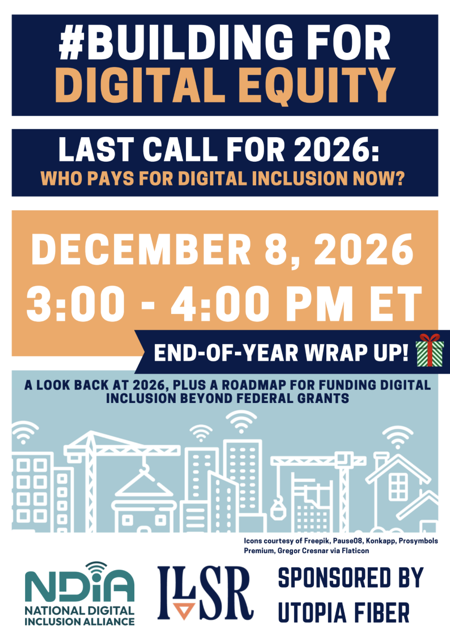
The next — and last — Building for Digital Equity (B4DE) livestream of 2026 will take on the question digital inclusion practitioners are still wrestling with: who pays for digital inclusion now?

Join us Tuesday, December 8, at 3 pm ET as the Institute for Local Self-Reliance’s Community Broadband Networks initiative and the National Digital Inclusion Alliance (NDIA) co-host: “Last Call for 2026: Who Pays for Digital Inclusion Now?”

Registration for the free webinar is now open here.

Image
B4DE Flyer

The hour will begin with a fast look back at the year, with NDIA’s Angela Siefer helping us take stock. That segment will cover the Digital Equity Act’s cancellation, NDIA’s lawsuit, and the revived grant program now headed toward a December opening.

Off the Funding Cliff: Building Sustainable Support for Digital Adoption – Episode 31 of Unbuffered

Unbuffered Logo - Two text bubbles

In this episode of Unbuffered, Chris is joined by Samantha Schartman, Director of Philanthropic Programs at Connect Humanity, to discuss the Alt Funding Field Guide: Building Sustainable Funding for Digital Adoption. 

The guide is a new resource that maps how digital skills and connectivity programs create value across six sectors: education, healthcare, telecom, workforce development, housing, and local government.

Samantha shares the personal history behind the guide. She helped lead the BTOP-funded Connect Your Community program, which trained 33,000 first-time computer users across five states, only to see its staff laid off when federal funding ended. 

She describes watching the field rebuild during the pandemic with ARPA and Capital Projects Fund dollars, then shrink again after the Digital Equity Act was canceled. That experience led her to form the Alt Funding Working Group, which has grown from six people to more than 150 leaders nationwide.

Together, they dig into the core idea of co-investment. Rather than relying on the next grant, programs can show local stakeholders the value they receive and ask them to invest in proportion to it. 

That could be a hospital system cutting emergency costs, an ISP gaining subscribers, or a housing provider seeing more regular rent payments. Samantha explains why this requires programs to move from testimonials to measurable outcomes, and to redesign their work around community goals.

Concluding with a case for government efficiency, Samantha shares findings from her Connecting Cuyahoga report. It found that serving social service clients offline costs roughly four times as much as serving them online, meaning digital inclusion programs can pay for themselves. 

Chris and Samantha also take aim at wasteful policies, like Medicaid-funded tablets locked to a single use, and preview future episodes that will dive deeper into each sector.

For more information about Connect Humanity's Alt Funding Field Guide, click here!

This show is 48 minutes long and can be played on this page or via Apple Podcasts or the tool of your choice using this feed. 

You can also check out the video version via YouTube.

Transcript below.

We want your feedback and suggestions for the show-please e-mail us or leave a comment below.

Listen to other episodes in our index. See other podcasts from the Institute for Local Self-Reliance.

Thanks to Whitedrift for the song Operator, licensed Creative Commons Attribution (3.0).
ILSR Launches New Digital Opportunity Lab

As ILSR continues to support local communities in solving Internet connectivity challenges, the Community Broadband Networks (CBN) team has kicked off a new initiative deep in the heart of Texas we are calling the Digital Opportunity Lab.

It mixes elements from the on-going Tribal Broadband Bootcamps with ingredients from CBN’s community engagement work to create a customizable-program in support of digital equity coalitions and community leaders amid a national effort to unlock the participatory benefits of broadband for all.

“Our focus isn’t on telling communities what they should or shouldn’t do,” ILSR Community Broadband Networks Director Christopher Mitchell explained. “We zero in on demystifying the technology involved, illuminating the digital landscape as it functions today, and share what we’ve learned and distilled after nearly two decades of documenting what local communities are doing to bridge multiple digital divides.”

Image
Digital Opportunity Lab young student crimping

Digital Opportunity Lab Debut

In a colonia outside of Pharr, Texas – nestled in the Rio Grande Valley – the first Digital Opportunity Lab convened last week with a focus on high school-aged students.

Connect Humanity, Microsoft Join Forces to Fund Appalachia Broadband

The nonprofit digital equity organization Connect Humanity has struck a new partnership with Microsoft to fund the deployment of affordable broadband access to long neglected residents of Appalachia.

The new partnership, outlined in a recent announcement, will leverage the Connect Humanity’s IDEA Fund (Investing in Digital Equity Appalachia) to help finance community-focused Internet Service Providers (ISPs) “best placed to meet the digital needs of residents and businesses in Appalachia’s unserved areas.”

Appalachia – which technically stretches from the Catskill Mountains in New York State to the hills of Mississippi – continues to be among the least connected areas in the nation. Appalachian residents are 31 percent more likely than the national population to lack a broadband subscription, and fewer than 20 percent of households use the internet at broadband speeds.

Image
Appalachia heat map from ILSR

Only 25 of the existing 423 Appalachian counties meet or exceed the national average for broadband speeds – and all were in metropolitan areas. Given the unreliable nature of FCC broadband maps, Appalachia’s digital divide is likely worse than measurements indicate.

Martinsville, Virginia To Finally Take Full Advantage Of Decades-Old Muni Fiber Network

Martinsville, Virginia has technically owned a municipal fiber network for the better part of a generation. But the city never had the time, resources, or interest in maximizing the Municipal Internet Network’s (MINet) full potential until COVID demonstrated the importance of affordable access and federal broadband grants made expansion a viable reality.

At a Martinsville city council meeting on February 13, the council offered unanimous support for a phased expansion of the city’s fiber network.

What exactly the expansion will look like, and how it will be funded, very much remain a work in progress.

The core MINet fiber network originally consisted of 48 strands and 20 miles of fiber connecting city schools, municipal buildings, local businesses, and key anchor institutions. A 2009 estimate indicates the network has saved the city between $100,000 and $150,000 annually on telecom lease agreements every year since its inception.

Image
Martinsville map

Despite having been first constructed in the 1990s, Martinsville’s MINet only has about 376 customers (98 of them being residential) in a city of nearly 14,000 residents. There’s roughly 20 users currently on a multi-month waiting list, eager to get access to affordable fiber at speeds up to a gigabit per second (Gbps).

Mike Scaffidi has been the MINet director for 26 years. He tells ILSR that while the city has contemplated network expansion for a long time, the city never had the staff or resources to prioritize the expansion or marketing of the city-owned fiber network.

NTIA Letter of Credit Waiver Victory for Community Broadband

The National Telecommunications and Information Administration (NTIA) recently announced it has created a “programmatic waiver” that offers alternatives to the much-criticized letter-of-credit (LOC) requirement buried in the BEAD program.

The announcement comes after hearing from a coalition of public interest groups and a chorus of broadband experts that the LOC requirement would effectively shut out smaller ISPs from participating in the national effort to expand high-speed Internet access.

When the bipartisan infrastructure law was passed in 2021, establishing the $42.5 billion BEAD program, the NTIA issued a Notice of Funding Opportunity (NOFO) that detailed the spending rules for BEAD grants. Designed to ensure Internet service providers (ISPs) did not take federal grant dollars and leave a project incomplete, the LOC requires BEAD grant applicants to provide a letter-of-credit from a bank that verifies the applicant has at least 25% of the grant dollar amount in cash reserves held in a bank account for the entire time it takes to complete a network build.

Expert Coalition Says Existing BEAD Rules Harm Small ISPs, Municipalities

A massive coalition of more than 300 broadband policy experts and organizations have written a letter to the U.S. government, warning that smaller broadband providers, nonprofits, and municipalities will be elbowed out of an historic $42.45 billion broadband grant program without some notable changes to program rules.

At the heart of their concerns sits the Broadband Equity Access and Deployment (BEAD) program, made possible by the recently passed infrastructure bill, and administered by the National Telecommunications and Information Administration (NTIA). The grant program is a once-in-a-lifetime opportunity to put a significant dent in America’s longstanding digital divide.

But BEAD program rules currently require grant recipients to obtain a letter of credit (LOC) from a bank, collateralized by cash or cash-equivalent. They also require grant winners to provide "matching funds of not less than 25 percent of project costs," though the latter restriction can be waived in some high deployment cost areas.

While the restrictions were intended to reduce the risk of project failure (a touchy subject for the government in the wake of problems with the FCC’s RDOF program), they require grant recipients to lock away vast and untouchable sums of capital for the duration of any broadband build, most of which last several years.

The referenced media source is missing and needs to be re-embedded.

According to the coalition’s letter to lawmakers, such requirements present unnecessary obstacles for smaller ISPs and cash-strapped municipalities, undermining the infrastructure bill’s goal of equitable, affordable broadband for all.

Indigenous Connectivity Summit 2023 Calls to Action

Each year since its creation in 2017, the Indigenous Connectivity Summit (ICS) has convened those working on the frontlines of Tribal connectivity. It brings together decision makers and stakeholders to build support for digital sovereignty and quality, affordable connectivity for Indigenous communities. 

With less than 60 percent of those living on Tribal lands in the lower 48 states having access to basic broadband connections – as Native Nations have regularly been excluded from policy conversations around these issues – ICS has become an important voice as the federal government is finally investing billions of dollars to expand high-speed Internet access across Indian Country.

The Summit, held this year in Anchorage, Alaska, was hosted by the Indigenous Connectivity Institute, an affiliate of Connect Humanity, an organization that supports underserved communities’ pursuit of better Internet access and enhancing digital skills. The Summit has become the most prominent event of its type in North America.

Image
Indigenous Connectivity Summit 2023 Calls To Action

Summit participants don’t just convene and talk. They also agree on a series of calls-to-action for governments and other entities with an eye on promoting digital equity in Indigenous communities. Last year’s calls to action, which included messaging around inclusive Tribal consultation, government and industry accountability, Indigenous spectrum rights, and workforce development, served as the foundation for this year’s focus.

Tribal Broadband Bootcamp Comes to Saint Regis Mohawk Reservation in Northern New York

As a young woman of the Nuxalk Nation, Mallory Hans is “clearing a path for future generations.”

A 2022 graduate of the British Columbia Institute of Technology, she’s one of about 50 people hailing from various Tribes and First Nations across North America in attendance for the latest Tribal Broadband Bootcamp, a three-day intensive learning experience focused on building and running Tribal Internet networks.

Held in different tribal regions several times a year since the initiative began in 2021, this bootcamp (the eighth in an ongoing series of hands-on seminars) is being hosted at the Akwesasne Mohawk Casino Resort on the Saint Regis Mohawk reservation along the New York/Canada border.

“So far so good,” Mallory said on Day Two of the bootcamp just as the attendees broke into small groups to go through a variety of demonstration stations set up by bootcamp instructors and Tribal employees who run Mohawk Networks, which provides fiber-to-the-home (FTTH) Internet, video, and voice services across the reservation in northern New York.

Image
Mohawk Networks Truck

In continuing the driving impulse to demystify technologies and build capacity among cohorts in Tribal nations, Day Two was centered around fiber stations that included demonstrations of how network operation centers are run; one on fiber splicing; another showcasing equipment used to install fiber inside of households with representatives from Calix, and another station on the electronic equipment that measures the performance of fiber lines.

“I’m enjoying it, feeling more confident and finding out I’m capable,” said the 22 year-old, newly minted fiber technician.

CBN’s Signal to Noise Ratios Week of July 24

In this week’s round-up of broadband news, we culled three stories we think are worth reading.

How Much is Fast Enough?

The first is a story from Ars Technica – FCC chair: Speed standard of 25Mbps down, 3Mbps up isn’t good enough anymore – written by veteran IT reporter Jon Brodkin.

For years now, broadband-for-all advocates have lamented the FCC’s minimum broadband speed standard of 25 Megabits per second (Mbps) download and 3 Mbps upload as being laughably antiquated. Indeed, it’s been almost three years since we made the case for Why 25/3 Broadband Is Not Sufficient, though it was outdated long before then.

Image
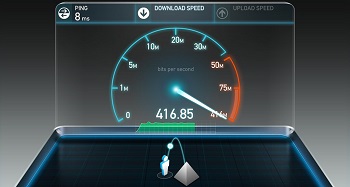
Speed Test

But as Brodkin reported this week, the FCC’s minimum speed standard “could finally change under Chairwoman Jessica Rosenworcel, who is proposing a fixed broadband standard of 100Mbps downloads and 20Mbps uploads along with a goal of bringing affordable service at those speeds to all Americans.”

Under Rosenworcel’s plan, the FCC would look at availability, speeds, and prices to determine whether the agency should take regulatory actions under Section 706 of the Telecommunications Act, which requires the FCC to determine if high-speed Internet access is being deployed "on a reasonable and timely basis" to all Americans.