Louisville has overcome a tall hurdle in its efforts to bring better connectivity and more competition to the community through local control. On August 16th the U.S. District Court for the Western District of Kentucky supported the city’s one touch make ready (OTMR) ordinance. AT&T challenged the ordinance in court, but their arguments fell flat and court confirmed that the city has the authority to manage its rights-of-way with OTMR.
State Law
AT&T’s claim based on state law asserted that the city was overstepping its authority by enacting the OTMR ordinance because it was impinging on Kentucky Public Service Commission jurisdiction. AT&T attorneys argued that, according to state law, the PSC has exclusive jurisdiction over utility rates and services, but the court found that argument incorrect.
Within the state law, the court found that the OTMR ordinance fell under a carve-out that allows Louisville to retain jurisdiction over its public rights-of-way as a matter of public safety. The ordinance helps limit traffic disruptions by reducing the number of instances trucks and crews need to tend to pole attachments. The court wrote in its Order:
AT&T narrowly characterizes Ordinance No. 21 as one that regulates pole attachments. But the ordinance actually prescribes the “method or manner of encumbering or placing burdens on” public rights-of-way. … It is undisputed that make-ready work can require blocking traffic and sidewalks multiple times to permit multiple crews to perform the same work on the same utility pole…. The one-touch make-ready ordinance requires that all necessary make-ready work be performed by a single crew, lessening the impact of make-ready work on public rights-of-way. … Louisville Metro has an important interest in managing its public rights-of-way to maximize efficiency and enhance public safety. … And Kentucky law preserves the right of cities to regulate public rights-of-way. … Because Ordinance No. 21 regulates public rights-of-way, it is within Louisville Metro’s constitutional authority to enact the ordinance, and [the state law granting authority to the PSC] cannot limit that authority.
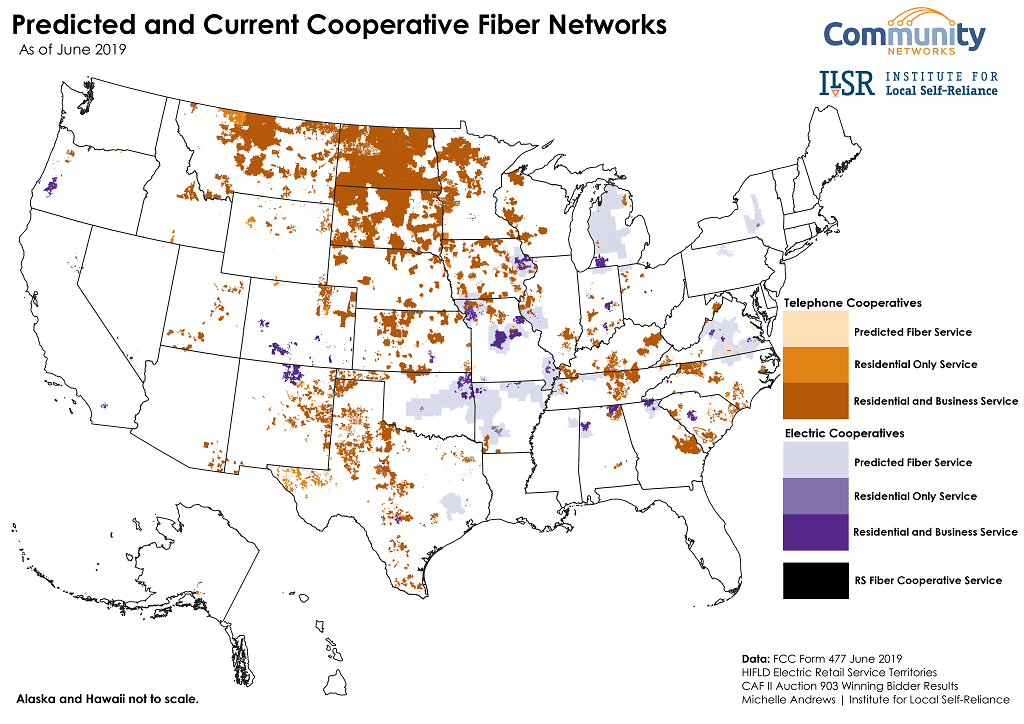
Cooperatives around the country have built on their long legacy of delivering essential infrastructure by starting to deliver next-generation Internet services. Here, we cover the basics of cooperatives in rural areas and then discuss the details of electric and telephone cooperatives that have already branched out into Internet service. Finally, we highlight the first fiber optic cooperative provider, and discuss how other communities have better Internet service through building their own networks.
Cooperatives are part of the fabric of rural America. The member owners control the cooperative: each person receiving service is a member of the cooperative and can directly vote in elections for the Board of Directors or even become a member of the Board.
Starting in the 1930s, the U.S. Department of Agriculture supported communities as they created more than 900 electric cooperatives across the country. In the 1950s, the federal government again supported communities building telephone networks, crisscrossing the country with telephone cooperatives to connect rural communities.
Each technology brought new markets, revitalized economies, and revolutionized industries. Cooperatives have a long history of building and maintaining essential infrastructure and providing excellent service in rural communities. Now they have the chance to do that again by building next-generation networks for Internet service.
Rural Public Policies
Rural areas face a number of challenges that urban and suburban communities do not. Low population density coupled with rough terrain can make building infrastructure challenging. Added to these factors, rural communities may not have access to the same financial resources as larger towns and cities do.
Image
Cooperatives, however, have made infrastructure projects work in rural communities for nearly a century. They have access to funding from their membership base, local banks, and often the federal government. Some state governments have expanded their broadband grant and loan programs to include electric cooperatives. Other states have clarified laws and policies to recognize that electric cooperatives can build fiber networks for Internet service using their current infrastructure. A few states have even removed legislative hurdles that stymied investments by electric cooperatives. Technically, the 1996 Telecommunications Act, Section 253, prohibits states from stopping any co-op from offering Internet service, but co-ops in many states are loathe to challenge state law in court.
North Carolina
In 2019, the state removed restrictions that prevented electric cooperatives from using USDA funding for non-electrical purposes, such as broadband networks. Our 2016 report, North Carolina Connectivity: the Good, the Bad, and the Ugly, highlighted how this roadblock kept the state’s electric co-ops from providing service to many rural communities.
Tennessee
During the 2017 legislative session, this state has clarified the language in its laws to allow electric cooperatives to build networks for Internet service.
Indiana
Cooperatives already have access to utility poles, easements, and Rights-of-Way in the communities that they serve. Indiana, however, needed to clarify that electric co-ops can use this access to provide Internet service, so it passed the FIBRE Act. Other states, including Georgia, Maryland, and Texas, have since followed suit.
Minnesota & Colorado
Minnesota and Colorado have made funding easier to access for cooperatives interested in providing Internet service. Both states have designed grant programs that promote local solutions to connectivity problems. In Minnesota, cooperatives provide most of the Fiber-to-the-Home Internet service thanks in no small part to that grant program.
Overbuild Or Underbuild?
In Community Broadband Bits Podcast Episode 91, Christopher Mitchell and Lisa Gonzalez discusses strategies for building Internet infrastructure in rural are. What do communities need to thrive?
More than 900 rural electric cooperatives provide electricity to about 12 percent of the U.S. population. Their service area, however, covers more than half of the total land, nearly 2 million square miles. About 90 rural electric co-ops have embarked on fiber optic projects to increase Internet access for their members.
Several of these electric cooperatives started by building fiber optic lines to substations and large demand centers to increase the reliability of the electric system through better monitoring. This could then form the backbone of a network for Internet service to businesses and residents.
Articles and Interviews
We have written many articles and collected several reports detailing how electric cooperatives have tried to increase Internet access in their communities. These stories show the many different ways electric cooperatives have structured partnerships and programs for their members.
Image
Several electric cooperatives provide Internet service themselves. Some started pilot projects, while others built out to their entire service area. The Fiber-to-the-Home project by Valley Electric Association boosted the local economy in Pahrump, Nevada. The co-op has already added 31 new jobs because of the fiber service.
Others partner with an existing telephone cooperative or telephone company. Ouachita Electric in Arkansas is one of the many cooperatives to have done this. By combining their resources and expertise, this partnership is able to extend electric and Internet service throughout much of southern Arkansas.
Many electric cooperatives work together, such as Sho-Me Power in Missouri and LS Networks in Oregon. These cooperatives have provided connectivity for local ISPs and businesses, and now are looking to connect residents.
In episode 229 of the Community Broadband Bits podcast, Jon Chambers, the former head of the FCC Office of Strategic Planning and Policy Analysis, describes how electric cooperatives have the potential to bring Internet access to unserved rural America.
Mel Coleman, president of NRECA and CEO of North Arkansas Electric Cooperative, joined the podcast in episode 243 to discuss how the electric co-op had improved Internet access for its members and what other cooperatives are doing.
This is a list of the rural electric cooperatives that have programs and projects to increase connectivity in their service areas. They do not all provide Fiber-to-the-Home. Some only offer fiber connections to businesses or provide wireless last mile connections while others focus on dark fiber and fiber transport services for other Internet Service Providers. (Total: 109) (Last updated: 12/2019)
Electric Cooperative
State
Project
Central Alabama Electric Cooperative
Alabama
FTTH (announced)
Joe Wheeler Electric Membership Corporation
Alabama
FTTH (announced)
North Alabama Electric Cooperative
Alabama
FTTH
Tombigbee Electric Cooperative (freedom FIBER)
Alabama
FTTH
Wiregrass Electric Cooperative
Alabama
Fiber backbone (under construction) — collaboration with cable company to connect members
Arkansas Valley Electric Cooperative (WAVE Rural Connect)
Arkansas
FTTH
Craighead Electric Cooperative Corporation (Empower)
Arkansas
FTTH
North Arkansas Electric Cooperative (NEXT)
Arkansas
FTTH
Ouachita Electric Cooperative (ARIS)
Arkansas
FTTH — collaboration with telephone company
Ozarks Electric Cooperative (OzarksGo)
Arkansas
FTTH
South Central Arkansas Electric Cooperative (South Central Connect)
Arkansas
FTTH
Anza Electric Cooperative (ConnectAnza)
California
FTTH
Plumas-Sierra Rural Electric Cooperative (Plumas-Sierra Telecommunications)
California
FTTH & wireless with fiber backbone
San Luis Valley Rural Electric Cooperative (Ciello)
Colorado
FTTH
Delta-Montrose Electric Association (Elevate Fiber)
Colorado
FTTH
Southeast Colorado Power Association (SECOM)
Colorado
FTTH
Yampa Valley Electric Association (Luminate Broadband)
Colorado
FTTH
Blue Ridge Mountain EMC
Georgia & North Carolina
FTTH
Habersham Electric Membership Corporation (Trailwave; North Georgia Network Cooperative)
Georgia
FTTH; FTTB and Schools
Jefferson Energy Cooperative
Georgia
FTTB — collaboration with Pineland Telephone Cooperative
Illinois Electric Cooperative
Illinois
FTTH
Jo-Carrol Energy (Sand Prairie)
Illinois
FTTH & wireless with fiber backbone
Jackson County Rural Electric Membership Corporation (Jackson Connect)
Indiana
FTTH
Johnson County Rural Electric Membership Corporation
Indiana
FTTH — collaboration with NineStar Connect
NineStar Connect (merger between Central Indiana Power and Hancock Telecom)
Indiana
FTTH
Orange County Rural Electric Membership Corporation
Indiana
FTTH
South Central Indiana Rural Electric Membership Corporation
Indiana
FTTH
Tipmont Rural Electric Membership Corporation (Wintek)
Indiana
FTTH
Allamakee-Clayton Electric Cooperative (AC Skyways)
Iowa
Wireless with fiber backbone
Maquoketa Valley Rural Electric Cooperative (MVLink)
Iowa
FTTH
Bulter Electric Cooperative (Velocity)
Kansas
FTTH
Warren Rural Electric Cooperative Corporation
Kentucky
FTTH pilot projects (announced) — collaborations with North Central Telephone Company and Franklin Electric Power Board
Great Lakes Energy (Truestream)
Michigan
FTTH
Midwest Energy Cooperative (Midwest Energy and Communications)
Michigan
FTTH
Tri-County Electric Cooperative (HomeWorks Connect)
Michigan
FTTH
Arrowhead Electric Cooperative (True North Broadband)
Minnesota
FTTH
Meeker Cooperative Light and Power Association (Vibrant Broadband)
Minnesota
Wireless with fiber backbone — collaboration with Mabel Cooperative Telephone Company and Spring Grove Communications
MiEnergy Electric Cooperative
Minnesota
FTTH & wireless with fiber backbone
Mille Lacs Energy Cooperative (XStream Internet)
Minnesota
FTTH — collaboration with telephone cooperative CTC
Roseau Electric Cooperative
Minnesota
FTTH (announced) — collaboration with local telephone company
Alcorn County Electric Power Association (ACE Fiber)
Mississippi
FTTH (announced)
Coast Electric Power Association (CoastConnect)
Mississippi
FTTH (announced)
Delta Electric Power Association
Mississippi
FTTH
Monroe County Electric Power Association (M-Pulse Fiber)
Mississippi
FTTH (announced)
Natchez Trace Electric Power Association (NT Spark)
Mississippi
FTTH
Northcentral Mississippi Electric Power Association (Northcentral Connect)
Mississippi
FTTH
Northeast Mississippi Electric Power Association (North East Fiber, LLC/NE SPARC)
Mississippi
FTTH
Pearl River Valley Electric Power Association (PearlComm Fiber)
Mississippi
FTTH (Announced)
Prentiss County Electric Power Association
Mississippi
FTTH (announced)
Singing River Electric Power Association (Singing River Connect)
Mississippi
FTTH (pilot)
Southern Pine Electric Power Association
Mississippi
FTTH
Tallahatchie Valley Electric Power Association (TVI-Fiber)
Mississippi
FTTH (announced)
Tippah Electric Power Association
Mississippi
FTTH (announced)
Tishomingo County Electric Power Association
Mississippi
FTTH
Tombigbee Electric Power Association
Mississippi
FTTH (announced)
Barry Electric Cooperative (goBEC)
Missouri
FTTH
Callaway Electric (Callabyte Technology)
Missouri
FTTH — collaboration with Kingdom Telephone Cooperative
Co-Mo Electric Cooperative (Co-Mo Connect)
Missouri
FTTH
Grundy Electric Cooperative (Mid-States Services)
Missouri
FTTH
Pemiscot Dunklin Electric Cooperative (Pemiscot Dunklin Fiber)
Missouri
FTTH
Ralls County Electric Cooperative (Ralls Technologies)
Missouri
FTTH
SEMO Electric Cooperative (GoSEMO Fiber)
Missouri
FTTH
United Electric Cooperative (United Fiber)
Missouri
FTTH
Crawford Electric Cooperative / Sho-Me Power Electric Cooperative (Sho-Me Technologies)
Missouri
FTTB & Transport Services
Gascoasage Electric Cooperative / Sho-Me Power Electric Cooperative (Sho-Me Technologies)
Missouri
FTTB & Transport Services
Howell-Oregon Electric Cooperative / Sho-Me Power Electric Cooperative (Sho-Me Technologies)
Missouri
FTTB & Transport Services
Intercounty Electric Cooperative Association / Sho-Me Power Electric Cooperative (Sho-Me Technologies)
Missouri
FTTB & Transport Services
Laclede Electric Cooperative / Sho-Me Power Electric Cooperative (Sho-Me Technologies)
Missouri
FTTB & Transport Services
Se-Ma-No Electric Cooperative / Sho-Me Power Electric Cooperative (Sho-Me Technologies)
Missouri
FTTB & Transport Services
Southwest Electric Cooperative / Sho-Me Power Electric Cooperative (Sho-Me Technologies)
Missouri
FTTB & Transport Services
Webster Electric Cooperative / Sho-Me Power Electric Cooperative (Sho-Me Technologies)
Missouri
FTTB & Transport Services
White River Valley Electric Cooperative / Sho-Me Power Electric Cooperative (Sho-Me Technologies)
Missouri
FTTB & Transport Services
Valley Electric Association (Valley Communications Association)
Nevada
FTTH
Continental Divide Electric Cooperative (Red Bolt Broadband)
New Mexico
FTTH
Kit Carson Electric Cooperative (Kit Carson Internet)
New Mexico
FTTH
Delaware County Electric Cooperative
New York
FTTH — collaboration with local telephone companies
Otsego Electric Cooperative (OEConnect)
New York
FTTH
French Broad Electric Membership Corporation
North Carolina
FTTH
Lumbee River Electric Membership Corporation (Bluewave Communications NC)
North Carolina
FTTH — collaboration with Horry Telephone Cooperative
Roanoke Electric Cooperative (Roanoke Connect)
North Carolina
FTTH
Consolidated Electric Cooperative
Ohio
FTTH
East Central Oklahoma Cooperative (ecoLINK)
Oklahoma
FTTH (under construction)
Lake Region Electric Cooperative (Lake Region Technology & Communications)
Oklahoma
FTTH
Northeast Oklahoma Electric Cooperative (Bolt Fiber Optic Services)
Oklahoma
FTTH
Oklahoma Electric Cooperative (OEC Fiber)
Oklahoma
FTTH
Consumers Power (Peak Internet)
Oregon
FTTP (open access network) — collaboration with Pioneer Consolidated and Stayton Cooperative Telephone Company
Central Electric Cooperative (LS Networks)
Oregon
FTTB, Schools, & Transport Services
Douglas Electric Cooperative (Douglas Fast Net; LS Networks)
Oregon
FTTH; FTTB, Schools, & Transport Services
Hood River Electric Cooperative (CACHE Communications; LS Networks)
Oregon
FTTH; FTTB, Schools, & Transport Services
Umatilla Electric Cooperative (LS Networks)
Oregon
FTTB, Schools, & Transport Services
West Oregon Electric Cooperative (LS Networks)
Oregon
FTTB, Schools, & Transport Services
Sullivan County Rural Electric Cooperative
Pennsylvania
FTTH (announced)
Tri-County Rural Electric Cooperative
Pennsylvania
FTTH (announced)
Mid-Carolina Electric Cooperative (Carolina Connect)
South Carolina
FTTH
Newberry Electric Cooperative (Carolina Connect)
South Carolina
FTTH — collaboration with Mid-Carolina Electric Cooperative
Appalachian Electric Cooperative
Tennessee
FTTH
Cumberland Electric Membership Cooperative (Cumberland Connect)
Tennessee
FTTH (announced)
Forked Deer Electric Cooperative (Forked Deer Connect)
Tennessee
FTTH
Gibson Electric Membership Corporation (Gibson Connect)
Tennessee
FTTH
Holston Electric Cooperative (Holston Connect)
Tennessee
FTTH
Meriwether Lewis Electric Cooperative (MLConnect)
Tennessee
FTTH
Sequachee Valley Electric Cooperative (SVEConnect)
Tennessee
FTTH
Tri-County Electric Cooperative
Tennessee
FTTH
Volunteer Electric Cooperative (Twin Lakes, powered by VEC)
Tennessee
FTTH — collaboratin with Twin Lakes Telephone Cooperative
Bandera Electric Cooperative (BEC Fiber)
Texas
FTTH
Grayson Collin Electric Cooperative (Grayson Collin Communications)
Texas
FTTH
Guadalupe Valley Electric Cooperative
Texas
FTTH
Jackson Electric Cooperative (MyJEC.net)
Texas
FTTH & wireless with fiber backbone
Taylor Electric Cooperative (Access Fiber)
Texas
FTTH
Victoria Electric Cooperative (Infinium)
Texas
FTTH & wireless with fiber backbone
BARC Electric Cooperative (BARC Connects)
Virginia
FTTH
Central Virginia Electric Cooperative (Firefly Broadband)
Virginia
FTTH
Craig-Botetourt Electric Cooperative
Virginia
FTTH (announced)
Mecklenburg Electric Cooperative (EMPOWER Broadband)
Virginia
FTTH
Prince George Electric Cooperative (Ruralband)
Virginia
FTTH
Columbia Rural Electric Association (Columbia iConnect)
Washington
FTTH Pilot Project
Orcas Power & Light Cooperative (Rock Island Communications)
Washington
FTTH
Chippewa Valley Electric Cooperative (Ntera)
Wisconsin
FTTH — collaboration with telephone cooperative Citizens Connected
Telephone Cooperatives
There are about 260 telephone cooperatives in the United States. Many provide Internet service as a natural extension of their existing infrastructure. Many started out by providing dial-up and DSL services, but only recently have begun to transition to Fiber-to-the-Home. Some have already transitioned to an all-fiber network, having upgraded everyone in their territory to fiber.
The Rural Broadband Association (NTCA) has a gigabit certification program in order to draw attention to how many small telephone companies cooperatives have built these next-generation networks.
Articles & Interviews
We have featured a number of these cooperatives on our website. Some cooperatives choose to work with local governments or electric cooperatives while others focus on providing service alone. Below is just a small selection of the many cooperatives that have built Fiber-to-the-Home networks.
Episode 188 of the Community Broadband Bits Podcast features Eric Cramer, the President and CEO of Wilkes Communications/RiverStreet Networks. He explained how the telephone cooperative has built a Fiber-to-the-Home network throughout several counties in northern North Carolina.
Cooperatives are not just telephone and electric. There is now a workable model for Internet cooperatives created from scratch. RS Fiber in Minnesota is the first cooperative formed for the express purpose of providing reliable, high-speed Internet service.
Yampa Valley Electric Association (Luminate Broadband)
Colorado
Electric
Yucca Telecommunications Systems
New Mexico
Telephone
Community Broadband Bits Podcast Episodes
Listen to our collection of Community Broadband Bits Podcasts to learn firsthand about how electric cooperatives have made the decision to provide Internet service.
What does it take for a telephone co-op in North Carolina to provide FTTH? President and CEO of Wilkes Communications and RiverStreet Networks explains
Rural Greene County, Tennessee, can’t attract national providers to invest in high-quality connectivity because it doesn’t have the population density ISPs look for to justify investment. According to GLPS General Manager Bill Carroll, the utility serves an average of 17 or 18 customers per mile. Greene County is approximately 650 square miles. Without a reason to bring better infrastructure to serve residential customers, national ISPs aren’t there to provide services to the police or sheriff facilities either.
GLPS will bring connectivity to Greene County 911, the Greenville Police Department, and the Greene County Sheriff’s Department. Each entity will pay for the construction of the fiber network to their facilities and pay a monthly fee to GLPS. The rate for their connectivity is based on a “per-mile” calculation, which allows GLPS to cover their costs; GLPS charges the school system the same way. Greeneville City Schools are saving approximately $50,000 per year, a significant savings in a town of 15,000 people.
GLPS will not act as an Internet Service Provider, but will allow public safety departments to cut down on expenses by eliminating leased lines. More importantly, the new network will be creating reliable connections. Greenville Police Department Captain Mike Crum said, “This partnership will truly save lives. That is a very difficult aspect to quantify when conducting a cost analysis.”
What The Future Holds
GLPS has no plans to expand their approach to serve residents and businesses throughout the county, but they haven’t ruled it out:
Carroll and his staff are assessing to determine if a project of that magnitude could be feasible and said they will bring that information to the Power Board as it becomes available.
On the border of Tennessee and Kentucky, an electric cooperative looks to a more connected future. The Tri-County Electric Cooperative that operates across state lines is preparing to build a state-of-the-art network for high-speed Internet service throughout Trousdale County, Tennessee. This will be the first year of construction for the cooperative after several years of planning.
Tri-County Electric plans to soon begin services to Trousdale County, the smallest county in Tennessee. Many of the county's 8,000 residents' choice is limited to Comcast and AT&T, and Tri-County Electric's Vice-President and General Manager Paul Thompson noted that people in the county often only subscribe to about 6 Mbps download and 1 Mbps upload. With a steady membership base of 50,000 spread across two states and a close relationship with the county, the electric co-op is in a good position to move forward with the Fiber-to-the-Home (FTTH) project. The cooperative intends to offer an affordable base package that provides faster, more reliable connectivity than what the incumbents are willing to offer the rural communities.
Funding From The Feds
Since 2014, Tri-County Electric Cooperative has actively pursued financing for a FTTH network in the county. The co-op applied for a grant through the Rural Broadband Experiments program managed by the Federal Communications Commission. They did not receive any funding, but the process resulted in a tangible plan.
The process of applying for the grant built up community support for the project and enabled the co-op to identify key assets. As part of the grant application, they noted which census blocks they expected to connect and what community anchor institutions, such as schools, libraries, and government buildings, could be included. The Trousdale County government even passed a resolution giving explicit permission for Tri-County Electric to build and operate a FTTH network.
One Touch Make Ready (OTMR) policies are recognized as a way to cut down on the expense and the time it takes to deploy fiber optic networks. At least three sizable urban communities have adopted OTMR practices to streamline fiber optic construction and ensure consistent standards. For other communities looking at ways to encourage brisk fiber optic investment, it pays to study the language of OTMR resolutions and policies.
OTMR allows a pre-approved contractor to move cables belonging to more than one entity on one visit to the pole to make room for the new fiber optic cable. This is a departure from the old method, in which each entity takes turns visiting the pole in question to move only their wires. The old approach is time consuming because each entity must take turns in the order in which their wires are installed on the poles. If one entity causes a delay, every other entity that needs to work after them must also wait. What follows is a snowball effect and an entire project can fall far behind schedule.
San Antonio, Texas
San Antonio’s municipal utility, CPS Energy, adopted a broad set of pole attachment standards that include specific requirements for OTMR, including what needs to happen before, during, and after the process.
The standards lay out administrative procedures, technical provisions, and specific provisions for both wired and wireless attachments. It incorporates recommendations from the FCC on how best to expand broadband while also weaving in safety standards from the Occupational Safety and Health Administration (OSHA). In the introduction, CPS Energy writes:
From a holistic perspective, the Standards seek to balance the competing needs and interests of multiple communications providers to access and utilize CPS Energy Poles, while at the same time recognizing that the core purpose and function of these Poles is for CPS Energy’s safe and reliable distribution and delivery of electric services to CPS Energy customers. Hence, any use of CPS Energy’s Poles must at all times ensure the continued operational integrity, safety and reliability of CPS Energy’s Facilities, electric services, personnel and the general public.
This is the transcript for Episode 257 of the Community Broadband Bits Podcast. Christopher Mitchell and Colman Keane discuss Chattanooga, Tennessee. The city's network has community support with a high number of subscribers. Listen to this episode here.
Colman Keane: When you look at Chattanooga, it was really the perfect time, and really a good place to launch this. When you're able to bring something like this to an engaged community, then you can get the benefits that Chattanooga sees.
Lisa Gonzalez: This is episode 257 of the Community Broadband Bits Podcast from the Institute for Local Self Reliance. I'm Lisa Gonzalez. Colman Keane is back on the show for an update on the situation in Chattanooga, Tennessee. In addition to surpassing expectations for subscribers, the municipal utility is doing very well financially. Electric rates have been kept in check for everyone in the EPB service area, regardless of whether or not they use the fiber to the home Internet service, and the infrastructure smart grid has kept expensive outages to a minimum. Colman and Christopher also talk about the Chattanooga community, and how it's culture has contributed to the success of the network, which has in turn provided multiple benefits.
First, we want to urge you to take a moment to help us out, by contributing at Muninetworks.org, or ILSR.org. Shows like this don't have commercial interruptions, and we like it that way. But they still cost money to produce. If you're already a donor, we want to thank you. Your contributions help spread the facts about municipal networks, so kudos to you for participating. Now, here's Christopher with Colman Keane from Chattanooga's EPB.
Christopher Mitchell: Welcome to another edition of the Community Broadband Bits Podcasts. I'm Chris Mitchell. Again, coming at you from Mountain Connect in Keystone, Colorado, a wonderful regional conference, one of the best in the nation. I'm here today with Colman Keane, the Director of Fiber Technology for EPB Chattanooga. Welcome back to the show.
As Newport Utilities (NU) in Tennessee moves forward with a plan to offer Fiber-to-the-Home (FTTH) connectivity, they are holding public informational meetings. At a recent meeting, locals received the plan positively, reinforcing that idea that NU is on the right track.
The network will be funded by a $3.5 million interdepartmental loan from the utility’s electric system in addition to a USDA loan. The first phase of the build out will connect just under 6,800 residential and approximately 1,200 business premises. It will also bring electric substations, the city of Newport, emergency services, and local schools on to the new infrastructure. The second phase will continue to connect remaining NU’s service area.
Why Are THEY Here Anyway?
In recent weeks, anti-muni groups from Knoxville and other areas have targeted the project, raising questions among the community; NU officials wanted to address the misinformation directly. Chair of the board Roland Dykes said:
“There has been alot of publicity, negative and positive in the community and we wanted to do this to make sure everybody understood what we are trying to do, and what broadband will mean for our community.”
WNPC reported that “virtually all of the attendees were positive about the plan, because many areas of Cocke County are without Internet service.” WNPC also noted that the only unfavorable opinion was from an attendee who refused to answer when asked if he was backed by the cable industry. That individual doesn’t live in Cocke County.
Raising Speeds, Holding Down Rates...A Muni Tradition
One of the very many treats at Mountain Connect this year was a keynote from Chattanooga EPB's Director of Fiber Technology, Colman Keane. (Watch it here.) After discussing their remarkable successes, we snagged an interview with him (he was last on the show for episode 175).
We discuss whether or not Chattanooga is an appropriate role model for other cities considering a municipal fiber investment and the general viability of citywide approaches in the current market.
We also get an update on Chattanooga's financials, their enthusiasm on connecting well over 90,000 subscribers, and how the smart grid deployment is creating tremendous value for both the utility and the wider community.
For more about Chattanooga, take a look at our ongoing coverage. We've been following the network and the community since 2009.
In addition to studying how and where local communities examine the potential for publicly owned Internet networks, we’ve looked at rates over time in select areas of the country. We recently put together a comparison of historical rates for municipal networks in Tennessee. Our findings are consistent with what we’ve seen all over the country - publicly owned networks don't hesitate to raise speeds while keeping rates affordable. We've documented the data on our fact sheet: Municipal Networks: Speed Increases & Affordable Prices.
Not Like The Big Guys
National providers make it a habit to periodically raise rates and over time those increases add up. They’ve done it so often, subscribers have come to expect it on a regular basis. Price increases don’t usually include a speed increase. With no need to appease shareholders, officials in charge of publicly owned networks can set rates at a level that allow a network to be sustainable rather than rates that maximize profits.
Publicly owned networks have increased speeds for subscribers, often with little or no fanfare other than quietly alerting subscribers to their improved service. Places Chattanooga’s EPB, Morristown’s FiberNET, and BET in Bristol are in a much different habit than Comcast or AT&T - they increase speeds with no increase in price. Other Tennessee communities have increased speeds significantly with only slight price increases over years of service.
Speeds, Rates Then And Now
On our fact sheet, we include prices for the basic tiers now and when the network began offering services. We also compare the basic speeds when the network began serving the community and today. The results reflect how publicly owned networks focus on providing fast, affordable connectivity to subscribers rather than collecting profit from customers.
Professor Christopher S. Yoo and Timothy Pfenninger from the Center for Technology, Innovation and Competition (CTIC) at the University of Pennsylvania Law School recently released "Municipal Fiber in the United States: An Empirical Assessment of Financial Performance." The report attempts to analyze the financial future of several citywide Fiber-to-the-Home (FTTH) municipal networks in the U.S. by applying a Net Present Value (NPV) calculation approach. They applied their method to some well-known networks, including Chattanooga's EPB Fiber Optics; Greenlight in Wilson, North Carolina; and Lafayette, Louisiana's LUS Fiber. Unfortunately, their initial data was flawed and incomplete, which yielded a report fraught with credibility issues.
So Many Problems
In addition to compromising data validity, the authors of the study didn’t consider the wider context of municipal networks, which goes beyond the purpose of NPV, which is determining the promise of a financial investment.
Some of the more expansive problems with this report (from our Executive Summary):