
preemption

Content tagged with "preemption"

Related Topics
Displaying 1 - 10 of 407

FCC Circulating Order to Preempt California Copper Retirement Rules
*The following story by Broadband Breakfast Reporter Jake Neenan was originally published here.

The head of the Federal Communications Commission has prepared an order that would preempt California’s copper retirement rules, the agency said Thursday.

AT&T asked for the move in May, following a March FCC order that invited companies to ask the agency to set aside state regulations that hindered their copper retirement efforts. The request has been supported by the wireless industry and opposed by state regulators and consumer advocates.

The FCC has already granted AT&T’s request to turn off copper telephone service at more than 184,000 locations in California. The California Public Utilities Commission has more stringent rules about what qualifies as an adequate replacement service — FCC Chairman Brendan Carr has been happy to accept reported wireless coverage — which has prevented the company from acting on the FCC approval.

ISPs are eager to decommission their old copper networks, which are costly to maintain and no longer provide competitive broadband speeds. The FCC and state agencies regulate the process to avoid rural areas being stranded without essential 911 services.

In a release, the FCC said its proposed order would preempt California regulations that prevented companies from moving forward with discontinuances approved by the FCC.

UTOPIA Fiber Marks Another Banner Year

UTOPIA Fiber is celebrating another banner year.

Created in 2009 by a coalition of Utah cities to cultivate a competitive market for fast affordable fiber Internet, the nation’s largest community-owned open access network recently announced it officially hit the 70,000 subscriber mark.

UTOPIA (Utah Telecommunication Open Infrastructure Agency) is now delivering fiber-to-the-home (FTTH) access in 21 Utah cities, partnering with 19 private-sector ISPs, while offering business-class service in 50 cities.

Over the past year – having deployed 1.9 million feet of fiber-optic cable, 1.3 million feet of underground conduit, 68,190 feet of aerial strand, and 8,660 handholes – UTOPIA’s growth in 2024 means fiber access is now available to 23,684 new homes and an additional 1,974 businesses in Utah, UTOPIA officials said.

Image

This comes after having completed its West Haven City buildout and the nearly complete construction of Bountiful Fiber’s network, which is on track to be finished by July. Additionally, UTOPIA has also completed fiber installations in 22 homeowner associations (HOAs) and are gearing up to connect more in the coming months.

UTOPIA Fiber executive director Roger Timmerman pointed to the surging demand for affordable fiber connectivity as to what’s fueling the growth:

“Residents are the driving force behind these fiber projects because they need better Internet now, not years down the road.”

For Timmerman, the truth is in the ledger. UTOPIA added 11,256 new subscribers in 2024, which pushed its subscriber total to over 70,000 – half of whom joined the network in the past three to four years.

Cooperatives Playing Major Role In Arkansas’ ARPA-Fueled Fiber Expansion

The Arkansas State Broadband Office – ARConnect – continues to leverage American Rescue Plan Act (ARPA) funds to drive affordable fiber access into underserved parts of the Natural State.

Three funding rounds are winding their way to completion, as fiber connectivity is being made available to rural markets for the first time, with a heavy reliance on local cooperatives.

ARConnect officials say they’ve now awarded more than $534 million in grants that will expand access to 130,000 locations in total, with most of the projects completed by 2030. Including matching funds, $1 billion is expected to be invested in total, bringing notable improvements to an estimated 875,000 Arkansas residents.

The Arkansas ARC Grant Program began in February 2021, using federal Coronavirus State and Local Fiscal Recovery Funds (SLFRF) Program funding propped up by ARPA, which both Republican Arkansas state senators voted against.

Image
American Rescue Plan Act pic

As of last December, state officials have committed all but $4,832 of its $1.57 billion in ARPA funds to active projects in the state.

ARC Round 1 doled out $118 million in grants to 76 projects, expanding access to approximately 55,700 homes, businesses, and community anchor institutions.

ARC Round 2 awarded $274.4 million in grants to 87 different projects, impacting approximately 54,000 homes, businesses, and community anchor institutions.

Carver County, Minnesota’s CarverLink Closes In On 100% Gigabit Fiber Coverage

Officials in Carver County Minnesota continue to make great progress expanding affordable fiber access to the county of 111,000 residents, thanks largely to their publicly-owned open access fiber network CarverLink and their partnership with Metronet.

Since its inception in 2013, Carver County has leveraged public and private collaborations and funding with the goal of making symmetrical gigabit (1 Gbps) fiber available to all locations county wide. With the looming completion of its most recent $10.5 million expansion, CarverLink Fiber Manager Randy Lehs told ISLR they’re getting very close to their ultimate goal.

The county currently has ownership and use of nearly 1,200 miles of fiber throughout Carver County and southern Minnesota connecting more than 280 last mile public and community support locations. Many of these markets have no connectivity; many others are stuck on dated, sluggish, patchy connectivity from regional monopolies.

CarverLink doesn’t provide fiber directly to residents and businesses. Instead it long-ago established a partnership with Metronet (formerly Jaguar Communications), to provide gigabit fiber service to businesses and local residential households. Winner of PCMag's “Fastest Major ISP for 2023” award, Metronet provides multi-gigabit fiber to 300+ communities across 17 states.

Image
Carver County map

“CarverLink also oversees the availability of dark fiber within our network that is available to qualified service providers or other entities using dark fiber for new opportunities–open access, open interconnect fiber,” Lehs said.  “And through our open access fiber, services are also available from Broadband-MN and Arvig.”

Championing Community Broadband in Montana with Representative Kelly Kortum - Episode 633 of the Community Broadband Bits Podcast

In this episode of the podcast, Chris sits down with Representative Kelly Kortum of Montana to discuss his efforts to repeal a law that restricts municipal broadband networks in the state. Drawing on his personal experience growing up in a small Montana town with limited Internet access, Representative Kortum shares how his passion for technology has shaped his advocacy for better broadband for rural communities.  

The conversation explores Montana’s existing barriers to broadband expansion, including outdated legislation favoring incumbent cable companies and the impact of federal funding programs like ARPA and BEAD. Representative Kortum highlights the critical role cooperatives and nonprofits, like Yellowstone Fiber in Bozeman, play in bridging the digital divide. Together, they emphasize the importance of local control in infrastructure development and the broader implications of equitable broadband access for innovation and economic growth.  

Tune in to learn how one legislator is working tirelessly to empower small towns across Montana with faster, affordable Internet and to challenge corporate control of connectivity.

This show is 17 minutes long and can be played on this page or via Apple Podcasts or the tool of your choice using this feed.

Transcript below.

We want your feedback and suggestions for the show-please e-mail us or leave a comment below.

Listen to other episodes or view all episodes in our index. See other podcasts from the Institute for Local Self-Reliance.

Thanks to Arne Huseby for the music. The song is Warm Duck Shuffle and is licensed under a Creative Commons Attribution (3.0) license

Wadsworth, Ohio Converting City-Owned Broadband Network From Coaxial To Fiber

Wadsworth, Ohio officials say they’re making steady progress on the expansion of a city-owned broadband network that’s extending affordable fiber connectivity to the city’s nearly 25,000 residents.

Originally a coaxial-based network, the city now says it’s in the process of delivering Wi-Fi to many city residents while they go block-by-block removing older coaxial cable and upgrading residents to more future-proof fiber optic connectivity.

All told, city officials say they currently have around 5,800 existing subscribers that will ultimately be upgraded to fiber.

Image
Wadsworth Citylink logo

Wadsworth, Ohio first launched its hybrid fiber-coaxial CityLink network back in 1997, and has been offering broadband, television, and phone access to the community ever since.

In 2020 ILSR spoke with Wadsworth IT Manager Steve Lange in Episode 438 of the Community Broadband Bits Podcast.

Affordable, Popular Alternatives To Monopoly Power

The network, unlike many similar deployments, is separate from the city’s municipal electric department. Wadsworth Assistant Service Director Mike Testa recently told the Medina County Gazette that the city has completed around 400 fiber installations so far, including a recently updated area along Weatherstone Drive where 120 homes were connected.

New Ideas in Competition Policy

Image
VPA report

A new report out from Vanderbilt University's Policy Accelerator re-emphasizes some of the important steps federal government agencies could take to make sure that upcoming Broadband Equity, Access, and Deployment (BEAD) funding is used as efficiently and equitably as possible. 

New Ideas in Competition Policy covers ground beyond the broadband space - including agriculture, commerce, energy, and more - but authors Ramsay Eyre and Ganesh Sitaraman hit again some of the important and well-trod ground. Among them, they argue that:

  1. NTIA should remove the letter of credit (LOC) requirement for participating in BEAD entirely, as it is a barrier for new and smaller entrants.
  2. NTIA should consider all Rural Digital Opportunity Fund (RDOF) areas as eligible for BEAD funding, given the number and level of defaulting the program as seen.
  3. NTIA should effect a rulemaking that takes a strong stance against state municipal preemption laws, either by refusing final proposals from those states or issue a rule preempting these laws itself.

The Vanderbilt Policy Accelerator conducts research and writes about markets of all different shapes around the United States. 

Read New Ideas in Competition Policy.

Roanoke Cooperative Thinks Big With North Carolina Fybe Fiber Expansion

North Carolina’s Roanoke Cooperative continues to make steady progress with expansion of its Fybe last mile fiber network within The Tar Heel State.

Cooperative officials tell ILSR that the cooperative and a coalition of organizations across North Carolina have major expansion plans in the works, starting with a fiber build in Halifax County, population 47,298.

Currently, Fybe provides fiber broadband service to around 6,000 subscribers in North Carolina, but thanks to an historic infusion of federal and state grants, the hope is to expand fiber access to the bulk of unserved addresses county-wide.

Fybe COO Bo Coughlin tells ILSR that the lion’s share of the cooperative's upcoming efforts to bring affordable connectivity to unserved and under-served portions of North Carolina will be under the banner of a coalition dubbed Encore, a nonprofit collaboration between MCNC, North Carolina Electric Membership Cooperatives (EMC), and Fybe.

“MCNC has been around for 40 years,” Coughlin notes. “It started as an economic Development institution funded by the state. Their goal was originally to help birth the microchip industry in RTP down in Raleigh, but today they provide transport to around a hundred universities, charter schools, and community anchor institutions across nearly 100 counties.”

Image
Fybe service territory map

Back in April, Fybe won a $9 million Growing Rural Economies with Access to Technology (GREAT) grant to help bring fiber to the largely underserved, heavily-rural residents of Martin, Bertie, Halifax, and Hertford counties.

“So currently, we pass about 5,000 total homes across Northampton and Halifax,” Coughlin said of Fybe’s current footprint.

‘Innovation’ Think Tank Pushes Lazy Smear Of Community Broadband

Here at ILSR we’re no stranger to telecom monopoly-backed efforts to mislead the public about the significant benefits of community owned broadband access.

That’s why a new “study” by the industry-backed Information Technology and Innovation Foundation (ITIF) maligning municipal broadband doesn’t come as much of a surprise.

The study professes to take a look at a very small number of municipal broadband networks, then makes sweeping and patently false claims about the entire sector.

“In most cases, local governments have neither the competence nor the economies of scale to deliver broadband as well as private ISPs,” the study concludes. “So, favoring government-owned networks wastes societal resources, creates unfair competition, and is frequently unsustainable in the long run.”

Image
Community Nets map

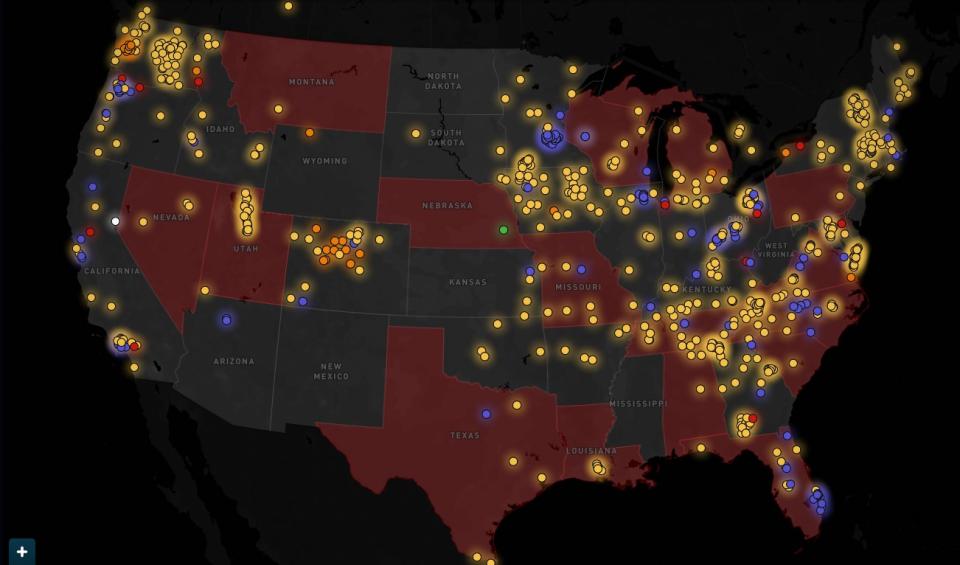
There’s numerous problems here. One being that the survey only looked at 20 municipal broadband networks in a country where more than 450 community broadband networks – serving close to 800 different communities – now pepper the American landscape.

The study author acknowledges the study’s sample size was “too small for the data to represent all U.S. [government-owned broadband networks] reliably,” then proceeds to make broad sweeping assumptions unsupported by any actual evidence.

LUS Fiber Brings Popular Broadband Service Into Church Point, Louisiana

Lafayette Utilities System’s LUS Fiber subsidiary is taking the show on the road. Louisiana’s only publicly-owned broadband provider says it’s expanding access into nearby Church Point, bringing affordable fiber access to the town of nearly 4,200 residents.

LUS Fiber was awarded a $21 million grant to expand fiber outside of Lafayette as part of the U.S. Department of Commerce’s National Telecommunications and Information Administration’s (NTIA) Broadband Infrastructure Program (BIP).

“This expansion not only improves the lives of our residents but also enhances opportunities for businesses, education, and healthcare in our town,” Church Point Mayor Ryan ‘Spanky’ Meche said in a prepared statement. “LUS Fiber’s work here is a tremendous step forward for our community.”

Image
LUS Fiber comes to church point celebration

The expansion is part of a series of new broadband deployments that should bring more than one million feet of new fiber options to numerous new Louisiana communities, including Ville Platte, Venice, Mamou, and Basile. Church Point residents are currently able to start scheduling installations via the LUS Fiber website.

The deployments technically began earlier this year, starting with Ville Platte, which data indicates, currently has the fifth-slowest average broadband speeds in the continental U.S.

Like most of America, much of Louisiana is dominated by a handful of regional telecom monopolies that see little competitive incentive to compete on speeds, coverage, prices, or quality customer service.