
muni

Content tagged with "muni"

Displaying 281 - 290 of 977

Three Communities Make Big Moves Toward Municipal Fiber Networks

A March article in Broadband Properties Magazine spotlights three communities around the country that are making progress toward creating municipal fiber networks. The City of Centennial, Colorado announced that they have completed a feasibility study and a Master Plan detailing the city’s plans to develop a network. Additionally, the Cities of Indianola, Iowa and Rancho Cucamonga, California announced that they have begun studying the feasibility of starting their own municipal fiber networks. 

Indianola, Iowa

Indianola, Iowa is a city of about 15,000 just 20 miles south of Des Moines. As we wrote a few years ago, Indianola currently owns an open access Fiber-to-the Premise (FTTP) network which provides Gigabit speed Internet access, plus TV, and phone service to most businesses and select residents in Indianola. The study they recently commissioned will explore the feasibility of using this existing network for constructing a FTTP network to the entire community. 

Indianola built its existing fiber network, which they launched in 2012, out of frustration as CenturyLink refused requests from the community to upgrade their DSL network and the incumbent Mediacom began overcharging for their Internet services. Today, Indianola Municipal Utilities is the infrastructure owner and a wholesale provider of this fiber network while Mahaska Communication Group, an Iowa-based Internet Service Provider (ISP), performs the operations and maintenance services for the network. 

Rancho Cucamonga, California

The City of Rancho Cucamonga, California recently asked a private consulting firm to perform a study to determine the feasibility of creating a fiber optic network. City officials see a municipal fiber network in this city of just over 170,000 as a potential driver of economic development. The city is located about 45 miles east of Los Angeles.

BT Advisory Board and Community Agree: Local Is Best

As Burlington, Vermont, searches for a buyer for Burlington Telecom, the local residents and business owners continue to remain engaged in the future of their beloved Fiber-to-the-Home (FTTH) network. Most recently, they made it clear that their first priority is finding a local company to own and operate the fiber network.

VT Digger reported that, according to a survey conducted by the BT Board of Advisors:

Several residents have said they would like to see Burlington Telecom sold to a locally owned co-operative and that their greatest concern is the utility being sold to one of its larger competitors such as Comcast, AT&T or FairPoint.

From the report:

Though the City is precluded by the terms of its settlement Agreement with Citibank from continuing to own the Asset, a carried equity interest is permitted. It is important that all ownership options be explored and considered in light of the legal requirements and the City’s goals for BT. However, the BTAB [Burlington Telecom Advisory Board] agrees with the vast majority of interested participants in this process that the sale of BT to one of its existing, national competitors would likely not be in the overall best interests of the City. 

At a recent meeting, David Provost, chair of the advisory board said, “The best option from our perspective is finding a buyer with ties to the local community that will allow the city to have a minority stake in Burlington Telecom."

A Troubled Past, An Uncertain Future

After years of cover-ups by the city's past leadership, CitiBank eventually sued Burlington for $33 million. The parties settled and, as part of the settlement, Burlington transferred ownership to Blue Water LLC, a company formed by Burlington businessman Trey Pecor. In exchange, Blue Water provided $6 million in bridge financing to allow the city to settle the lawsuit with Citibank. The city is still leasing the network temporarily but the ultimate goal is to find a partner to purchase the network. 

Sun Prairie Utilities' Pilot Project Shows Way to Better Connectivity

Welcome back to Sun Prairie, Wisconsin. This town has brought to light the shocking stories of slack service from incumbent providers, the complicated decisions of community representatives, and the hopeful beginning of a fiber-to-the-home (FTTH) network

The City Council has just approved $16,000 to hire an engineering consultant for the estimated $27-35 million citywide plan. 

In the Pilot Project, So Much Demand!

In July 2015, City Council approved the $624,000 plan for the pilot project, but several factors brought the actual cost up to about $653,000. The pilot project area included the neighborhood Smith's Crossing, the Main Street Corridor, and the TIF District 9 area. 

Sun Prairie Utilities first slated the project for completion in early December, but that underwent several delays. For instance, an over-booked contractor started on the project a month later than expected. Meanwhile, rocky soil conditions and high-demand slowed the pace of construction while raising costs. The Sun Prairie Utilities Manager Rick Wicklund will present the final costs for the pilot project this month. 

The original budget had assumed a 30 percent take-rate that would see a positive cash flow in three years. In actuality, 54 percent of households in the pilot project area are requesting the services.

Forty-three percent have requested the 100 Megabits per second (Mbps) for $49.98 each month while 11 percent want the higher-speed service of 250 Mbps for $69.98 each month. The capital expenditure of these unexpected last mile connections brought the cost up, but the extra revenue from these connections will certainly help offset those costs. 

Pilot Project Teaches Lessons

Sweet Sixteen: Waverly Utilities Hooks Up First Fiber Customers

This week in Waverly, Iowa, the local electric utility, Waverly Utilities, hooked up the first customers for its new Fiber-to-the-Home (FTTH) network. It’s been a long time coming for the town of 10,000 people. 

16 Years Ago: A Vision

The community first had the idea back in 2000 when they voted to form a municipal telecommunications utility after incumbent providers proved a letdown.  Reacting to the vote, those incumbent providers improved their networks a bit, so Waverly Utilities decided to hold off on building a fiber network. 

In 2013, residents and businesses found that the incumbent providers were again not providing necessary connectivity. Taking matters into their own hands, they pushed to create a new, publicly owned network. By 2015, the community had secured revenue bonds for the $12 million project.

Today: A Reality

Waverly Utilities already has 1,100 customers signed up to receive the service, and more homes and businesses will be connected over the next three months. By July 1st, Waverly Utilities’ network will be fully operational, delivering the next-generation connectivity that residents have long been waiting for.

For more about Waverly's project, take a few minutes to listen to Chris interview Mike Litterer, who was serving as Interim General Manager of Waverly Light and Power in 2013. He talked with Chris during Episode #53 of the Community Broadband Bits podcast.

There's "MAGIC" In Westminster

It was just last year when the City Council in Westminster, Maryland voted to begin a partnership with private ISP company Ting Internet. Ting now delivers high quality Internet access via the citywide, publicly owned fiber network.

A new collaborative initiative, facilitated in part by the still expanding Westminster Fiber Network, is bringing new cultural opportunities and economic benefits to city residents. “Tech Incubation” aims to give local students hands-on experience exploring their interests in technology.

Incubating Talent, Innovation

For the first project within the Tech Incubation initiative, 15 students from local high schools spent several weeks learning to create and operate an actual temporary wireless network. The city then used the network for its annual Celtic Canter and Downtown Irish Celebration in March, providing attendees of the celebration with unprecedented levels of bandwidth and broadband speeds.

The Tech Incubation Initiative is the product of a collaboration between the City of Westminster, the Mid-Atlantic Gigabit Innovation Collaboratory (MAGIC), Ting Internet, and the Westminster-based company Freedom Broadband. Freedom Broadband supervised the project and provided the wireless equipment necessary to build the network; Ting and the City of Westminster provided the necessary Gigabit backhaul over the Westminster Fiber Network.

More Opportunities Ahead

This project is the first in a series of planned, ongoing projects to teach students technology skills and encourage a culture of innovation. MAGIC is developing the Tech Incubation program in response to requests by students in Westminster for more opportunities to learn about technology.

Westminster’s City Council President Dr. Robert Wack described the value of the Tech Incubation initiative to community:

OECD Study on Munis Digs Deep, Discovers Dividends

A recent large-scale cross-national study from the Organisation for Economic Co-operation and Development (OECD) offers strong evidence that municipal broadband networks provide numerous benefits for communities around the world. Among the study’s major findings include evidence that municipal networks contribute to efforts aimed at improving local economic development, stimulating business productivity and innovation, and enhancing people’s quality of life.

The study's analysis of European nations is of special interest to us as European municipal networks are the only international municipal networks in the study that closely resemble U.S. municipal networks. In particular, the findings from the study’s central econometric analysis of Swedish municipal networks have direct implications for our understanding of the impact of municipal networks in the United States.

Findings from Econometric Analysis of Sweden

As the researchers note, extensive municipal broadband development across Sweden has contributed to a remarkably high level of nationwide fiber penetration, putting the country far ahead of the US in global rankings. The researchers report a series of features and benefits of Sweden’s widespread fiber penetration and aggressive municipal broadband efforts, including:

Increased rates of employment (with even greater employment increases in highly urbanized municipalities), increased business creation, and reduced car usage (also greater in the most urban cities) as fiber networks make it easier to telecommute to work and to shop for goods and services online.

Holland, Michigan Pilot Project Could Lead to More

pilot project in the City of Holland, Michigan is now delivering gigabit speed Internet service via a dark fiber network built by the city more than two decades ago; three commercial buildings are connected. The project, led by the Holland Board of Public Works (HBPW), is the first phase in an effort to develop a municipally owned and operated fiber network.

Holland is home to about 33,500 people and situated on the shores of Lake Michigan. The community is known for its roots in Dutch culture and is a popular summer tourist destination. Windmills and tulips dot the landscape.

Daniel Morrison, the president of a software company in Holland and a member of a local public interest group called Holland Fiber, recognizes that businesses need fast, affordable, reliable connectivity:

“Our whole business is online,” he told the Holland Sentinel newspaper. “We’re working with clients all over the world and we want to be able to work as quickly as possible.”

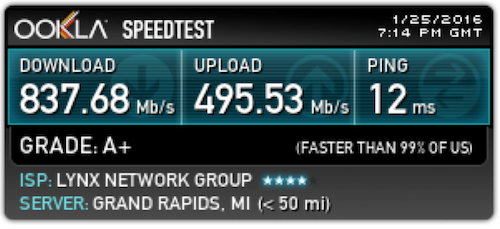
Morrison’s company is a pilot tester. After the testing program began in January, Morrison Tweeted out a screen grab showing his Internet speeds:

screen-grab-holland-mi.png

Pretty darn fast.

Toward a Municipal Network?

Pilot testing is set to last for three months to allow Holland’s Board of Public Works (BPW) to test out network technologies and solicit feedback from testers. All of the pilot testers are getting free fiber Internet service during the testing period.

Holland's BPW plans to apply their findings from the test toward a business plan for a municipal network for the entire service area. They will also use the business plan to support an application to the State of Michigan to become an authorized Internet Service Provider. BPW officials expect state regulators to respond to their application by the fall of 2016.

Santa Monica's Muni To Help Bridge The Digital Divide

Earlier this month, the Santa Monica City Council met to approve rates for the city's Digital Inclusion Pilot Program. The program is already in place, bringing free Gigabit per second (Gbps) Internet access to computers in community rooms in ten affordable housing complexes. The March 1st vote expands the program to offer residents the opportunity to sign up for services in their homes.

According to the Santa Monica Mirror, official monthly rates are set at $69 for 1 Gbps and $360 for 10 Gbps. People receiving Public Assistance will be able to obtain a discount to lower the rates to $48 and $252 per month respectively. An additional FCC Lifeline subsidy for those who qualify will lower the cost further to $38.25 per month for 1 Gbps Internet access. Download and upload speeds are the same.

Staff at the city established the rates for the pilot after studying rates in other markets where Gigabit access is available including Chattanooga, Lafayette, and Google Fiber. In order to support adoption in lower income households, city staff analyzed discounts that typically apply for other utilities and suggested a 30 percent discount for those actively participating in those programs. This approach does not exclude the elderly or households without school age children, one of the criticisms of Comcast's Internet Essentials. The staff report is available at the city website.

The Council approved a resolution, which also included construction funding of $175,000 for the project.

“In a global economy, any competitive edge we can offer our community is a worthy venture,” Gary Carter, Santa Monica City’s Community Broadband Manager told The Mirror.

“Santa Monica is uniquely positioned to collaboratively innovate as a community to fully leverage the technology of a cutting edge fiber optic network.” 

Long Time Coming

Chattanooga's EPB Sparks Local Entrepreneurial Ecosystem

Chattanooga's EPB Fiber Optics continues to stand out as a model for the municipal broadband movement, demonstrating the extraordinary impact that fast, affordable, reliable Internet access can have on economic development efforts. 

Now, a new research report from the Ewing Marion Kauffman Foundation highlights the network’s vital role in kick starting the development of what has become a thriving “entrepreneurial ecosystem” in this city of about 174,000.

Collaboration, Public Private Partnerships

The report, titled "Little Town, Layered Ecosystem: A Case Study of Chattanooga," credits the EPB network as the “spark” for an explosion of economic development since the network's launch in 2010. As the article notes, the EPB estimates that since the launch, Chattanooga has seen an influx of ninety-one new companies with approximately $50 million in venture capital contributions from six firms. 

According to the report, the network has also encouraged an entrepreneurial climate in this city that had a “long history of collaboration and public-private partnerships” even prior to the network launch. The report cites examples of the city's collaborative spirit in several non-profit entities, city officials, local anchor companies and universities, and the city’s recently opened Innovation District.

Yasuyuki Motoyama, director of Research and Policy at the Kauffman Foundation and one of the paper's authors, explains the lessons that other cities might take away from Chattanooga’s example:

"Chattanooga organized and mobilized its assets to orient itself to entrepreneurial initiatives. This demonstrates what a small-size city can do when factions from different sectors focus on a common goal and collaborate to achieve that goal. This case of Chattanooga provides lessons for other cities to leverage their own unique assets and to create equally successful ecosystems."

TN and NC vs. FCC: Oral Arguments Scheduled for Thursday, March 17th

This Thursday, March 17th, attorneys for the FCC and the states of Tennessee and North Carolina will present arguments to the Sixth Circuit Court of Appeals on a case that could define parameters for publicly owned Internet networks. The proceedings begin at 9 a.m. eastern. Each side has 15 minutes to present.

As we reported a year ago, the FCC ruled that state barriers in Tennessee and North Carolina limiting expansion of publicly own networks are too restrictive and threaten the U.S. goal of expanding ubiquitous access. The FCC overruled the harmful state laws but soon after, both states filed appeals.

The cases were consolidated in the Sixth Circuit and a number of organizations, including ILSR, offered Amicus briefs. We have collected all the briefs and made them available for you here. As most of our readers will recall, the case focused on Chattanooga and Wilson, two communities that know the many benefits of publicly owned networks.

So, when you raise your glass of green beer on Thursday to celebrate St. Paddy's, send some luck to our friends in Wilson, Chattanooga, and the FCC!