

muni

Content tagged with "muni"

Displaying 161 - 170 of 977

Fiber Optic Otis: FTTH Service To Start This Fall

People in Otis, Massachusetts, are now seeing utility crews make space for fiber optic cable on poles as they prepare for the community’s publicly owned Internet network. The schedule calls for cable installation in August; the network should start serving residents and businesses this fall.

Working With A Neighbor

Like several other hill towns in western Massachusetts, Otis is working with Westfield Gas + Electric’s WhipCity Fiber, which will handle construction of the network. WhipCity will construct the network in phases, connecting premises as neighborhoods are completed. The project will connect 1,687 premises and will cost approximately $5 million. 

Construction is finally able to commence because in May, the Massachusetts Broadband Institute (MBI) released funding for last mile broadband networks to several towns that advocated for their own solutions. Otis received $1.7 million. Communities like Otis that chose to invest in publicly owned infrastructure are required to contribute to the cost of their network.

MBI chose to release the funds after a drawn out situation in which unserved and underserved communities in the western part of the state first planned to unite as a broadband cooperative, WiredWest. MBI was the administrator of approximately $50 million in federal stimulus and state grant funding but withheld the funds. They felt there were problems with the WiredWest business model, but local towns and municipal network experts did not share those concerns. Instead, MBI planned to dole out the funding to large incumbent providers, which angered many of the local communities that have expressed dissatisfaction with treatment by those very companies over the years. Comcast will still obtain large amounts of the grant money to build out in several of the smaller communities. Those small towns will not be required to contribute, but 100 precent of their premises are not always served and they will not own the infrastructure.

Ammon Examines Muni Fiber Impact - Community Broadband Bits 259

For episode 259 of the Community Broadband Bits podcast, we are going back to the well in Ammon, Idaho - one of the most creative and forward-thinking fiber network deployments in the country. Strategic Networks Group has completed a study examining the impact of Ammon's open muni fiber network on local businesses and residents.

To discuss the results, we welcome back Ammon Technology Director Bruce Patterson and SNG President Michael Curri. After a quick reminder of how Ammon's network works and what SNG does, we dive into how Ammon's network has materially benefited the community.

The city is expected to realize savings approaching $2 million over 25 years. Subscribers will be saving tens of millions of dollars and businesses seeing benefits over $75 million over that time frame. Listen to our conversation to get the full picture.

Bruce has visited us for the podcasts, including episode 207 on Software-Defined-Networks, episode 173 in which he described public safety uses for Ammon's network, and episode 86 from back in 2014 when local momentum was starting to grow for better connectivity. 

Michael has also joined been on the show in the past. He participated in episode 93, talking about the benefits of broadband utilization.

This show is 31 minutes long and can be played on this page or via Apple Podcasts or the tool of your choice using this feed

Transcript below. 

We want your feedback and suggestions for the show-please e-mail us or leave a comment below.

Listen to other episodes here or view all episodes in our index. See other podcasts from the Institute for Local Self-Reliance here.

Thanks to Arne Huseby for the music. The song is Warm Duck Shuffle and is licensed under a Creative Commons Attribution (3.0) license.

Holland BPW To Act As Pilot ISP In Michigan

The community of Holland, Michigan, has moved carefully and deliberately as it has advanced toward providing better connectivity through publicly owned infrastructure. On June 7th, the City Council held a first reading on an ordinance that will allow the Holland Board of Public Works (BPW) to act as an Internet Service Provider (ISP) as it expands its Fiber-to-the-Home (FTTH) pilot project.

Taking Another Step Forward

Holland's pilot project brings high-quality connectivity to several downtown businesses and recently adopted a Master Plan in March to solidify their commitment to more businesses and residents. The ordinance will receive a public hearing, final reading, and likely be adopted on July 19th. It allows Holland to adopt fees and charges related to the new service and will permit the city to comply with a state law relating to rights-of-way and telecommunications providers.

In addition to offering Internet access themselves, BPW will open up the fiber so competing providers can serve Holland residents and businesses. BPW officials are still hashing out rate details, but estimate residential customers who take Internet service from the utility will pay approximately $85 per month for symmetrical gigabit (1,000 Megabit per second) connectivity. Customers who wish to obtain Internet access from a provider other than BPW will pay $40 - $60 per month for transit services from BPW, but will still need to pay an ISP for Internet access. 

One Step At A Time

BPW General Manager Dave Koster explained to City Council members that BPW described the pilot participants’ service so far as “outstanding.” The utility intends to monitor the success of the expanded pilot services for a year and then decide their next step.

Construction will begin in August; BPW expects to start serving new customers in October. BPW officials estimate the expanded pilot will cost $602,000 based on a 35 percent take rate.

Read the ordinance here.

Traverse City Picks A Path To FTTH

After long deliberation, utility board members in Traverse City have taken a firm step toward Internet infrastructure in order to improve connectivity in Michigan’s “Cherry Capital of the World.” The board of Traverse City Light & Power (TCL&P) voted unanimously to adjust their six-year capital improvement plan to include the cost of a citywide fiber network.

Making A Decision

City leaders have considered several options to give residents and businesses better Internet access. They’ve had their own fiber infrastructure for about ten years, which they’ve leased to schools and hospitals and used to offer free downtown Wi-Fi. For over a year now, they've tossed around several possibilities on how to move forward to meet the demands of the community.

TCL&P has mulled over the pros and cons of offering retail services themselves as well as leasing the infrastructure to a single provider. The consultants who developed their feasibility study examined both options. A local group of tech enthusiasts encouraged TCL&P to consider an open access plan, but their consultants reviewed the option and advised against it. Other options were to do nothing or work with an electric cooperative serving the rural areas around the city.

At their May 10th meeting, board members decided to eliminate the option that places TCL&P in the role as retail ISP. They will expand the existing network by another 184 fiber miles over the next two years to approximately 10,800 customers; TCL&P will own and operate the infrastructure, but they intend to seek some other entity to serve as ISP. The up front investment is lower with this plan than if they were to operate as a muni ISP and they’ve had discussions with at least one interested provider. TCL&P officials note that their current decision doesn’t prevent them from an open access arrangement or contracts with multiple providers in the future. 

Board members decided they weren’t ready for the extra investment required for TCL&P to serve as ISP in addition to infrastructure management:

Great Community Advice and Colorado Update - Broadband Bits Podcast 253

Bonus episode! We did several interviews while at the Broadband Communities Summit and Dallas, so we are publishing two episodes this week. Diane Kruse joined us for today's discussion, episode 253, with an update about progress around community broadband in Colorado and great advice for communities considering an investment.

Diane is the CEO and President of NeoConnect, a consulting firm located in Colorado that works with communities around the country. We discuss realistic expectations for the nearly 100 communities that have voted to restore their authority to build and partner for better Internet networks.

We also discuss the range of options from doing nothing to building the full citywide fiber-optic network that Longmont is currently completing. Our interview touches on everything from incremental approaches to shadow conduit. 

This show is 35 minutes long and can be played on this page or via Apple Podcasts or the tool of your choice using this feed

Transcript below. 

We want your feedback and suggestions for the show-please e-mail us or leave a comment below.

Listen to other episodes here or view all episodes in our index. See other podcasts from the Institute for Local Self-Reliance here.

Thanks to Arne Huseby for the music. The song is Warm Duck Shuffle and is licensed under a Creative Commons Attribution (3.0) license.

TN Broadband Bill Hits Local And National Media

When state legislators in Tennessee recently passed the Broadband Accessibility Act of 2017, tech writers quoted our Christopher Mitchell, who pointed out that the proposal has some serious pitfalls.

Christopher's statement appeared in several articles:

"Tennessee taxpayers may subsidize AT&T to build DSL service to Chattanooga's [rural] neighbors rather than letting the Gig City [Chattanooga] expand its fiber at no cost to taxpayers. Tennessee will literally be paying AT&T to provide a service 1,000 times slower than what Chattanooga could provide without subsidies."

Motherboard

Motherboard noted that the Tennessee legislature had the opportunity to pass a bill, sponsored by Senator Janice Bowling, to grant municipal electric utilities the ability to expand and serve nearby communities. Nope. Legislators in Tennessee would rather pander to the incumbent providers that come through year after year with generous campaign contributions:

logo-motherboard.jpgTo be clear: EPB wanted to build out its gigabit fiber network to many of these same communities using money it has on hand or private loans at no cost to taxpayers. It would then charge individual residents for Internet service. Instead, Tennessee taxpayers will give $45 million in tax breaks and grants to giant companies just to get basic infrastructure built. They will then get the opportunity to pay these companies more money for worse Internet than they would have gotten under EPB's proposal.

The Motherboard reporter quoted Bowling from a prior article (because, like the movie "Groundhog Day," she keeps finding herself in the same situation year after year):

"What we have right now is not the free market, it's regulations protecting giant corporations, which is the exact definition of crony capitalism," she said.

TechDirt Gets Personal

Comcast Apparently Forgot About Gig In Chattanooga. From The Oops! File

If you’re going to talk about gigabit Internet access, Chattanooga is going to be part of the conversation. Chattanooga’s Electric Power Board (EPB) is the go-to example for citywide, symmetrical, high-quality, gigabit connectivity, and it has been since 2010.

But some one forgot to tell Comcast.

On March 20th, the ISP posted a new Xfinity video to “introduce” Chattanooga to gigabit speeds. Many, many snarky comments followed, from critique about the poor Internet access to complaints about slipshod customer service. The Times Free Press picked out some of the more memorable responses:

* Jason Schmurr: "Nope, Comcast is definitely not introducing gig-speed Internet to Chattanooga. In fact, the only thing they have introduced was a lawsuit attempting to ban gig-speed Internet from Chattanooga."

* Matthew Borden: "If I had the choice.... I'd still choose EPB. Unfortunately I am stuck with Comcast because they are the only provider in my area with broadband Internet access."

* Alixanderia Echbright: "I'd rather birth a cactus than deal with Comcast ever again. Gig speeds have been here for years, buck up."

* Scott Vandergriff: "The difference is EPB has no traffic throttling, no data cap and no "introductory" pricing. $69/month for straight unimpeded, symmetric gigabit fiber and it's been that way for years."

* Vince Cantrell: "Not sure why anybody would pay for Comcast over EPB. EPB has direct fiber to every house in Chattanooga, and has had gigabit for 7+ years already."

* Brent Tapio: "LOL, 'Introducing'? You guys have heard the term 'Gig City' used before right?"

* Patrick Alan Jaworski: "You guys realize that was already a thing ....right?"

* Steve Allen: "I'm glad I'm not the Comcast person that has to respond to all these comments."

Comcast told the Times Free Press that the strong negative response to the marketing campaign came from a "misunderstanding" in what the national provider meant to convey. Guess they should have said what they meant and meant what they said.

You judge:

Pew Survey Reveals Overwhelming Support For Local Authority

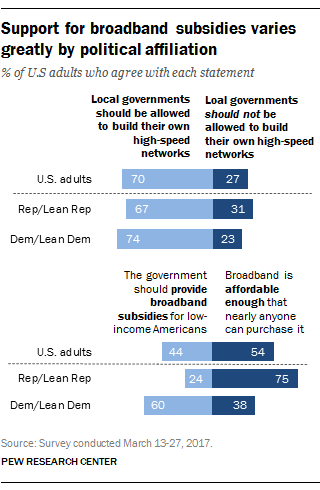
A new Pew Research Center survey reveals that 70 percent of adults, regardless of political leanings, believe local governments should be able to invest in municipal Internet networks.

Local Authority Has No Party

The survey, conducted March 13 - 27 supports the finding that local authority for telecommunications decisions is a bipartisan notion. On closer examination of the survey results, we see that 67 percent of Republicans and Republican leaning respondents and 74 percent of Democrats and Democratic leaning respondents support local authority to invest in municipal networks.

In Colorado, two more local communities voted this month to opt out of the state’s restrictive SB 152. The law prevents local communities from investing in Internet infrastructure to offer telecommunications services or work with a partner to improve local connectivity. Colorado Springs and Central City became cities 97 and 98 to join the growing list of communities opting out, which includes places that have taken action to deploy and others who merely want the option. 

pew-survey-image.png Colorado Springs, known as one of the state’s more conservative communities, passed the measure with 61 percent of the vote, not far from the results of the Pew Research survey.

Of Growing Importance

The survey also asked U.S. adults about how important high-quality Internet access is at home. Forty-nine percent said home broadband is essential and 41 percent described it as important but not essential. That leaves just one out of ten survey respondents who describe home broadband as either not too important or not important at all.

Respondents also answered questions about assistance to low-income households to help them pay for Internet access. Unlike support for municipal networks, political affiliation, income level, and current access to the Internet appeared to play a part in respondent replies.

Feasibility Study? How to Start a Community Network - Community Broadband Bits Podcast 246

After discussing this issue time and time again, with community after community, we finally recorded our thoughts on how communities should get started when considering a community network. Eric Lampland, the guy behind Lookout Point Communications, is our guest on Community Broadband Bits podcast episode 246. 

We talk about common mistakes and the importance of developing a comprehensive vision when evaluating an investment or partnership to improve Internet access. 

We also talk a little about the importance of some technical knowledge and having at least one person championing the effort. This is not something a consultant can do for you - someone in the community has to take ownership and responsibility. 

These are very important considerations for any community considering what it should be doing in the modern era.

Eric has also been a guest on Episode 128 "Open Access and Incumbent Challenges" and Episode 84 "Justifying a Network with Indirect Cost Savings."

This show is 33 minutes long and can be played on this page or via Apple Podcasts or the tool of your choice using this feed

Transcript below. 

We want your feedback and suggestions for the show-please e-mail us or leave a comment below.

Listen to other episodes here or view all episodes in our index. See other podcasts from the Institute for Local Self-Reliance here.

Thanks to Break the Bans for the music. The song is Escape and is licensed under a Creative Commons Attribution (3.0) license.

Public-Private Partnership Pursued in Pennsylvania

Pennsylvania’s state barriers won’t stop this community from improving Internet service for its municipal facilities, residents, and businesses. The City of Lancaster is collaborating with private provider MAW Communications to ensure the community has next-generation technology. Their public-private partnership, LanCity Connect, will offer affordable 1 gigabit (1,000 Megabits per second) service over a new Fiber-to-the-Home (FTTH) network.

Shared Risk, Public Financing

The Lancaster Online has closely followed the development of the partnership from a 2015 Wi-Fi project between the partners to the current citywide fiber plan. Here's a quick summary of the basic framework of the partnership: 

MAW Communications originally built a $1.7 million fiber backbone starting in 2015 with financing from the city's water fund bond. The city had refinanced its water utility debt, saving some $7.8 million and they worked out an agreement with MAW where the private partner would deploy and own a backbone fiber network. Over the 20 year term of the deal, the city has the right to half the network for city services, including automatic meter reading (AMR) and a traffic control system, with the city being able to renew the deal for four additional terms. Officials have said this arrangement will not impact water rates.

MAW Communications will extend the network to premises, aided by a $1.5 million loan with a 7 percent interest rate from the city's general fund reserves. The provider will repay the loan over a 13 year period. As long as MAW Communications has an outstanding loan to the city, the provider cannot sell the network without the city's written approval. Though the loan will help MAW to begin building the network, the costs of connecting homes and businesses would still be prohibitive at $1,000 each if not for another element of the plan.