
fixed wireless

Content tagged with "fixed wireless"

Displaying 151 - 160 of 188

Highlands Looking For A Partner: RFI Responses Due June 9th

Highlands, North Carolina, deployed a Fiber-to-the-Home (FTTH) infrastructure and fixed wireless complement to serve the community. The small rural community has been operating the municipal network in the Appalachians since late 2015, but is now considering passing the mantle to a private partner. They recently released a Request for Information (RFI) and responses are due June 9th.

High In The Appalachians

Tourism is one of the town’s staple economies, as it’s known for its natural surroundings atop the Nantahala National Forest in the mountains. While less than 1,000 people live in the town all year, summer tourists swell the population to around 20,000. There are several country clubs nearby that cater to the affluent second-home owners in Highlands and there are at least 500 homes that are valued at $1 million or more.

The FTTH network does not serve the entire community. Local leaders want the network available to the entire community, in part to keep second home owners in Highlands for extended periods of time. With better connectivity, many could work from home. The community also operates a municipal electric utility that owns 2,600 utility poles and 110 miles of line, most of it aerial. Interestingly, the Highlands Electric Utility serves over 3,000 accounts, some in the suburban Atlanta areas.

Highlands issued the RFI to search out  provider that would be interested in expanding the FTTH network and acquiring more customers for the network as a whole. They still want to own the infrastructure, but hope to attract a provider willing to lease the existing network and add to it.

Read the rest of the RFI.

Responses are due Friday, June 30th.

Transcript: Community Broadband Bits Episode 254

This is the transcript for episode 254 of the Community Broadband Bits Podcast. Christopher Mitchell sits down with Joshua Breitbart, the Senior Advisor for Broadband to the Chief Technology Officer (CTO) of New York City. Listen to this episode here.

Joshua Breitbart: From New York City, I think that we are maybe the first city to begin to look at how we can take responsibility for the space of the Internet itself.

Lisa Gonzalez: This is episode 254 of the Community Broadband Bits podcast from the Institute for Local Self-Reliance. I'm Lisa Gonzalez. Finding ways for lower income individuals and families to obtain high quality Internet access is a problem in most urban areas. As Internet access becomes more central to our lives for everyday tasks, solving that problem becomes more immediate. In New York City the Queensbridge Connected project is aiming to solve that problem by working with a private sector partner and involving the community. This initiative will bring high-speed Wi-Fi to residents of Queensbridge Housing, which is part of the New York City Public Housing Authority. In this interview, Christopher talks with Joshua Breitbart who works for New York City. Joshua describes how the project has progressed, how they view the Queensbridge Connected project as a model of other parts of the city, and shares some of the lessons learned that have helped guide the project. Now here's Christopher and Joshua Breitbart talking about New York City's Queensbridge Connected initiative.

Christopher Mitchell: Welcome to another edition of the Community Broadband Bits podcast. I'm Chris Mitchell, still in my hotel room, talking with another person from the Broadband Community Summit down here in Dallas, 2017. Welcome to the show, Joshua Breitbart. Senior advisor for Broadband to the CTO of New York City.

Joshua Breitbart: Hello, Chris. Good to be here.

Eastern Shore of Virginia Broadband Authority Expands Wireless And FTTH Coverage

Eastern Shore of Virginia Broadband Authority (ESVBA) has expanded its fixed wireless coverage area to include the community of Bloxom. The organization has also approved plans to expand its Fiber-to-the-Home (FTTH) deployment beyond the test project town of Harborton.

Towering Above The Shore

ESVBA opened its Bloxom Tower last fall so residents and businesses in the rural community of about 380 people. The tower enables better connectivity in the underserved town and provides better cellular coverage. ESVBA is also providing a free wireless hotspot near the tower.

In order to stimulate competition and provide choice to potential subscribers, ESVBA’s Broadband Initiative Program will provide free Internet access and transport for up to 12 months for wireless ISPs.

In a press release, Chris Kreisl, of the Bloxom Town Council said:

“We knew how important it was for us to have this kind of infrastructure. Without it, we were being left behind as the information economy continued to push citizens around the globe online. Now, Bloxom businesses have the opportunity to compete on equal footing.”


The ESVBA

We introduced readers to the not for profit ESVBA in February. The open access middle mile network began in 2008 with funding from Accomack and Northampton Counties. The organization has obtained about $8 million dollars for deployment and expansions, some from NASA and the National Oceanographic and Atmospheric Administration, which use the infrastructure. ESVBA returned Accomack and Northampton counties’ investments when the network became sustainable.

More Fiber

Transcript: Community Broadband Bits Episode 245

This is the transcript for episode 245 of the Community Broadband Bits Podcast. Brough Turner of Netblazr joins the show to explain point-to-point wireless service. Listen to this episode here.


Brough Turner: Here's the deal. It's $59.95 a month. No contracts. No teaser rates. No special deals. But we're not pulling any funnies on anybody and you can leave at any point.

Lisa Gonzalez: This is Episode 245 of the Community Broadband Bits Podcast from the Institute for Local Self-Reliance. I'm Lisa Gonzalez. NetBlazr is a Boston wireless Internet service provider that focuses on urban delivery of high-quality Internet access. This week, Brough Turner, founder and chief technology officer, connects with Christopher to talk about the ins and outs of providing the point-to-point wireless service in an urban area. Brough gets into the technology and the guys discuss what might be in the future of wireless. Brough also shares his company's experience as a startup, some of the challenges they faced, and how NetBlazr is keeping up with demand. Check out their website, NETBLAZR.com, to learn more about the company, the technology, and the team. Here's Christopher talking with chief technology officer and founder of NetBlazr, Brough Turner.

Christopher Mitchell: Welcome to another edition of the Community Broadband Bits Podcast. I'm Chris Mitchell. Today I'm speaking with Brough Turner, the founder and chief technology officer for NetBlazr. Welcome to the show.

Brough Turner: Thank you.

Christopher Mitchell: We'll get into this in a second, but NetBlazr's a wireless firm. We're going to talk a lot about wireless technologies. Maybe you can just tell us a little bit about what you know about wireless networks. I guess a different way of saying that would be, tell the audience why they should listen to you.

netBlazr Offering Blazing Fast Fixed Wireless - Community Broadband Bits Podcast 245

Like other urban centers in the U.S., Boston is filled with multi dwelling units (MDUs) and buildings that house multiple business tenants. Obtaining high-quality connectivity in such an environment can be a challenge, especially if choices are limited to just one or two incumbents with little or no competition. With the advancement of new fixed wireless technologies in recent years, however, residential and business subscribers now have better options.

This week, Christopher talks with Brough Turner, the founder and Chief Technology Officer at netBlazr. The company provides high-quality fixed wireless Internet access to residents and businesses across the city. Listeners who enjoy our occasional deep dives into the technical side of wireless connectivity, you’re in for a treat.

Brough and Christopher also discuss the company and the challenges they face working in a market traditionally reserved for the big incumbents. The guys spend time discussing the future of wireless and what Brough, who has extensive experience in this field, expects to see both in the short and long term.

This show is 35 minutes long and can be played on this page or via Apple Podcasts or the tool of your choice using this feed

Transcript below. 

We want your feedback and suggestions for the show-please e-mail us or leave a comment below.

Listen to other episodes here or view all episodes in our index. See other podcasts from the Institute for Local Self-Reliance here.

Thanks to Break the Bans for the music. The song is Escape and is licensed under a Creative Commons Attribution (3.0) license.

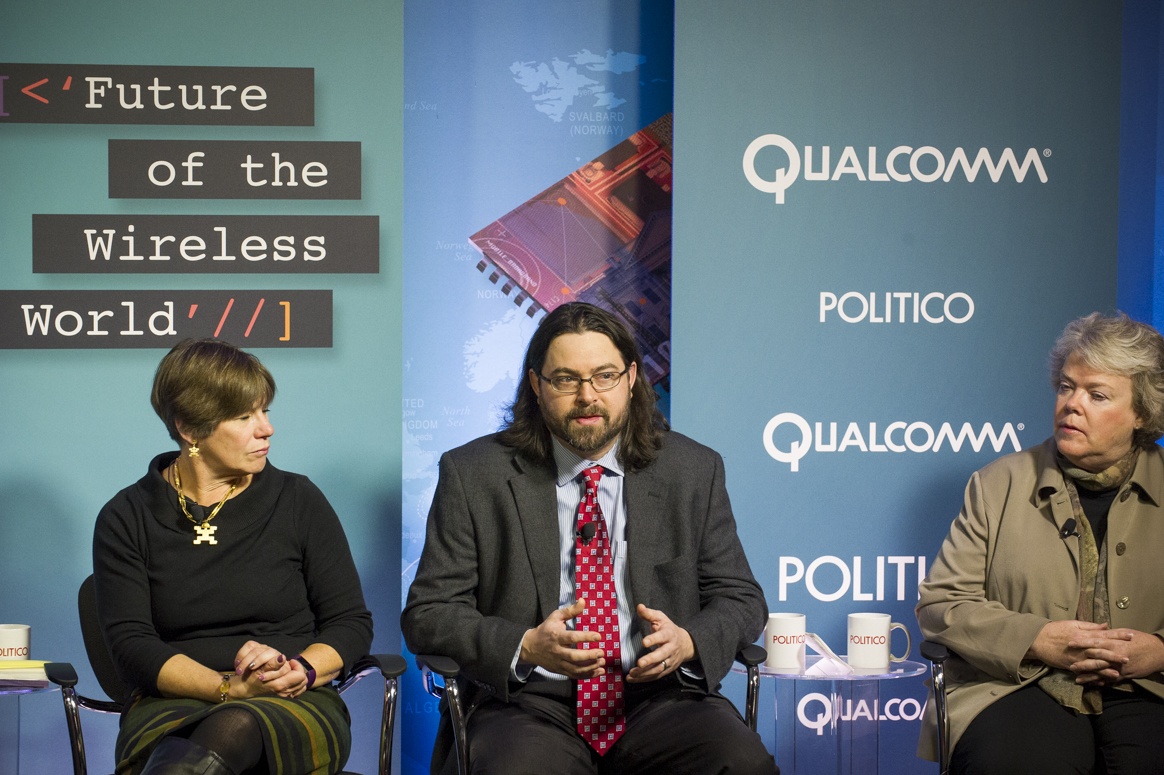
Christopher Speaks to Politico Live on "The Future of the Wireless World"

On March 7th, Christopher participated in a panel discussion sponsored by Politico and Qualcomm as part of an event called "The Future of the Wireless World." The panel was moderated by Politico Technology Reporter Alex Byers and included the following participants:

  • Steven Crowley, P.E., Consulting Wireless Engineer
  • Mindel De la Torre, former Chief of the International Bureau, Federal Communications Commission
  • Christopher Mitchell, Director of Community Broadband Networks Initiative, Institute for Local Self-Reliance
  • Joan Marsh, Senior Vice President of Federal Regulatory, AT&T

Watch the video at Politico's website.

Highlights from this conversation include Christopher's interaction with the AT&T representative about their claim that a "one touch make ready" policy was specific to Google Fiber. This interaction is at 36:20 in the conversation.

Sho-Me Your Fixed Wireless, Houston, MO!

Electric cooperatives are increasingly creating local solutions to rural connectivity woes. Many have built networks that rival those in the best connected cities in the U.S. Rather than waiting for disinterested national providers, cooperatives and their members have found workable solutions.

In south-central Missouri, the Sho-Me Power Electric Cooperative is once again exercising the power of community network projects. The Houston Herald reports that Sho-Me Technologies, the communications subsidiary of the co-op, is deploying a fiber-backed, fixed wireless project to connect businesses in Houston, Missouri.

Houston, We’ve Got A Problem

Houston (population: 2,000) is the capital of Texas County, Missouri -- yes, Missouri. Home to about 25,000 people, the rural county has poor connectivity; about 90 percent of the county’s population doesn't have access to high-speed Internet service of 25 Mbps download and 3 Mbps upload. The Houston Herald reports that speeds of up to 10 Mbps download are the norm in Texas County. Upload speeds are even slower.

The situation has been rough for small businesses in Houston, where they could not perform routine updates without impeding service. For instance, the local dentist office, Family Dentistry, could not accept Microsoft updates for its network without disrupting daily operations at the practice.

Downtown Houston Finds The Local Co-op Solution

Eastern Shore of Virginia Broadband Authority Improves Connectivity

In 2008, the counties of Accomack and Northampton created the Eastern Shore of Virginia Broadband Authority (ESVBA) to serve local needs and boost economic development. NASA provided key funding to build the backbone of the regional network. Today, the ESVBA has already improved wireless services in several communities and is at work on a Fiber-to-the-Home (FTTH) test project.

The space agency played a key role in bringing high-speed connectivity to rural communities on the Eastern Shore of Virginia. Wallops Flight Facility on Wallops Island, Virginia, employs 1,100 people, launches rockets, and features a visitor center. Government agencies, local schools, and healthcare institutions on the shore all needed reliable connectivity for their programs.

Internet Service Like Lightspeed

The FTTH test project started last September in Harborton, Virginia, as part of the Town Broadband Initiative Project. The landscape is typical of rural Virginia with little density as houses and businesses spread out into the woods. They have recently signed up the first few customers; this small town on the eastern shore has about 100 homes.

Community Effort: Local Seed Funding

In 2008, the counties of Accomack and Northampton created the public, not for profit entity through the Virginia Wireless Service Authorities Act to solve a growing problem on the shore. The lack of connectivity was having a negative impact on local rural communities. The counties provided an initial sum of about $270,00 to ESVBA to plan the network. 

logo-ESVBA.png

United Fiber Tackles Missouri's Most Rural - Community Broadband Bits Podcast 240

The most rural area of Missouri is getting a Fiber-to-the-Home network from the United Electric Cooperative, which has created United Fiber and is expanding across its footprint and to adjacent areas that want better Internet access. Chief Development Officer Darren Farnan joins us to explain why his co-op has taken these steps.

We discuss how they are rolling it out - focusing on areas that need the service while respecting the telephone cooperatives that are within their electric footprint. The project has benefited from a broadband stimulus award and also incorporates fixed wireless technology in some areas.

We discuss some of the economics behind the project and are sure to clarify that though the utility has needed some capital subisides to build the network, it does not need any operating subsidies to continue - it runs under its own revenue. And we talk about the demand for better, faster connections - it is much higher than most realize.

This show is 30 minutes long and can be played on this page or via Apple Podcasts or the tool of your choice using this feed

Transcript below. 

We want your feedback and suggestions for the show-please e-mail us or leave a comment below.

Listen to other episodes here or view all episodes in our index. See other podcasts from the Institute for Local Self-Reliance here.

Thanks to Admiral Bob for the music. The song is Turbo Tornado (c) copyright 2016 Licensed under a Creative Commons Attribution (3.0) license. Ft: Blue Wave Theory.

Librarians Leading The Way: Apply For "Beyond the Walls" Grant

San Jose State University’s School of Information (iSchool) and the Gigabit Libraries Network are accepting proposals for projects under a National Leadership Grant from the Institute of Museum and Library Services (IMLS) to expand the Libraries WhiteSpace Project. According to the announcement, five projects will be funded.

The “Beyond the Walls” Awards will provide $15,000 grants “to libraries for the most innovative proposals to use TV WhiteSpace (TVWS) technologies to enable new library hotspots in the service of their communities.”

Co-director Kristen Reman of SJSU said:

"This initiative will further explore the role of libraries as leading community anchors promoting access and inclusion through strategic technology integration. There's a nice intersection between what we're implementing and the concept of community anchors, which has been used by IMLS to describe the role of libraries in providing civic engagement, cultural opportunities, and economic vitality to communities,"

The first round of applications will be accepted until March 6th winners will be announced near the end of April. Libraries interested in applying for an award can watch a quick 2-minute video to help them determine if they meet qualification criteria. You can also contact info(at)giglibraries.net with questions; they will even help you put together a project plan.

Read the full announcement online.

Watch the video here:  

White Space Technology

"White spaces" or "TVWS" are the unlicensed low-frequency spectrum that was reserved for television signals prior to digitization of television. Now that the spectrum is not being used for TV, it's been freed up for fixed wireless Internet accesss.