
Fast, affordable Internet access for all.
FCC
Content tagged with "FCC"
The Five Fundamentals for Future Telecommunications - Community Broadband Bits Podcast #32
Harold Feld, Senior Vice President of Public Knowledge, is back on Community Broadband Bits to discuss five fundamental rules necessary to ensure we have a great telecommunications system that benefits everyone. Harold first appeared on our show in episode 23. Harold explains the Five Fundamentals here and includes a link to their full filing [pdf]. In short, the fundamentals are: Service to all Americans, Interconnection and Competition; Consumer Protection; Network Reliability; and Public Safety. The comments also include some thoughtful words about the balance between federal, state, and local governments in ensuring these five fundamentals. Read the transcript from our conversation here. We want your feedback and suggestions for the show - please e-mail us or leave a comment below. Also, feel free to suggest other guests, topics, or questions you want us to address. This show is 25 minutes long and can be played below on this page or subscribe via iTunes or via the tool of your choice using this feed. Search for us in iTunes and leave a positive comment! Listen to previous episodes here. You can can download this Mp3 file directly from here. Find more episodes in our podcast index. Thanks to mojo monkeys for the music, licensed using Creative Commons.
Discussing the FCC's Gigabit Challenge
Taking Advantage of Chairman Genachowski's Gigabit Challenge
Goliath Regulator Asks For More Davids
Walking the floor of the Consumer Electronics Show last week, I kept thinking of that line from Jaws, “You’re going to need a bigger boat.” All the Internet-connected, data-hungry gadgets that are coming to market sent a strikingly clear message: we’re going to need faster broadband networks. ... It’s essential to economic growth, job creation and U.S. competitiveness.Yes! If only the head of the Federal Communications Commission understood what is preventing us from building those networks. Hint: It isn't a lack of demand. Google was inundated with applications for its gigabit service. Hundreds of communities have built their own networks (some of which he praises). Local businesses get it. Mayors get it. City councils get it. And unlike Chairman Genachowski, they know what the problem is: little incentive for massive, established cable monopolies to invest in networks when they are harvesting record profits and subscribers have no other choices. Wall Street not only gets it, it actually rejoices in it!
Comcast's traditional Cable Communications continues to grow and generate copious cash flow.. We're big fans of the firm's Video and High-Speed Internet businesses because both are either monopolies or duopolies in their respective markets.What is our FCC Chair doing about this problem? He helped Comcast to grow even bigger, with more market power to crush those rivals that he is calling on to build gigabit test beds. Chairman G wants to spur hundreds of David's while refusing to curb Goliath's power. Bad news, Mr. Chairman, Goliath actually wins most of the time. Rather than doing his job, Genachowski is begging others to do it for him.
Susan Crawford, Captive Audience, and How to Kill the Cable Monopoly
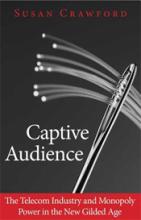
Susan Crawford, author of the just-released Captive Audience: The Telecom Industry and Monopoly Power in the New Gilded Age, is our guest for the 29th episode of the Community Broadband Bits Podcast. A former adviser to President Obama, she has been a leading figure in the struggle to preserve an open Internet. Susan has long been an advocate of communities deciding for themselves if a community owned network is a wise investment and recognizes the benefits of smart government policies to prevent big companies like Comcast from dominating the telecommunications arena. We talk about her book and reactions to it -- big cable and telephone companies are attacking her under false pretenses by either putting words in her mouth or misrepresenting her main points. But we also discuss the steps concerned people can take to bring force some accountability on the big monopolies. We have previously noted Susan's words and presentations here and we noted some Captive Audience reviews here. Read the transcript from this episode here. We want your feedback and suggestions for the show - please e-mail us or leave a comment below. Also, feel free to suggest other guests, topics, or questions you want us to address. This show is 17 minutes long and can be played below on this page or subscribe via iTunes or via the tool of your choice using this feed. Search for us in iTunes and leave a positive comment! Listen to previous episodes here. You can download the Mp3 file of this episode directly from here. Find more episodes in our podcast index. Thanks to mojo monkeys for the music, licensed using Creative Commons.
Susan Crawford's Captive Audience Book Reviewed
State and local laws that make it difficult — if not impossible — for new competition to emerge in broadband markets should be reformed, according to Crawford. For example, many states make it very difficult for municipalities to create public wireless networks, thanks to decades of state-level lobbying by the industry giants. In order to help local governments upgrade their communications grids, Crawford is calling for an infrastructure bank to help cities obtain affordable financing to help build high-speed fiber networks for their citizens. Finally, U.S. regulators should apply real oversight to the broadband industry to ensure that these market behemoths abide by open Internet principles and don’t price gouge consumers.Art Brodsky also reviewed the book on the Huffington Post. He leads with a reminder of the damage done by the NFL's replacement refs, an apt comparison given how poorly the FCC and Congress have protected the public. Susan will be our guest for the Community Broadband Bits Podcast (episode 29) on Tuesday, Jan 15, and I will be offering periodic thoughts on passages from the book in coming days/weeks.
Susan Crawford Discusses Captive Audience at Berkman Center
AT&T, Others Overcharge Subscribers Based on Secret Bandwidth Meters
Imagine going to a gas station, putting 10 gallons into your car's 12 gallon tank, and driving off only to find your needle only approaches half a tank? This scenario is quite rare because government inspects gas stations to ensure they are not lying about how much gasoline they dispense.
But when it comes to the Internet, we have found measurements of how much data one uses is unregulated, providing no check on massive companies like AT&T and Time Warner Cable. And we are seeing the results -- AT&T is not open about what its limits are or how to tell when one has exceeded them.
Stop The Cap has noted that AT&T has advertised unlimited bandwidth for its DSL/ U-verse product while chiding and charging customers who exceeded certain amounts of monthly usage. Customers were quietly warned and charged $10 for each additional 50 GB over 150 GB for DSL subscribers or 250 GB for U-verse customers. Clearly, "unlimited" has several definitions, depending on whether one is a customer or an ISP.
Complaints have also come in from SuddenLink customers and others. The ISP charged usage based customers for bandwidth usage when they didn't even have power. Simlarly, AT&T customers began to complain about inaccurate meters from the beginning of the program. This from a 2011 DSL Reports story - one of many comments from AT&T customers:
AT&T's data appears to be wholely corrupted. Some days, AT&T will under-report my data usage by as much as 91%. (They said I used 92 meg, my firewall says I used 1.1 Gigs.) Some days, AT&T will over-report my data usage by as much as 4700%. (They said I used 3.8 Gig, dd-wrt says I used 80 meg. And no, this day wasn't anywhere near the day they under-reported.)
AT&T's Many Broken Merger Promises
AT&T and others regularly woo their regulators and policymakers with promises to built increase investments or expand networks in return for deregulation or merger approval. A recent Gerry Smith Huffington Post article examines a familiar pattern of broken promises made by telcos, what has developed into a chronic wham-bam-thank-you-ma'am attitude by these massive corporations.
We actually have a name for this, Kushnick's Law: "A regulated company will always renege on promises to provide public benefits tomorrow in exchange for regulatory and financial benefits today."
Smith revisits promises made back in 2006 when AT&T merged with BellSouth. AT&T promised to roll out broadband to every customer in its territory by 2007. Tell that to Cedric Wiggins from rural Mississippi. From the article:
But five years after that deadline, Wiggins, 26, is still waiting. Inside his trailer, his only affordable Internet option is a sluggish dial-up modem that takes five minutes to load the online job listing sites he has visited since being laid-off as a truck driver in May. Every few months, he calls AT&T to ask when he will receive a faster connection. The answer never changes.
“They said they don’t offer it in my area right now,” he said. “There’s nothing I can do.”
Smith found that promises made to gain merger approval are traditionally broken and/or so weakly constructed that the players can comply with little or no effort. Empty promises continue to be accepted by the feds and conveniently forgotten, except people like Wiggins.
No one knows the pattern better than those on the inside:
“We have a problem at the commission, historically, with following-up on merger conditions,” said Michael Copps, who served on the FCC from 2001 to 2011, and who voted to approve the AT&T-BellSouth merger. “A lot of these conditions that get attached are not that great, and they are not always really enforced.”