
Digital Equity Act

Content tagged with "Digital Equity Act"

Related Topics
Displaying 21 - 30 of 41

Digital Inclusion Leaders Brace for Impact

Digital inclusion organizations are reeling after the Trump administration announced the Digital Equity Act grant programs, embedded in the bipartisan infrastructure law, was being cancelled months after federal grants had already been reviewed and awarded.

On Friday evening, President Trump announced via a Truth Social post that he was cancelling the Digital Equity Act, claiming it to be “unconstitutional” and “racist,” and, therefore, “ending this immediately.” Yesterday, state broadband offices began receiving letters from NTIA, the federal agency administering the program, to formally announce funding was being terminated.

As news began to trickle out, many of those working on these issues across the nation had more questions than answers as they scrambled to process a mix of confusion and frustration, especially mindful of the fact that the Digital Equity Act barely touches on the subject of race. Although Black, Brown, and Indigenous communities have been disproportionately left on the wrong side of the digital divide, only one of the of eight “covered populations” identified by Congress in the law even mentions race.

President Trump Targets Digital Equity Act —What It Means for Communities and the Future of Connectivity - Episode 646 of the Community Broadband Bits Podcast

In this urgent episode of the podcast, Chris is joined by Angela Siefer and Amy Huffman of the National Digital Inclusion Alliance (NDIA) to unpack a stunning announcement: President Trump has declared the Digital Equity Act “unconstitutional” and vowed to cancel it.

Angela and Amy explain what the Digital Equity Act really does, who it serves, and why this sudden political attack puts millions of Americans—and the country’s digital future—at risk.

They offer insights into what’s still unclear, how local organizations are reacting, and what’s at stake if this critical program is dismantled.

NDIA's response to President Trump's statement can be found here.

This show is 33 minutes long and can be played on this page or via Apple Podcasts or the tool of your choice using this feed.

Transcript below.

We want your feedback and suggestions for the show-please e-mail us or leave a comment below.

Listen to other episodes or view all episodes in our index. See other podcasts from the Institute for Local Self-Reliance.

Thanks to Arne Huseby for the music. The song is Warm Duck Shuffle and is licensed under a Creative Commons Attribution (3.0) license

Charter and Cox Merge, Hotspots Under Threat, and the End of the Digital Equity Act | Episode 114 of the Connect This! Show

Connect This! Show

Catch the latest episode of the Connect This! Show, with co-hosts Christopher Mitchell (ILSR) and Travis Carter (USI Fiber) joined by regular guests Kim McKinley (TAK Broadband) and Doug Dawson (CCG Consulting) and special guest Angela Siefer (National Digital Inclusion Alliance) to talk about all the recent broadband news that's fit to print. Topics include:

Join us live on May 16th at 2pm ET, or listen afterwards wherever you get your podcasts.

Email us at [email protected] with feedback and ideas for the show.

Subscribe to the show using this feed or find it on the Connect This! page, and watch on LinkedIn, on YouTube Live, on Facebook live, or below.

Chittenden County CUD Will Soon Emerge From The 'Dark Ages' with Fiber Expansion

Vermont’s Communications Union Districts (CUDs), which were the subject of a recently released ILSR report, continue to make steady inroads in delivering high-quality broadband access to long-neglected rural Vermont residents.

In 2021 the Vermont legislature passed Act 71, ensuring CUDs would play a key role in expanding fiber access in the Green Mountain state. In Vermont, municipally-led CUDs – municipal entities created by two or more towns with a goal of building communication infrastructure – can legally fund needed broadband expansions through debt, grants, and donations – but not taxes, though they themselves are tax-exempt nonprofits.

The CUD model allows municipalities to bond together to tackle broadband network deployments that might otherwise prove too costly or logistically difficult if attempted alone.

The results have been transformative for state residents long underserved or completely unserved by the state’s regional incumbent monopoly providers. Locals at times have likened the transformation to moving out of the “dark ages.”

Much of Vermont’s $150 million ARPA-based broadband package went toward assisting CUDs in a state where 85 percent of municipalities and 90 percent of all underserved locations fall under an existing CUD’s jurisdiction.

Broadband Bottlenecks and Bureaucracy: What’s Holding the Internet Back? - Episode 642 of the Community Broadband Bits Podcast

In this episode of the podcast, Chris is joined again by telecom policy expert Sascha Meinrath for a wide-ranging discussion on why billions in broadband funding still haven’t reached communities. 

They unpack the dysfunction behind the BEAD program rollout, federal stalling on digital equity grants, and the maddening reality of broken broadband maps. 

The conversation tackles political gridlock, regulatory capture, and the very real consequences for underserved communities still waiting for high-speed Internet.

You can find the article that Chris and Sascha reference during their conversation about Ezra Klein here.

This show is 41 minutes long and can be played on this page or via Apple Podcasts or the tool of your choice using this feed.

Transcript below.

We want your feedback and suggestions for the show-please e-mail us or leave a comment below.

Listen to other episodes or view all episodes in our index. See other podcasts from the Institute for Local Self-Reliance.

Thanks to Arne Huseby for the music. The song is Warm Duck Shuffle and is licensed under a Creative Commons Attribution (3.0) license

‘The Human Infrastructure of Broadband’ Will Take Center Screen at Upcoming B4DE

As digital inclusion advocates look to get their bearings amid an all-out assault on federal broadband funding programs, the next Building For Digital Equity livestream offers a port in the storm.

Slated for March 13 from 3 to 4:15 pm ET – and once again co-hosted by ILSR’s Community Broadband Networks Initiative and the National Digital Inclusion Alliance (NDIA) – the keynote speaker for the UTOPIA Fiber sponsored event will be Revati Prasad, Vice President of Programs with the Benton Institute for Broadband & Society.

Charting the Course: Adapting to Policy Shifts While Keeping Our Eyes on the Prize” promises to bring hundreds of digital inclusion practitioners together to regroup and recalibrate while hearing from those working in the trenches to adequately address broadband access challenges across the nation.

Registration for the increasingly popular live stream is now open here.

Prasad will focus on Benton’s recently published report: “The Human Infrastructure of Broadband: Looking Back, Looking Around, and Looking Ahead.”

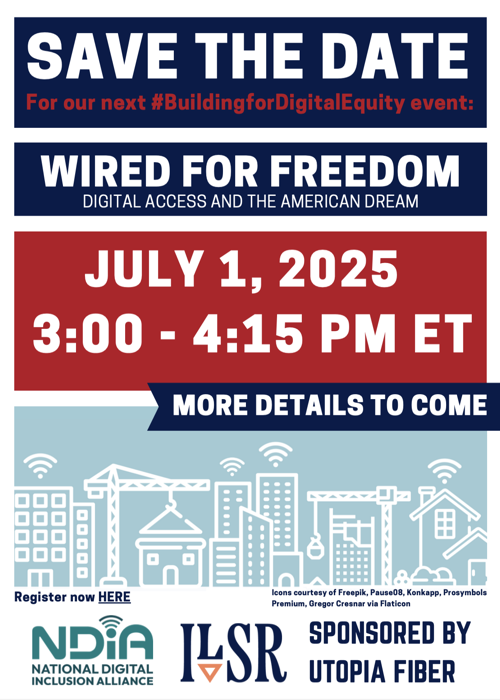
Save the Date: Next B4DE Marks Pivotal Time In ‘Charting the Course’ Forward

With uncertainty swirling around the future of BEAD and Digital Equity Act programs in the wake of an Executive Order by the Trump administration freezing federal funding and loan programs, the next Building for Digital Equity (#B4DE) live stream is shaping up to be perhaps the most monumental one to date.

Charting the Course: Adapting to Policy Shifts While Keeping Our Eyes on the Prize” promises to bring hundreds of digital inclusion practitioners together for the increasingly popular virtual gathering that aims to offer insights and ground-truth on how communities continue to their work in closing the digital divide at a time when the programs established to do so have been tossed into disarray.

Registration is now open here.

Image
Vintage photo compass, hourglass and map on wooden desk

Slated for March 13 from 3 to 4:15 pm ET, the upcoming live stream will once again be co-hosted by ILSR’s Community Broadband Networks Initiative and the National Digital Inclusion Alliance (NDIA) and sponsored by UTOPIA Fiber.

B4DE Offers Insights For Navigating Broadband Political Divide In Nation's Capital

Digital inclusion advocates are bracing themselves for an uncertain year ahead.

As the incoming GOP regime takes aim at key aspects of the Digital Equity Act (DEA) and the BEAD (Broadband, Equity, Access, And Deployment) program, those working to bridge the digital divide have more questions than answers just as states are preparing to dole out federal grant money yet to be awarded to grant recipients.

One major question looming over both BEAD and the Digital Equity Act is whether a new Congress can leverage the Congressional Review Act – a tool Congress can use to overturn certain federal agency actions – to undermine the 2021 bipartisan infrastructure law behind the national “Internet For All” initiative.

Image
Building for Digital Equity

“The Congressional Review Act only applies to things that were adopted in the last six months. I know that there were a number of things the FCC did to make sure that they were done and would be non-reviewable under the CRA and I suspect NTIA did that as well (with BEAD),” former FCC Chief of Staff and now New Street Research policy advisor Blair Levin said during our final Building For Digital Equity (B4DE) livestream of 2024.

Next B4DE Event: Reflect, Recharge, and Reach Forward

In the wake of the election, and with potential major changes ahead for the national "Internet For All" effort, many in the broadband world are wondering: where do we go from here?

That's what the next Building For Digital Equity (#B4DE) livestream event seeks to answer, inviting you to wear your ugly sweater, join the free virtual gathering, and dive into what a post-Biden administration broadband world may look like.

Slated for December 16, 2024 from 3 to 4:15 PM ET, the "Reflect, Recharge, Reach Forward" themed livestream promises to offer penetrating insights and practical ideas on the way forward.

Registration is now open here.

Image
B4DE December 2024 flyer

Co-hosted by Institute for Local Self Reliance (ILSR) Community Broadband Networks Initiative and the National Digital Inclusion Alliance (NDIA), the popular (and free) online event will feature two prominent figures in this space: NDIA Executive Director Angela Siefer and New Street Research Policy Advisor Blair Levin.

Pierrette Dagg on Research, Engagement, and Digital Inclusion - Building for Digital Equity Podcast Episode 17

Building for Digital Equity logo

Our Building for Digital Equity podcast series is back.

The first episode of 2024 features an insightful conversation with Pierrette Renée Dagg, Director of Research for the MERIT Network in Ann Arbor, Michigan.

Pierrette discusses the importance of using research to inform community engagement and digital equity strategies, as well as the use of community-facing research methods like surveys and qualitative/quantitative analysis. She also highlights the importance of considering broader systemic issues that should be taken into account when forming digital equity strategies.

This show is 10 minutes long and can be played on this page or using the podcast app of your choice with this feed.

Transcript below. 

We want your feedback and suggestions for the show-please e-mail us or leave a comment below.

Listen to other episodes here or see other podcasts from the Institute for Local Self-Reliance here.

Thanks to Joseph McDade for the music. The song is On the Verge and is used per his Free-Use terms.