
competition

Content tagged with "competition"

Related Topics
Displaying 341 - 350 of 709

Transcript: Community Broadband Bits Episode 279

This is episode 279 of the Community Broadband Bits Podcast. Russ Brethrower, a project specialist at Grant County Public Utility District, discusses how Grant County, Washington, pioneered open access infrastructure in the United States. Listen to this episode here.

Russ Brethrower: Our commission, management, everybody's made it really clear. Our capital is an investment in the future of the county up and down the food chain. It's -- it's a given that it's an investment and the capital is not expected to be returned.

Lisa Gonzalez: You're listening to episode 279 of the Community Broadband Bits podcast from the Institute for local self-reliance. I'm Lisa Gonzalez. Christopher recently attended the broadband community's economic development conference. He attends every fall and if he's lucky he's able to record interviews with people from some of the communities we're curious about. He also makes the trip to each Broadband Community Summit the spring time event. While he was at the November event in Atlanta, he connected with several people including this week's guest Russ Brethrower from the Grant County Public Utility District in Washington Grant County PUD has one of the most established and geographically largest open access community networks in the US. The rural communities population is sparse and widely distributed but community leaders had an eye toward the future when they decided to invest in fiber infrastructure. In this interview, Russ shares the story of their network and describe some of their challenges. Here's Christopher with Russ Brethrower from the Grant County Public Utility District in Washington.

Another Perspective on Policy From American Action Forum - Community Broadband Bits Podcast 281

Christopher went to Atlanta for the Broadband Communities Economic Development Conference in early November, and while he was there, he touched base with this week’s guest Will Rinehart. Will is the Director of Technology and Innovation Policy at the American Action Forum, a DC nonprofit organization that’s been around since 2009.

Will and Christopher don’t always see eye to eye on issues that affect telecommunications and broadband policy, but both agree that it’s important to have spirited debate to share perspectives. Only by examining issues from different sides can we craft policy that creates lasting benefits.

In this interview, Will describes his organization and his work there. Chris and Will look at compelling issues such as ISP competition, government regulations, and how the FCC’s 2015 upgraded definition of broadband has reverberated in the market. The two get into franchising and ubiquitous broadband, local authority, and connectivity in rural America. It’s a spirited discussion chock-full of issues.

You can tweet to Will, he’s @WillRinehart on Twitter.

This show is 30 minutes long and can be played on this page or via Apple Podcasts or the tool of your choice using this feed

Transcript below. 

We want your feedback and suggestions for the show-please e-mail us or leave a comment below.

Listen to other episodes here or view all episodes in our index. See other podcasts from the Institute for Local Self-Reliance here.

Thanks to Arne Huseby for the music. The song is Warm Duck Shuffle and is licensed under a Creative Commons Attribution (3.0) license.


Lessons From the Nation's Oldest Open Access Fiber Network - Community Broadband Bits Podcast 279

Grant County's Public Utility District was, along with some nearby PUDs, among the very first deployers of Fiber-to-the-Home networks shortly after the turn of the millennium. And per Washington's law, they built an open access network that today has more than twenty service providers.

Grant County PUD Project Specialist Russ Brethrower joins us for Community Broadband Bits podcast 279, a live interview from the Broadband Communities Economic Development Conference in Atlanta

We discuss the history of the network and other observations from Russ, who has more direct experience in these networks than the vast majority of us that regularly speculate on them. We also talk about the experiences of open access over 16 years and how they financed the network. 

Read the transcript for this show here.

This show is 23 minutes long and can be played on this page or via Apple Podcasts or the tool of your choice using this feed

Transcript below. 

We want your feedback and suggestions for the show-please e-mail us or leave a comment below.

Listen to other episodes here or view all episodes in our index. See other podcasts from the Institute for Local Self-Reliance here.

Thanks to Arne Huseby for the music. The song is Warm Duck Shuffle and is licensed under a Creative Commons Attribution (3.0) license.

Image of Deep Lake in Grant County © Steven Pavlov / http://commons.wikimedia.org/wiki/User:Senapa, via Wikimedia Commons.

Couldn't Make It To Ammon? Event Videos Now Available

You may not have been able to get to Ammon, Idaho, to attend the official lighting ceremony of the community’s open access fiber network. Perhaps you weren’t able to watch the stream to the event either; life is demanding and sometimes we just can’t fit everything into our day. But you can still watch the event at your own pace because we’ve broken down the presentations and panels for you.


Deb Socia (NCC) & Jeff Christensen (EntryPoint) Introduce Ammon Mayor Dana Kirkham :

https://youtu.be/YvBTjaoPRuc?t=35m30s


Mayor Dana Kirkham :

https://youtu.be/YvBTjaoPRuc?t=43m46s


State Senator Brent Hill :

https://youtu.be/YvBTjaoPRuc?t=47m38s


Keynote: How Does the City of Tomorrow Get ‘Smart’? 

Glenn Ricart, Founder and CEO, US Ignite :

https://youtu.be/YvBTjaoPRuc?t=53m5s


Panel - How do we make ‘smart cities’ a reality?

logo-next-century-cities.jpg

  • Glenn Ricart, Founder and CEO, US Ignite
  • Shawn Irvine, Economic Development Director, Independence, Oregon
  • Aarushi Sarbhai, Graduate Research Assistant, University of Utah
  • Jeff Peterson, CTO, EntryPoint Networks
  • Moderated by Deb Socia, Executive Director, Next Century Cities

https://youtu.be/YvBTjaoPRuc?t=1h14m20s


Bobbi-Jo Meuleman, Chief Operations Officer, Idaho Department of Commerce :

https://youtu.be/YvBTjaoPRuc?t=2h27m29s


Policy Discussion: Does government have a role to play? 

Christopher Mitchell, Director, Community Broadband Networks :

https://youtu.be/YvBTjaoPRuc?t=2h29m58s

Ammon Report: "Enabling Competition and Innovation on a City Fiber Network"

Image

As Ammon, Idaho, celebrated the official launch of its publicly owned open access network on October 5th, 2017, the folks from Harvard University’s Digital Access to Scholarship at Harvard (DASH), shared Ammon’s story in their new report. Enabling Competition and Innovation on a City Fiber Network, by Paddy Leerssen and David Talbot provides the details of the community’s pioneering network that uses technology to increase competition for the benefit of citizens.

The report explains Ammon’s “Network Virtualization” strategy and how they accomplish it with software-defined networking (SDN) and networking function virtualization (NFV). The results reduce costs and allow users to take advantage of more specialized services, including allowing them to easily switch between Internet service providers. The environment encourages ISPs to take extra steps to please their subscribers.

Leerssen and Talbot also take the time to explain the network’s evolution from classic I-Net to groundbreaking Fiber-to-the-Home (FTTH). Information in the report includes detail about pricing, and how the city determines the cost for connectivity to property owners. Readers can also learn about the ways users are taking virtualization to the next level by creating their own private networks.

Readers can learn how the Ammon Model has changed prior conceptions of municipal networks because the community needed and wanted a new approach. While Idaho is not one of the states where legal barriers discourage municipal Internet networks, the authors address how some state laws have effectively crippled local attempts to improve connectivity.

Key Findings from the report:

Ammon’s network initially served government and business users. Construction of a residential network—paid for by a property assessment equal to $17 monthly for 20 years—began in September of 2016. As of August 2017 it had 145 residential customers, with more than 270 homes expected to be connected by November 2017 in the first connected neighborhood. 

Transcript: Community Broadband Bits Episode 271

This is the transcript for Episode 271 of the Community Broadband Bits Podcast. Research Associate Hannah Trostle takes over as host in order to quiz Christopher Mitchell on the latest developments in community networks. Listen to this episode here.


Christopher Mitchell: I can't believe we're freek'n talking about satellite again!

Lisa Gonzalez:This is Episode 271 of the community broadband bits podcast from the Institute for Local Self-Reliance. I'm Lisa Gonzalez. What do the FCC satellite internet access mobile broadband. Madison, Wisconsin, and utility poles in Louisville, Kentucky, have in common. They're all in the recent community broadband news and they're all in this week's podcast. In this episode, Research Associate Hannah Trostle boots Christopher from the host chair to interview him about some significant recent developments. For more details on these and other topics check out the appropriate tags at MuniNetworks.org. Now, here's Hannah and Christopher.

Hannah Trostle: Welcome to the Community Broadband Bits podcast. This is your host this week Hannah Trostle. Joining me is the normal host Christopher Mitchell.

Christopher Mitchell: I don't know how normal I am but thank you for having me on my show.

Hannah Trostle: Now we're going to kick you off, and I'm only going to do the podcast from now on.

Christopher Mitchell: I can't say I don't deserve it.

Hannah Trostle: Well you've been gone quite a bit. Where have you been?

Shape the Rules for Rural Broadband Subsidies Fact Sheet - Reply Comments: October 18th, 2017

Another addition to our Community Networks Initiative resources! This fact sheet details the most important aspects of the Connect America Fund (CAF) Auction. What is it? What should it do? Who does it affect? And how can you make a difference?

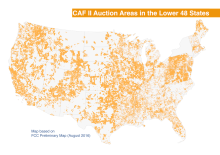
The Federal Communications Commission (FCC) manages the CAF program, which provides billions of dollars in subsidies to Internet service providers for areas where the cost of building networks is prohibitive. Some large providers decided not to accept some of the subsidies during Phase I - about $198 million annually for 10 years. Now, the FCC plans to host an auction so that providers can submit competing proposals on how best to serve these often rural, high-cost areas. (Check out the map of preliminary areas on the FCC website.)

Before the FCC can hold an auction though, the commission needs advice on how best to conduct it and what criteria they should consider. Jon Chambers, former head of the FCC's Office of Strategic Planning and Policy Analysis, outlined his concerns about the current proposed rules in his article, The Risk of Fraudulent Bidding in the FCC Connect America Fund Auction. Listen to his analysis on Episode 268 of the Community Broadband Bits Podcast.

The first round of public comments has passed, but reply comments are due October 18th, 2017. Read the fact sheet and then submit your own comments at FCC.Gov/ecfs/filings for "Proceedings" Docket 17-182 and Docket 10-90.

Fiber For All and More - Community Broadband Bits Podcast 271

After a friendly coup in the offices of the Institute for Local Self-Reliance, Hannah has taken the podcast host chair from Christopher for episode 271 of the Community Broadband Bits. Hannah grills Christopher on where he has recently traveled, interesting lessons, and recent news around community broadband. (Christopher mentions a great event in Pittsfield - video available here.)

The conversation starts with a discussion of why recent travels strengthened our belief that full fiber-optic networks are the best approach for the vast majority of America in the long term. Christopher and Hannah discuss the future of low-latency networks and what is more cost-effective over decades rather than just over the first few years.

They go on to discuss their fears of the FCC legitimizing satellite and mobile wireless connectivity as good enough for carrier of last resort in rural regions. The show wraps up with a discussion about One Touch Make Ready in Louisville and Madison's RFP for a fiber network partner. 

This show is 26 minutes long and can be played on this page or via Apple Podcasts or the tool of your choice using this feed

Transcript below. 

We want your feedback and suggestions for the show-please e-mail us or leave a comment below.

Listen to other episodes here or view all episodes in our index. See other podcasts from the Institute for Local Self-Reliance here.

Thanks to Arne Huseby for the music. The song is Warm Duck Shuffle and is licensed under a Creative Commons Attribution (3.0) license.

Transcript: Community Broadband Bits Episode 270

This is the transcript for episode 270 of the Community Broadband Bits podcast. Professor Barbara Cherry goes into detail on the history of common carriage and telecommunications law. Listen to this episode here.

Barbara Cherry: It's been a mess. And part of the problem is restoring a more accurate understanding of our history.

Lisa Gonzalez: This is Episode 270 of the Community Broadband Bits podcast from the Institute for Local Self-Reliance. I'm Lisa Gonzalez this week Christopher talks with attorney and legal scholar Barb Cherry about common carriage. We often talk about common carriage as it relates to telecommunications. And this week Christopher and Barb get into the policy. But most of us aren't aware of the legal history behind common carriage. Barb describes how its origins relate to the way it's applied today and how we need to consider the past as we move toward the future. Now here's Christopher and Barb Cherry.

Christopher Mitchell: Welcome to another edition of the Community Broadband Bits podcast. I'm Chris Mitchell from the Institute for Local Self-Reliance up in Minneapolis. Today I'm speaking with Barb Cherry a lawyer and a Ph.D. in communications who worked for the FCC for five years has 15 years in industry but is now a professor at the media school at Indiana University. Welcome to the show.

Barbara Cherry: Thank you, Chris.

Christopher Mitchell: Barb, one of the things I've warned you about. I'll tell the audience that you have an incredible amount of knowledge and you're very passionate. And so if this seems like it's getting a little bit too you know, friendly I might poke you a little bit to get some of that passion up on the surface.

Barbara Cherry: No problem.

Christopher Mitchell: Let's talk about common carriage which is something that I've never heard anyone explain as well as you have and and maybe you can just start with giving us a sense of the historical origins of common carriage in general.

Tennessee Co-op Expands In Kentucky

A Tennessee communications cooperative will soon bring fiber connectivity to Kentucky’s Warren County. North Central Telephone Cooperative (NCTC) will offer high-quality Internet access via gigabit (1,000 Megabits per second) connectivity via its North Central Communications, Inc., subsidiary.

Starting With New Construction

NCTC will start in a new subdivision and has already installed fiber prior to new home construction. The cooperative will also offer services in a nearby apartment complex. NCTC will make Internet access along with video service available to the new homes that are not yet built. They intend to expand to other multi-dwelling units and subdivisions in the area and hope to develop a larger regional footprint.

In order to accomplish their goal, NCTC is enlisting the help of other local entities:

“We’re talking to Warren Rural Electric Cooperative and Bowling Green Municipal Utilities, trying to implement your vision that everyone in Warren County is served by broadband eventually,” said [Nancy White, NCTC CEO]. “We all have the same vision to provide broadband to as many people as want it.”

Not A Stranger To Kentucky

Approximately 120,000 people live in Warren County with a little more than half making their homes in the county seat of Bowling Green. The population has increased steadily by double digits since 2000. It’s located in the south central area of the state and also home to Southcentral Kentucky Community and Technical College and Western Kentucky University.

On September 8th, the Warren County Fiscal Court approved a non-exclusive franchise agreement to allow NCTC to serve people in the county. NCTC is already serving subscribers in Allen County as part of the Kentucky Wired project. Warren County adjacent on the northwest border of Allen County. 

“They’ve been in Allen County for quite some time, and I have nothing but good things to say about them,” Allen County Judge-Executive Johnny Hobdy said. “They have continued to upgrade and bring service to parts of our county that hadn’t been served. I think Warren County will be satisfied with their service.”