
Longmont Chooses Local Self-Reliance

What a difference two years and a strong grassroots campaign makes. Two years ago, Comcast's ability to spend $245,000 on a campaign of lies was the determining factor over Longmont's decision about using publicly owned infrastructure to expand broadband competition.
Yesterday, despite Comcast spending even more by again funneling hundreds of thousands through the Colorado Cable Telecommunications Commission, voters overwhelmingly supported question 2A - reinstating local government authority to offer telecommunications services using its infrastructure.
Full congratulations must go to the Longmont citizens who organized a truly grassroots campaign that sent people out on the streets with signs, organized informational events, disseminated press releases, maintained an information web page (and Facebook page), wrote letters to the editor, commented on online news stories, and otherwise educated their peers about the opportunity 2A offered. Craig Settles is also celebrating with a post describing the victory.
Once again, the question was:
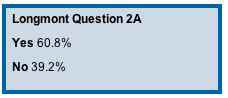 The results were 60.8% Yes, 39.2% No. 13,238 voted yes whereas 8,529 voted against.
Without increasing taxes, shall the citizens of the City of Longmont, Colorado, re-establish their City's right to provide all services restricted since 2005 by Title 29, article 27 of the Colorado Revised Statutes, described as "advanced services," "telecommunications services" and "cable television services," including any new and improved high bandwidth services based on future technologies, utilizing community owned infrastructure including but not limited to the existing fiber optic network, either directly or indirectly with public or private sector partners, to potential subscribers that may include telecommunications service providers, residential or commercial users within the City and the service area of the City's electric utility enterprise?
The results were 60.8% Yes, 39.2% No. 13,238 voted yes whereas 8,529 voted against.
 So who exactly is "Look Before We Leap?" They cannot point to any real local support in the community.
 This is a group with absolutely zero credibility. But they have tons of funding -- likely from Comcast and incumbent trade groups that fight these initiatives everywhere to preserve what is essentially a monopoly for the cable and telephone companies. We just republished an
 #6 is a great explanation of why communities should directly invest in broadband. Local economic growth and secondary investment enabled by broadband expansion is 10 times the initial investment.
Think about that. While private companies have long built, owned, and operated most of the broadband networks, they have seriously underinvested. They underinvest because they cannot monetize many of the benefits from broadband. Faster, more reliable connections simply do not translate into more revenue for cable and telephone companies. So the big incumbents have largely ceased investing in next-generation networks.
These massive corporations do not care about the growth of secondary investments or other spillover effects from better broadband in communities because it does not change their bottom line -- the one thing they are supposed to prioritize over all other matters.
This is why communities should be investing in themselves. Communities do care about secondary investments and spillover benefits from broadband. In fact, they are specifically tasked with investing to benefit the community!
So when it comes to maximizing the benefits of broadband, community investments tend to make a lot of sense... and other secondary benefits.
#6 is a great explanation of why communities should directly invest in broadband. Local economic growth and secondary investment enabled by broadband expansion is 10 times the initial investment.
Think about that. While private companies have long built, owned, and operated most of the broadband networks, they have seriously underinvested. They underinvest because they cannot monetize many of the benefits from broadband. Faster, more reliable connections simply do not translate into more revenue for cable and telephone companies. So the big incumbents have largely ceased investing in next-generation networks.
These massive corporations do not care about the growth of secondary investments or other spillover effects from better broadband in communities because it does not change their bottom line -- the one thing they are supposed to prioritize over all other matters.
This is why communities should be investing in themselves. Communities do care about secondary investments and spillover benefits from broadband. In fact, they are specifically tasked with investing to benefit the community!
So when it comes to maximizing the benefits of broadband, community investments tend to make a lot of sense... and other secondary benefits.