
rural

Content tagged with "rural"

Related Topics
Displaying 601 - 610 of 1070

$3.5 Million for Lake Connections in Minnesota

A northern Minnesota county has been approved for federal funding to bring high-quality Internet access to some of the community's most rural residents. Lake County (population: about 11,000) has been building Lake Connections, a county-owned community network, for the past few years. People living in the densely wooded region have always lacked adequate Internet service, but with this funding, they will have better connectivity than many city dwellers.

The Federal Communications Commission (FCC) recently authorized $3.5 million for Lake Connections through the Rural Broadband Experiment program. Lake Connections previously faced numerous delays, but this next stage of the project is ready to move forward.

Despite Best Efforts, Delays

Lake County has long been working towards a more connected future by building a Fiber-to-the-Home (FTTH) network. The massive project covers almost 3,000 square miles, connect almost 100 community anchor institutions, and will provide connectivity to over 1,000 businesses. Grants, loans, and matching local funds to complete the project add up to approximately $70 million.

The county obtained federal stimulus funding through the American Recovery and Reinvestment Act (ARRA) in 2010 (see our 2014 report, All Hands on Deck: Minnesota Local Government Models for Expanding Fiber Internet Access). Incumbent providers, Mediacom and Frontier, delayed the project by alleging rule violations and fighting for ownership of utility poles. By July 2014, however, the fiber network started serving its first 100 customers.

Transcript: Community Broadband Bits Episode 232

This is the transcript for episode 232 of the Community Broadband Bits podcast. In this episode, General Manager Josh Byrnes of Osage Municipal Utilities joins the show to share how fiber connectivity has benefited the Iowa community. Listen to this episode here.

Josh Byrnes: Everything is live about it, you can lock in your commodity prices, all your inputs and all those things can be done. We've got to have connectivity, in rural Iowa.

Lisa Gonzalez: Welcome to episode 232 of the Community Broadband Bits podcast from the Institute For Local Self-Reliance. I'm Lisa Gonzalez. In Osage, Iowa, the community's electric utility has served the town and some of the rural areas around it for about 125 years. Osage Municipal Utilities also offers natural gas services and invested in its own communication system in the early 2000s. They offer telephone, cable TV and Internet connectivity via their cable network. Clearly Osage is one of those rural communities that think about the future. In this interview Christopher speaks with Josh Byrnes, the general manager of Osage municipal utilities, who discusses their long term plans to bring Fiber-to-the-Home to the community. Josh who is also a former state representative spends some time discussing Iowa's approach to rural connectivity and its investment in the Iowa communications network. Now here's Chris talking with Josh Byrnes, general manager of the Osage municipal utilities and a former member of the Iowa House of Representatives.

Chris Mitchell: Welcome to another edition of the Community Broadband Bits podcast. I'm Chris Mitchell and today I'm speaking with Josh Byrnes, the general manager of Osage Municipal Utilities in Iowa. Welcome to the show.

Josh Byrnes: Thanks for having me Chris.

Chris Mitchell: I'm excited to talk to you, as I was saying in our pre-interview I actually have this memory and I'm excited to be reminded of the story that you'll be telling us in a few minutes about these cattle prices and an app, around how it's important to have Internet access out on farms near your community. Let's start with a little bit of background for people who aren't familiar with Osage. Where are you in Iowa? What's the community like?

Another Rural Electric Co-op Connects Missourians

For more than a century, electric cooperatives have ensured rural communities’ electricity needs are met. Now, many electric co-ops have made strides to ensure their communities have access to today’s newest necessity, Internet service.

In northeastern Missouri, Ralls County Electric Cooperative is bringing high-speed Internet service to the small city of New London. Nearby, the city of Perry hopes the electric cooperative will extend the project to its residents and they've let the co-op know that they will welcome the service with open arms.

Ralls County Electric Cooperative

Ralls County Electric Cooperative is working on a pilot project in New London that will bring incredibly fast and reliable Fiber-to-the-Home (FTTH) to the community's 1,000 residents. The project will offer triple-play services of Internet access, phone service, and high-definition TV.

The New London project won't be the first FTTH project for Ralls County Electric Cooperative. Between 2010 and 2015, the cooperative built a $19 million fiber network in the area. Funding came from the American Recovery and Reinvestment Act (ARRA) in the form of half as a loan and half as a grant. The electric cooperative formed a subsidiary, known as Ralls Technologies, for its telecommunications projects.

Perry Petitions

The Herald-Whig of Quincy, Illinois (about 45 minutes from the Missouri towns), recently reported that officials in Perry are encouraging Ralls County Electric Cooperative to come to their town. They have started a petition to show support for bringing the project to their community. 

Ralls County Electric Cooperative has not committed to extending the project to Perry, but the city’s Mayor Dustin Wasson has signed a letter of support on behalf of the City Council to the electric cooperative. Explaining the need, Mayor Wasson told the Herald-Whig:

Osage and the Iowa Legislature - Community Broadband Bits Podcast 232

Located in northwest Iowa, Osage has been an innovative utility leader with forward-looking investments in both telecommunications and clean energy with wind and solar. Osage Municipal Utilites General Manager Josh Byrnes joins us for Community Broadband Bits podcast 232. He is also in the midst of retiring after 3 terms in the Iowa Legislature. 

Osage built a hybrid fiber coaxial cable network many years ago that they are considering upgrading to being fully fiber-optic following a lot of community support for next-generation connectivity and most importantly, greater reliability. 

Josh and I also talk generally about the importance of connectivity in rural areas and how the state of Iowa has dealt with the need to improve access. We both agree that Iowa's approach thus far leaves much to be desired and we discuss the challenges that legislatures face in making these decisions. 

This show is 32 minutes long and can be played on this page or via Apple Podcasts or the tool of your choice using this feed

Transcript below. 

We want your feedback and suggestions for the show-please e-mail us or leave a comment below.

Listen to other episodes here or view all episodes in our index. See other podcasts from the Institute for Local Self-Reliance here.

Thanks to Admiral Bob for the music. The song is Turbo Tornado (c) copyright 2016 Licensed under a Creative Commons Attribution (3.0) license. Ft: Blue Wave Theory.

Osage, Iowa: Sun And Speed Projects Ahead

Iowans in the small town of Osage have been able to obtain cable Internet access from the community’s municipal utility since 2001. The community is about to take the next step; Osage Municipal Utility (OMU) is acquiring a fiber-optic backbone from a private provider. The purchase will get them started on what will eventually be a Fiber-to-the-Home (FTTH) upgrade.

Serving Osage For More Than 125 Years

Osage, the Mitchell County seat, is home to about 3,600 people and located in north central Iowa. The electric utility began as Osage Electric Light, Heat and Power Company in 1890. After several ownership changes, the municipality became the owner in 1941. In 1959, the utility began supplying natural gas and in 2001, the utility added a communications system. In addition to Internet access, OMU also began offering cable TV and telephone service.

OMU is also developing a Voluntary Community Solar Program in which customers can purchase units of Solar Array capacity and in return they receive a production-related credit on their monthly utility bill.

Another Local Tool

Josh Byrnes, general manager of OMU, described the backbone as “another tool in the economic toolbox.” He noted that the line will create opportunities for people outside of OMU’s service area that live along the backbone to potentially obtain service from private providers.

In addition to providing FTTH to customers in the future, Byrnes noted that OMU will also be bringing much needed redundancy in the area. Incumbent Omnitel Communications is the sole provider of fiber-optic services in Mitchell County. OMU will offer fiber in Mitchell, one of the towns in the county where Omnitel has no fiber presence.

“We are simply getting connectivity to Osage and build out from there. There are going to definitely be opportunities for savings to our rate payers long term. Even more important is the dependability of services moving forward. It’s hard to put a price on that.”

Fact Sheet on Rural Digital Divide in Minnesota

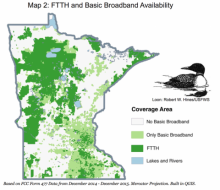
We have created a new fact sheet: Minnesota: Cooperatives and Local Governments Can Solve Rural Digital Divide. The fact sheet highlights rural areas with excellent connectivity and the role of cooperatives and municipalities.

Minnesota cooperatives and municipalities have done great work to bring fast, affordable, reliable Internet service to rural areas throughout the state. They've built many Fiber-to-the-Home (FTTH) networks, but there is still much work left to do.

One in 4 Minnesotans lives in a rural area, and of those rural households, 43 percent lack access to broadband, defined by the FCC as 25 Megabits per second (Mbps) download and 3 Mbps upload. Resilient, robust, fiber is the long-term goal, but fixed wireless can help extend coverage in hard-to-reach rural areas.

Download the fact sheet here.

Learn more about Minnesota’s connectivity in Community Broadband Bits Episode #190 with Dan Dorman, Executive Director of the Greater Minnesota Partnership. He discusses the "donut hole problem" and the economic development potential of rural Minnesota. 

Check out all of our Community Network Fact Sheets here. You can also subscribe to a once-per-week email with stories about community broadband networks.

Pikeville, KY, RFP For FTTP: Responses Due Jan. 4, 2017

Earlier this spring, Pikeville, Kentucky, released an RFI for partner interest to bring Fiber-to-the-Premises (FTTP) to businesses, community anchor institutions, municipal facilities, and residential properties. The Appalachian community is ready to move forward and recently released its Request for Proposals (RFP) for Partnership for FTTP Network Deployment. Responses are due January 4, 2017.

A Measured Approach

The community wants any potential partners to focus on a project to be executed in phases. This RFP is for Phase One, described as:

Phase One of the City’s multi-stage project will include constructing a fiber backbone in the selected service area—approximately 57 miles of distribution fiber that will pass 2,850 homes, businesses, and other community organizations that represent potential customers. Phase One will also include constructing a network “core” site that will aggregate traffic from the FTTP sites and house the network’s routers that will allow for interconnection with other networks including the network’s “upstream” connection to the Internet. Planning for upstream connectivity is a critical element of the partnership, and will require meaningful coordination between the City, the Partner, and the Commonwealth. 

Eventually, the goal is to deploy a network that will serve the city of Pikeville (pop. 7,000), nearby Coal Run Village, and other areas in Pike County. Pikeville expects to receive grants, but also anticipates contributing to the cost of the project with funds from bonds, loans, or other mechanism. They also state in the RFP that, depending on the type of partnership, they anticipate some sharing of risk and financial contribution from the partner they choose.

Pikeville

Highland Telephone Cooperative Gains Gigabit Recognition

The NTCA-Rural Broadband Association this month awarded the Highland Telephone Cooperative (HTC) of Sunbright, Tennessee, its national certification as a “Gig-capable” provider, reports the Independent-Herald.

HTC serves Scott and Morgan counties in Tennessee and McCreary County in Kentucky and is now one of 85 Gig-certified company/cooperative providers in the nation. The certification recognizes rural communities that are at the cutting-edge of broadband technology, offering Internet service of up to at least 1 Gigabit per second (1,000 Megabits per second or Mbps). The association launched this national campaign in the fall of 2015. 

Years of Planning

HTC completed its $66 million fiber-optic network within the last year; 1 Gig capacity Internet service is available to all 16,5000 members reports the Independent-Herald.  The six-year project upgrades the cooperative’s old copper network. Highland Telephone CEO Mark Patterson: 

"This gigabit certification caps off years of careful planning, investing and building a brand-new fiber network in our area...All along, we knew our commitment was worth the effort so our friends and families in this area could keep their rural lifestyle without sacrificing world-class connectivity."

The upgrade included more than 2,700 miles of fiber by the cooperative's crews and contractors — enough to stretch from Highland's office in Sunbright to Vancouver in British Columbia, the Independent-Herald reported.

"Our area lacks interstates and many economic advantages that other communities enjoy, and we've suffered through some extremely high unemployment in recent years," Patterson said. "An asset like a gigabit-capable network can be our competitive edge when it comes to bringing in industry and growing existing businesses."

85 Gig Networks

Transcript: Community Broadband Bits Episode 225

This is episode 225 of the Community Broadband Bits. Representatives of Midwest Energy Cooperative discuss their project to bring high-speed connectivity to rural southwest Michigan. Listen to this episode here.

Dave Allen: I really see this as a re-lighting of rural America.

Lisa Gonzalez: This is episode 225 of the Community Broadband Bits podcast, from the Institute for Local Self-Reliance. I'm Lisa Gonzalez. There's a project taking shape in rural southwest Michigan and the nearby regions of Indiana and Ohio. It's headed up by the Midwest Energy Cooperative. At the recent Broadband Communities Economic Development Conference in Minneapolis, Chris ran into Bob Hance, President and CEO of the cooperative, and Dave Allen, the cooperative's Vice President of Regulatory Compliance. Naturally, we wanted to hear more about their project and share the details with you. They provide some history and how access to high quality connectivity has positively impacted a number of their rural members. Chris, Bob, and Dave also have some interesting thoughts on federal funding programs, project standards, and the different rules for cooperatives and big corporate providers. Learn more about the project at teamfiber.com, where you can also discover more about the cooperative. Now you may notice some background noise. We apologize in advance. While we advocate for local choice and access to technology, sometimes technology is just not on our side. We had a little trouble with the mic that day. Also, Chris is suffering from allergies, and until winter sets in, he may sound a little like the late Howard Cosell, but never fear, it is our Christopher. Now, here with Chris are Bob Hance, President and CEO, and Dave Allen, Vice President of Regulatory Compliance for Midwest Energy Cooperative.

Christopher Mitchell: Welcome to another edition of the Community Broadband Bits podcast. I'm Chris Mitchell. Today, I'm speaking with two folks from Michigan. Bob Hance, the President and CEO of Midwest Energy Cooperative. Welcome to the show.

Bob Hance: Thank you.

Christopher Mitchell: And Dave Allen, the Vice President of Regulatory Compliance for the Cooperative. Welcome to the show.

Colorado Conversation: New ILSR Podcast!

In early November, voters in 26 additional Colorado communities chose to opt out of SB 152. The state’s restrictive law took away local telecommunications authority in 2005. The results in many of the towns and counties were overwhelming majorities - loud and clear in favor of local authority. Now, 95 local communities across the state have reclaimed local authority.

We covered the election results in detail on MuniNetworks.org and what those results say about local communities’ desire for better connectivity. We spoke with local community leaders. As part of the Institute for Local Self-Reliance’s Building Local Power podcast, episode #5, Christopher and I also discussed what those results say about the desire to make connectivity choices at the local level.

Beyond Colorado...

In addition to Colorado, we also talked about local publicly owned networks in other parts of the nation and how they are changing the expectations for Internet users in urban and rural America.

We also discussed the general election results that brought Donald Trump to the presidency, specifically noting the impact that his ascension brings to local communities’ ability to provide Internet connectivity to their residents. We pondered the implications of a Trump presidency on the Institute for Local Self-Reliance’s mission of working across partisan lines in local communities.

We invite you to check out episode 5 of the Building Local Power podcast and check out other episodes, all highlighting the work we do at the Institute for Local Self-Reliance.