
rural

Content tagged with "rural"

Related Topics
Displaying 1011 - 1020 of 1070

Time Warner Cable Monopoly Protection Act Heads to North Carolina Governor

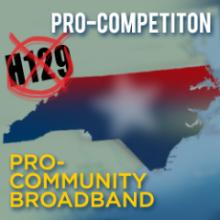
It took far more longer than expected, due to the many phone calls from concerned citizens opposing it, but Time Warner Cable's investments in the North Carolina Legislature have finally paid off. A bill that will crush its only potential broadband competition in the state is sitting on the Governor's desk. We join with SEATOA, the vast majority of businesses in North Carolina who depend on broadband, and local communities in calling on the Governor to veto it. The NC House had to approve it again due to changes made in the Senate -- including a change that absolutely gutted the rural exemption for communities who are lacking access broadband access to the Internet. Representative Avila and other sponsors have made many promises throughout this process that they never intended to hold true to. SEATOA has long organized to preserve local authority in this matter and reported:
We made certain Rep. Avila understood that that clarification gutted the exemption and she did not care. e-NC reports that the private sector providers are permitted to report an entire Census Block as having access to internet, if only one home in the block actually has it.  In essence, North Carolina will have no "unserved areas" or communities will have to do their own door to door surveys, an expensive and monumental feat.
But what do you expect from elected officials who calls something a "level field" while bragging that they are crafting rules (such as limited service territories) that only apply to the community networks, which already operate at a disadvantage to a $19 billion a year competitor like bill author Time Warner Cable? When the bill passed the Senate, a newspaper in Davidson noted its unequal approach that further handicapped communities:
Davidson Mayor John Woods said Tuesday MI-Connection deserves to be treated the same as private companies. “We strongly object to the territory limits that this bill will impose on MI-Connection which are not imposed on other broadband providers. In addition, MI-Connection would remain subject to open meeting laws, which do not apply to those other providers,” he said. Mr. Venzon also said local governments already face other rules that put them at a disadvantage to private competitors, including the requirement to operate under the N.C. Public Records Law.

Tennessee Bill to Encourage Economic Development Killed by Telco Lobbyists

As we continue to report on depressing campaigns to deny people fast, affordable, and reliable access to the Internet (as Time Warner Cable is doing in North Carolina), we are also making an attempt to highlight good legislation (as we recently did in Washington state). In that spirit, we turn to HB 2076 / SB 1847 in Tennessee From the bill summary:
This bill urges all municipalities to endeavor to utilize advanced broadband systems in their operations and to encourage the construction of advanced broadband systems.
The full bill is available here [pdf] but the most interesting part is what was not included. As reported by Andy Sher of the Times Free Press, the bill was intended to go much further.
The bill would have let the municipal utilities extend service up to 30 miles outside their service areas.
Unfortunately, the powerful incumbent lobbying machine (including AT&T, Comcast, and others who already hate having to compete with technologically superior networks in several Tennessee communities) killed the bill, a blow to the future of economic development in the state. Neighbors of Chattanooga, including Bradley County, desperately want access to the impressive 1Gbps network Chattanooga built -- the most advanced citywide network in the country. epbfiber.jpg Harold DePriest recognized the power of AT&T and Comcast in the Legislature, but vowed not to give up.

“Well, we would like to see the bill pass, but I think Gerald was dealing with the reality of the difficulty of moving the bill through the committee at this point in time,” he said Friday. “We will be back.

Broadband Properties Summit - Economic Development Program Streaming on Thursday

I'm heading down to Dallas tomorrow for the annual Broadband Properties Summit. I'll be focusing on the rural program on Wednesday and then Jim Baller's Economic Development program on Thursday -- if you cannot make it, you can stream the economic development sessions. I'll be presenting on the final panel, reviewing the day's discussion and offering ideas for next steps.

Chelan PUD in Washington Reconsiders Broadband Stimulus Grant

For the last 6 weeks in Chelan, Washington, the Public Utility District has had to make some hard decisions regarding expanding its rural FTTH network using a broadband stimulus award from the federal government. Chelan was an early pioneer of rural FTTH, operating a network that serves over 2/3 of a rugged county that offers great rock climbing and hiking opportunities (I checked it out personally). As we reported last year, Chelan's citizens had strongly supported accepting the stimulus award and paying for their required match by modestly increasing electrical rates (which are among the least expensive in the nation). At that time, the PUD believed its network passed over 80% of the county. But after reassessing their coverage and changing the leadership of the group in charge of the fiber-optic aspect of the utility, they found the network passed closer to 70% of the population. They also re-examined assumptions about the cost of expanding the network's reach:
The PUD’s financial review resulted in a series of revised statistics that PUD engineers presented to commissioners Monday. Of the county’s 43,000 premises — mostly homes and businesses — 30,000 have access to fiber. Some 6,000 don’t have access because they live in areas where hookups are more costly, despite their often urban settings. In these areas, the cables that supply electricity are buried directly in the ground. Fiber hookups require costly trenching and installing conduit. Another 7,000 premises don’t have access because they’re very rural. Fiber access to all but the most rural of these locations will be funded jointly by a $25 million federal stimulus grant and PUD matching funds of about $8 million.
Of the 30,000 with access, some 37% are taking a service (though they have to subscribe through independent service providers that contract with Chelan PUD due to Washington State law denying the opportunity for PUDs to offer retail services on their own network. Nonetheless, they are signing up 100 new customers per month. The problem is that some of the new connections are in high cost areas (whether due to distance or underground utilities).

WindomNet Saves Jobs, Provides Stellar Customer Service

Minnesota Public Radio, as part of its Ground Level Broadband Coverage has profiled WindomNet with a piece called "Who should build the next generation of high-speed networks?"
Dan Olsen, who runs the municipal broadband service in Windom, was just about to leave work for the night when he got a call. The muckety-mucks at Fortune Transportation, a trucking company on the outskirts of town, were considering shuttering their office and leaving the area. "They said, Dan, you need to get your butt out here now," Olsen recalls. "I got there and they said, 'You need to build fiber out here. What would it take for you to do it?'" Fortune, which employs 47 people in the town of 4,600, two and a half hours southwest of the Twin Cities, relies on plenty of high-tech gadgetry. Broadband Internet access figures into how the company bids for jobs, communicates with road-bound truckers, controls the temperatures in its refrigerated trucks and remotely views its office in Roswell, New Mexico. Fortune even uses the Internet to monitor where and to what extent drivers fill their gas tanks in order to save money. Yet, when it was time to upgrade company systems three years ago, Fortune's private provider couldn't offer sufficient speeds. That's where Windomnet came in. Though Fortune was a mile outside the municipal provider's service area, "We jumped through the hoops and made it happen," recalls Olsen. "The council said, "Do it and we'll figure out how to pay for it.' We got a plow and a local crew. We had it built in 30 days."
I have thought about this story frequently when I hear claims that publicly owned networks are failures.

Connecting to Each Other: Upstate New York

In the ongoing effort to better network us network-type people, I wanted to note a site, Agrilan Rural Broadband Blog, that is working toward better rural broadband in upstate New York. I plan to put up short posts like this from time to time in hopes that people will get a better sense of who is near them (or has similar interests) for coalitions to advocate for broadband networks that are structurally accountable to communities.

Examining Virginia's Broadband Problems

The Roanoke Times recently published an extensive story about broadband, covering everything from what it is to why it is needed and who doesn't have it. Aside from providing an excellent primer on these issues to those who are new to broadband discussions, Jeff Sturgeon writes about problems often ignored by the media, like the difficulties for companies and other entities can encounter when they need extremely high capacity connections:
Skip Garner directs the Virginia Bioinformatics Institute, which unites the powers of biology and information technology to advance medicine. It is at Virginia Tech. Garner said he, too, finds computing power a constraint. In spite of a 1 gigabit connection, "we are limited in what we could do," Garner said. When the lab's DNA sequencers pile up data, "we will often put it on a 1-terabyte drive ... and FedEx it to our customers," Garner said. An upgrade to 10 gigabits is coming. He expects it still won't be enough. It might appear that new facilities would not have such problems, but even the 5-month-old Virginia Tech Carilion Research Institute near downtown Roanoke is not satisfied with its Web service. While the speed is good at 10 gigabits, the cost it pays to service providers is staggering. "It's in the tens of thousands of dollars a month," said Executive Director Michael Friedlander.
This is one world. Communities with their own fiber networks are another -- where these connections are not prohibitively expensive. And yet another world is the world of several rural Minnesota Counties, who cannot even get T.1 lines from incumbent phone providers. In Cook County, in 2008, a company was quoted $600,000 to install a T.1 line. Yes, $600,000 - I had to hear it twice to make sure I wasn't imagining it. The article explores Design Nine founder Andrew Cohill's thoughts on improving broadband access. Cohill mentions Wired West, a network we have written about previously.
"We think it's got to be treated like essential public infrastructure," he said. That way, access would be open to any service provider on equal footing. Just as anyone could launch a cab company or food delivery service over the road system, anyone will be able to use the information highway's new lanes.

Ask Me Questions on Rural America Radio Friday

 I just joined the community at RuMBA - the Rural Mobile & Broadband Alliance - and will be appearing on Rural America Radio to discuss rural broadband issues on Friday, March 18. You can call in with questions. Details from Rural America Radio here:

Listen here: http://www.blogtalkradio.com/luisahandem

Fiber Networks are admittedly the most powerful tools for delivery of high-speed Internet anywhere. How can communities take ownership of their broadband choices and funding so as to ensure the best outcome? From Minnesota to North Carolina, there is clearly a battle of words going on between private corporations and rural counties, municipalities and other underserved areas on decision-making. In this edition of Rural America Radio, showhost Luisa Handem interviews Christopher Mitchell,  a strong proponent of publicly owned broadband networks. He is the Director of the Telecommunications as Commons Initiative with the New Rules Project of the Institute for Local Self-Reliance.  He has been published in a number of online magazines as well as print publications. Mitchell is the author of last year's report on publicly owned broadband networks titled “Breaking the Broadband Monopoly: How Communities Are Building the Networks They Need.”

You may join the show by dialing 646-378-1746 to ask a question from 3:00-3:30pm CDT, every Friday.

Rural America Radio gives voice to rural residents and those who wish to promote the wellbeing and economic growth of rural communities across the U.S. We bring you the very best in talk-show programming related to rural American affairs, by deliberately focusing on the use of technology, especially high-speed Internet, and healthy living. Rural America Radio is a project of the Rural Mobile & Broadband Alliance (rumbausa.com).


Rockingham County, NC, Passes Resolution Against Bill to Limit Community Networks

Rockingham County has joined Raleigh in officially passing a resolution against legislation to cripple community networks in the state.


RESOLUTION
BY THE ROCKINGHAM COUNTY BOARD OF COMMISSIONERS
AGAINST SENATE BILL 87 and HOUSE BILL 129

WHEREAS, Senate Bill 87 and House Bill 129 have been introduced in the 2011-2012 Session of the General Assembly of North Carolina; and

WHEREAS, these bills do not provide a level playing field to cities, towns and counties, but greatly hinder local governments from providing needed communications services, especially advanced high-speed broadband services, in unserved and underserved areas; and

WHEREAS, these bills impose numerous obligations on cities and towns that private broadband companies do not have to meet; and

WHEREAS, private companies, despite having received favorable regulatory and tax treatment to enable broadband investment, have chosen to avoid the financial commitment necessary to provide top quality services to all residents and businesses; and

WHEREAS, while private companies declare top quality service is cost-prohibitive in our country, the United States continues to lose ground to other nations in broadband access, user cost and growth in number of users, falling behind the United Kingdom, Korea, France, Japan and Canada to name a few, and Japan has Internet access that is at least 500 times faster than what is considered high-speed in the United States and at less cost; and

WHEREAS, the bills would prohibit North Carolina cities and towns from using federal grant funds to 

deploy or operate locally-owned or operated broadband systems, thereby denying N.C. residents access to federal assistance available to the rest of the country and hindering employment opportunities; and