

For years, Cleveland was labeled as one of the worst-connected cities in the nation despite the presence of AT&T and Charter Spectrum. But all of that is changing, thanks to an innovative nonprofit community network provider.
Even without getting a cent from the federal government’s flagship $42.5 billion dollar BEAD program, Cleveland is no longer just home to the Rock & Roll Hall of Fame. It’s now also the home of skyrocketing connectivity rates as DigitalC transforms the city’s digital landscape.
The data-backed progress was enough to convince the Cleveland City Council to recently sign off on a $4.35 million “performance payment” — part of an overall $20 million earmark from the city's coffers — to DigitalC after the nonprofit Internet provider blew past its 2025 goals for getting residents online and teaching them digital skills, a milestone city leaders are pointing to as proof that “The Cleveland Model” for closing the digital divide actually works.
Under its performance-based contract with the city, DigitalC was on the hook to add 4,700 new household Internet subscriptions and deliver digital skills training to 10,000 residents in 2025 or miss out on the multi-million dollar infusion of city cash.
The city's Bureau of Internal Audit crunched the numbers and certified that DigitalC surpassed both metrics: 4,862 verified new household subscriptions and 10,105 confirmed digital adoption service records.
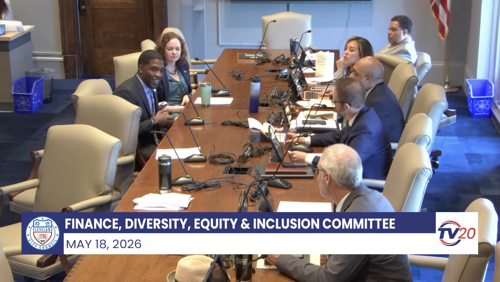
The Council signed-off on releasing the funds after the numbers were reviewed publicly by both the Utilities Committee and the city’s Finance, Diversity, Equity and Inclusion Committee.
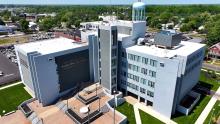
At the May 18 finance committee meeting, Council President Blaine Griffin praised the organization's progress and credited DigitalC CEO Joshua Edmonds for justifying the public support the nonprofit has garnered since its founding. Councilman Kris Harsh, who toured DigitalC's MidTown Tech Hive with city staff to go over the underlying data, was similarly impressed.
“The data was presented in a very clear, understandable way, and we were able to confirm that all the work is being done as expected and as stated in the contract,” Harsh said. “I feel really good about this now and happy to vote in favor of this.”
For his part, Edmonds said of the new infusion of cash:
“This is more than a contract milestone. This is validation of Cleveland’s investment, DigitalC's execution and the public, private and philanthropic partnership powering this work.”

Edmonds was also keen to acknowledge the leadership of Mayor Justin Bibb’s administration, Cleveland City Council members, the Jack, Joseph and Morton Mandel Foundation, the Ohio Department of Development and “a growing group of catalytic partners who understand that digital equity is essential civic infrastructure.”
City officials are framing the outcome as validation of what they're calling “The Cleveland Model” — a mix of “public dollars, nonprofit innovation, philanthropic backing, and community trust aimed at closing the digital divide at scale.”
The idea is that Cleveland's approach can show other cities how to smartly tackle broadband access, digital literacy, and the economic opportunity that results.
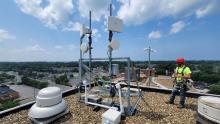
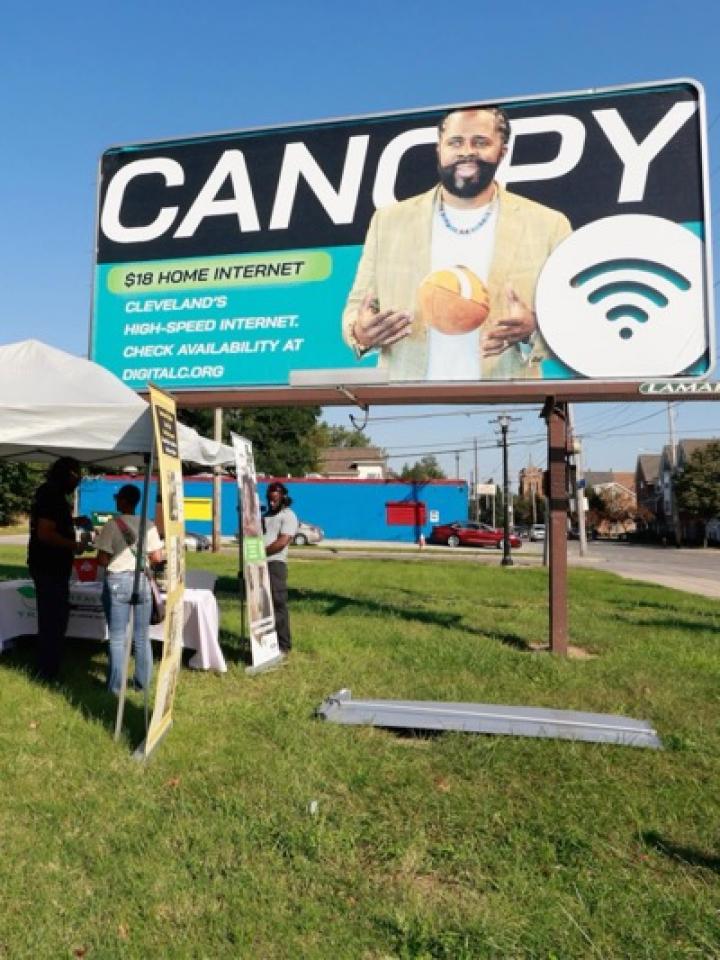
DigitalC operates both parts of that mission: Canopy, which connects residents to affordable high-speed Internet (100 Megabits per second symmetrical service for as little as $18 per month), and Click, which administers the digital skills side of the equation — training residents to use the Internet for work, school, healthcare, and accessing benefits.
In January 2024, DigitalC launched a four-year citywide connectivity initiative, part of Mayor Justin Bibb and the Cleveland City Council's push to put its American Rescue Plan funds toward broadband and increased digital skills access. The need was clear: Connect Your Community's analysis of Census Bureau data ranked Cleveland the second worst-connected big city in 2021, and by 2023 it remained near the bottom, second only to Detroit. DigitalC is now bootstrapping its way up.
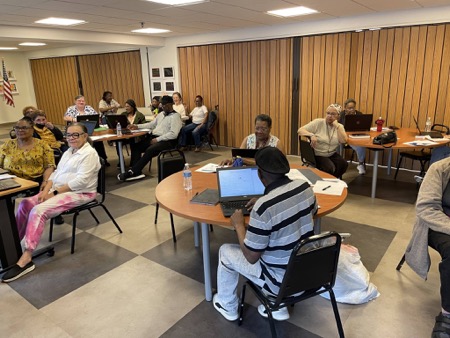
Since January 2024, DigitalC has connected more than 9,200 Cleveland homes, representing more than 23,000 residents connected to high-speed Internet through Canopy, offering high-capacity fixed wireless service. The organization also has trained more than 20,000 residents over the past two years in essential digital skills, delivering more than 26,000 digital skills classes through its Click initiative.
The Accountability Behind the Numbers
What's notable about DigitalC's approach isn't just that it hit its targets, it's how openly the organization has talked about the pressure that comes with performance-based funding, and what that has done to influence internal operations.
Speaking with ILSR’s Christopher Mitchell on the Institute for Local Self-Reliance's Unbuffered podcast, Edmonds described the scrutiny DigitalC has faced — from council members, staffers, and outside critics. It was an experience, he said, that ultimately sharpened the organization’s focus.
“It is frustrating,” Edmonds said, “but at the same time, my mind goes into its refining. It's refining us in our operations to be more disciplined when it comes to data.”
He noted how historically nonprofits and public agencies alike often struggle to keep clean records or rigorously track their own impact — an issue he's made a top priority at DigitalC. Under his watch, DigitalC has leaned into a more disciplined data collection effort rather than treating outside scrutiny as an obstacle.

If political pressure is coming, he added, the response is to build systems solid enough to withstand it. “If I see an iceberg a mile away and I still hit that, I’m blaming me,” he told ILSR. “I know where you guys are coming. So if I hit that, shame on me.”
He offered a concrete example of that mindset in practice: Edmonds pushed his team to aim past the city’s performance numbers for 2025 — ultimately landing nearly 7,300 subscriptions — anticipating that anyone digging into the results would look for reasons to discount them. “This is no surprise,” he told his team. “We need to go over the goal.”
A Model That Can Be Replicated
For a program built around the idea that performance-based public funding can work for community broadband, the stakes of falling short aren’t just financial. It amounts to proof-of-concept.
Cleveland's willingness to tie a multimillion-dollar payment to independently audited outcomes — and DigitalC's willingness to embrace that audit — is precisely what backers of “The Cleveland Model” say other cities should be watching.
Whether that model can be exported beyond Cleveland will depend on whether other nonprofits and municipalities are willing to build the same kind of data discipline Edmonds described — and whether they're willing to set their own targets high enough to survive the scrutiny that comes with public money.
Hoping to replicate the success they have had in Cleveland, DigitalC is now expanding into Detroit, where Edmonds formerly served as Detroit’s Director of Digital Inclusion.
“We have our pilot that is up and running,” he told ILSR. “We have three public housing communities that we're in, all leveraged within the Detroit Housing Commission. I think that what we've been able to show there is it's possible…to make a massive difference in their urban context, and even suburban and micropole and rural…this is a model that's replicable.”
Listen to DigitalC CEO Joshua Edmonds discuss DigitalC on our Unbuffered podcast below:
Header image of DigitalC service truck courtesy of DigitalC Facebook page
Inline image of Joshua Edmonds addressing City Council screenshot of online City Council meeting
Inline image of Joshua Edmonds greeting city residents courtesy of DigitalC Facebook page
Inline image of DigitalC Click class courtesy of DigitalC Facebook page
Inline image of state officials touring DigitalC site courtesy of DigitalC Facebook page
Inline image of DigitalC billboard courtesy of DigitalC Facebook page