
In Our View

Content tagged with "In Our View"

Related Topics
Displaying 1 - 7 of 7

IN OUR VIEW: Decoding The Possible Meaning of “Reforms” to the Tribal Broadband Connectivity Program

In the last two months of the Biden administration, nearly $500 million in grants were announced to support Tribal broadband projects. From Alaska to Virginia, 55 Tribal nations were poised to improve Internet access and advance digital sovereignty in their communities.

As President Trump took office, more than a hundred applicants still awaited word on their proposals, with nearly $500 million still available in the Tribal Broadband Connectivity Program (TBCP).

Then, silence. Ten months of silence.

In early November, Senators Maria Cantwell (D-Wash.) and Brian Schatz (D-Hawaii) sent a letter to NTIA officials asking about the TBCP. The program was established with two appropriations totaling nearly $3 billion. The first round of TBCP grants rolled out throughout 2022 and 2023, totalling nearly $100 million in use and adoption funding and over $1.7 billion in planning or infrastructure funding.

Image
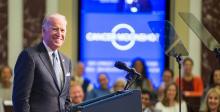
Sen. Maria Cantwell stands behind a microphone and podium with her hands raised in the air, palms upward

The $500 million announced at the end of the Biden administration was part of round two of the program, for which applications were due in March 2024. With about $1 billion available, only about half of the funding in round two had been allocated.

What was happening, the Senators asked, with the rest of that funding? There were other questions too.

IN OUR VIEW: ‘Without Political Power, There is No Path to Digital Equity’

For decades, ILSR has recognized that communities need to be engaged on Internet access issues to make sure that everyone – from low-income, historically marginalized residents to small businesses and even municipal departments – have the Internet access they need to thrive in the digital age.

Digital equity is essential to help resolve other challenges and the current chasm between the haves and have-nots makes solving many other challenges – like education – more difficult.

To further the quest for greater digital inclusivity, recently ILSR’s Community Broadband Networks Initiative Director Christopher Mitchell put together a panel for Net Inclusion 2024, a conference convened by the National Digital Inclusion Alliance (NDIA) that drew 1300 attendees and was by far the largest digital inclusion conference held in many years of doing this work.

Entitled “Without Political Power, There is No Path to Digital Equity,” the panel was originally going to focus on the importance of structural change – and how we cannot ensure everyone is connected by relying solely on the networks already present in neighborhoods that see quite low broadband penetration. Instead, the panel discussion went a bit deeper than that and landed on an observation often made by Joshua Edmonds from Digital C in Cleveland. To paraphrase Joshua, we cannot coupon our way to digital equity.

In Our View: Addressing Digital Discrimination Will Take More Than Policing ISPs

This is a walk and chew gum moment for broadband-for-all advocates. On the one hand, the Federal Communication Commission (FCC) new digital discrimination rules have the potential to rein in egregious examples of digital discrimination. On the other hand, the new rules still fall short of putting forward the kinds of structural solutions necessary to address underinvestment in communities where federal infrastructure dollars may never reach.

Last week, the FCC published its final digital discrimination rules, giving the agency the authority to penalize Internet Service Providers (ISPs) whose policies have a “disparate impact” on historically marginalized communities. The Infrastructure Investment and Jobs Act (IIJA), passed by President Biden in 2021, included a mandate directing the FCC to develop “rules to facilitate equal access to broadband internet access service, taking into account the issues of technical and economic feasibility presented by that objective, including—preventing digital discrimination of access based on income level, race, ethnicity, color, religion, or national origin.”

Image
FCC logo

After hosting listening sessions and inviting public comment, the final ruling ultimately defined digital discrimination as “policies or practices, not justified by genuine issues of technical or economic feasibility, that (1) differentially impact consumers’ access to broadband internet access service […], or (2) are intended to have such differential impact.” Such an approach authorizes the FCC to penalize providers even if it can’t identify instances of intentional discrimination.

Initial Responses to the Ruling

IN OUR VIEW: Save ACP And Then Some

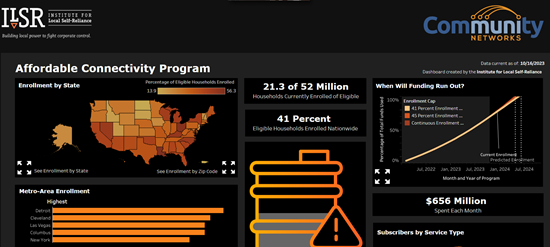
With the $14.2 billion Affordable Connectivity Program (ACP) on track to run out of funds by spring/early summer 2024, finally there is a request from the White House to extend funding for the program that over 21 million housholds now rely on to help pay for high-speed Internet service.

Last week, the Biden administration formally asked Congress for another $6 billion to extend the program through November 2024, joining a chorus of public interest groups (including AARP) calling on Congress to replenish the rapidly depleting fund.

(According to our calculations, an additional $6 billion would not fund the program through December 2024 as the White House said. It would fund the program through the end of November 2024. It would take $6.9B to get through the end of December).

Image
ACP Dashboard as of 10.31.23

First established with the passage of the Infrastructure Investment and Jobs Act (IIJA) in 2021 as part of the Biden administration’s “Internet for All” initiative, the ACP – currently administered by the Federal Communications Commission (FCC) – provides income-eligible households with a $30 monthly subsidy ($75 per month for those living on Tribal lands) to pay for their Internet service bill. The program also provides a one-time $100 benefit to go towards the purchase of an Internet-connected device such as a laptop or tablet.

IN OUR VIEW: Friday the 13th Mapping Challenge Deadline Highlights Failed Process

Last Friday was a major milestone in the process of moving $42.5 billion from the federal government to states to distribute mostly to rural areas to build new, modern Internet access networks. January 13th marked the deadline for error corrections (called challenges) to the official national map that will be used to determine how much each state will get. 

As an organization that has worked in nearly all 50 states over the past 20 years on policies to improve Internet access, we spent the last few weeks struggling to understand what was actually at stake and wondering if we were alone in being confused about the process. Despite the stakes, almost no expert we talked to actually understood which challenges – if any – would fix errors in the map data before it was used to allocate the largest single federal broadband investment in history. 

Update: On January 13th, Joan Engebretson confirmed in Telecompetitor that the location challenges deadline was October 30, 2022, and not Jan 13, 2023.

Image
FCC logo

This article will explore what is going wrong with the distribution of that $42.5 billion, the mapping process, and continued failure of the Federal Communications Commission (FCC) to show competence in the broadband arena. And it offers ways to fix these important problems as every jurisdiction from Puerto Rico to Hawaii feels overwhelmed by the challenge. 

In Our View: Slightly Better FCC Maps on Horizon, Maybe

Welcome to another installment of In Our View, where from time to time, we use this space to share our thoughts on recent events playing out across the digital landscape and take the opportunity to draw attention to important but neglected broadband-related issues.

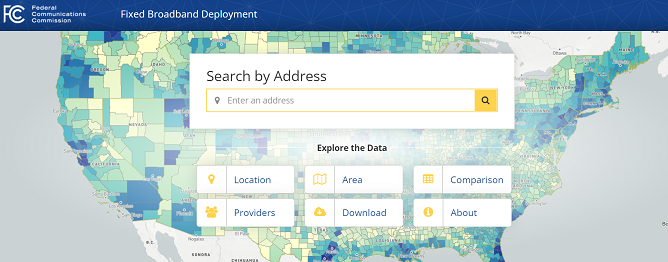
As its ongoing work to revamp the agency’s notoriously inaccurate broadband coverage maps continues, the Federal Communications Commission (FCC) announced last week the opening of a window for states, local and Tribal governments, service providers, and other entities to challenge the service data submitted by providers over the summer.

At the end of June, as FCC chairwoman Jessica Ronsenworcel noted, the FCC “opened the first ever window to collect information from broadband providers in every state and territory about precisely where they provide broadband services.” 

The key word here is “precisely” because the truth is: no one really knows precisely where broadband is, or is not, available. And with tens of billions of dollars in federal funding being spent to deploy high-speed Internet infrastructure, accurate mapping data is essential for targeting where those funds would be best allocated in each state and U.S. territory.

Image

Historically, the FCC relied on self-reported submissions of Internet service providers (ISPs) for information on which locations they serve and what speeds are available at those addresses. However, in practice, that meant the FCC maps could declare an entire census block to be “served” by a broadband provider if that provider claimed the ability to serve just one home in the entire block; thereby overcounting how many households have access to broadband.

In Our View: Don't Leave Out The Cities

The State of Texas is notorious for pitting communities against one another. This time around, it's the little town versus the big city in the funding arena to improve Internet access.

Last week, Texas Comptroller Glenn Hegar kicked off his Texas Broadband Listening Tour 2022, scheduled to take place at 12 different locations statewide. The goal of his stakeholder listening tour is to collect feedback for Texas' newly created broadband development office and how the state should spend a once-in-a-generation windfall of federal resources to close the digital divide. Great news for a state the size of Texas with 29 million residents, right? It depends on where you live. The majority of the communities hosting a public forum are smaller communities. Remember the Alamo? Not Heger's office. Dallas and Austin made the list of stops, but San Antonio and Houston, with some of the state's highest populations, didn't make the cut for the tour. 

Image

Texas has both unserved and underserved communities living on the wrong side of the digital divide. From 8-80 years old, residents and businesses throughout rural, suburban, and urban communities are all harmed by the lack of community broadband infrastructure, unaffordable connectivity services, and digital discrimination.  

We applaud the approach of public officials doing listening tours. However, we are deeply concerned that many states - red and blue - will ignore the needs of urban residents while focusing solely on solutions for rural areas. We laid this out more broadly in a policy brief we published last year. We can ensure everyone has high-quality Internet access, but we need to make sure that is the explicit goal.