
Greenlight Community Broadband

Content tagged with "Greenlight Community Broadband"

Related Topics
Displaying 1 - 3 of 3

Municipal Broadband Leaves Big National ISPs in the Dust, Report Finds

A new speed analysis published by Ookla finds that municipal broadband providers consistently leave their private Internet service provider (ISP) competition in the dust.

Small Towns, Big Speeds: How Some Municipal Broadband Providers Outperform Their ISP Peers” examined speed test data that included some of the largest municipal networks in the U.S. from December 2024 through December 2025 and compared their performance to each other and to their privately-owned ISP competitors.

Though it wasn’t in-depth study on other aspects of performance (or business models) – but a more narrowly-focused comparison of speed among 14 municipal providers – still the analysis shines a light on a leading performance indicator: “eight municipal providers in the U.S. that we monitored using Ookla Speedtest data beat their broadband competitors in median upload speeds and one municipal provider, Sherwood Broadband, outpaced the competition in median download speeds.”

Here are some of the report’s topline takeaways:

  • Fort Collins, Colorado’s Connexion was the leader in median upload speed, delivering an average median upload speed of more than 300 (Megabits per second) Mbps for the entire 13-month period from December 2024 to December 2025.
  • Sherwood Broadband in Sherwood, Oregon, was the top provider in median download speeds, delivering an average median download speed that surpassed 400 Mbps eight months out of a 13-month period from December 2024 to December 2025.
  • UTOPIA Fiber in Utah is a standout in latency, delivering the lowest latency of all 14 municipal broadband providers with a multi-server latency consistently in the low 6 milliseconds (ms) to 8 ms range.

The Problem With 'Unfair Competition'

The State of State Preemption: Stalled – But Moving In More Competitive Direction

As the federal government makes unprecedented investments to expand high-speed access to the Internet, unbeknownst to most outside the broadband industry is that nearly a third of the states in the U.S. have preemption laws in place that either prevent or restrict local municipalities from building and operating publicly-owned, locally-controlled networks.

Currently, there are 16 states across the U.S. (listed below) with these monopoly-protecting, anti-competition preemption laws in place.

These states maintain these laws, despite the fact that wherever municipal broadband networks or other forms of community-owned networks operate, the service they deliver residents and businesses almost always offers faster connection speeds, more reliable service, and lower prices.

In numerous cases, municipal broadband networks are able to provide low-cost or free service to low-income households even in the absence of the now expired federal Affordable Connectivity Program (ACP). And for several years in a row now, municipal networks consistently rank higher in terms of consumer satisfaction and performance in comparison to the big monopoly Internet service providers, as PCMag and Consumer Reports have documented time and time again.

Nevertheless, these preemption laws remain in 16 states, enacted at the behest of Big Cable and Telecom lobbyists, many of whom have ghost written the statutes, in an effort to protect ISP monopolies from competition.

The Infrastructure Law Was Supposed to Move the Preemption Needle But …

Small ISPs And Munis Top Consumer Reports Ranking While Altice, Comcast Fare Poorly

Consumer Reports’ latest survey of the most popular ISPs in America is once again dominated by smaller providers and community-owned and operated broadband networks.

The magazine’s semi-paywalled report measured the opinions of 48,000 readers on a 100 point scale across four criteria: value for money, connection reliability, customer service, and speed.

The top ranked (95 points) ISP in the nation according to Consumer Reports was Greenlight, a small fiber operator that deploys largely around upstate New York. The second (92) was EPB, the community-owned fiber network in Chattanooga, Tennessee whose deployment has helped the city envision an estimated $2.69 billion return on its initial investment.

Image
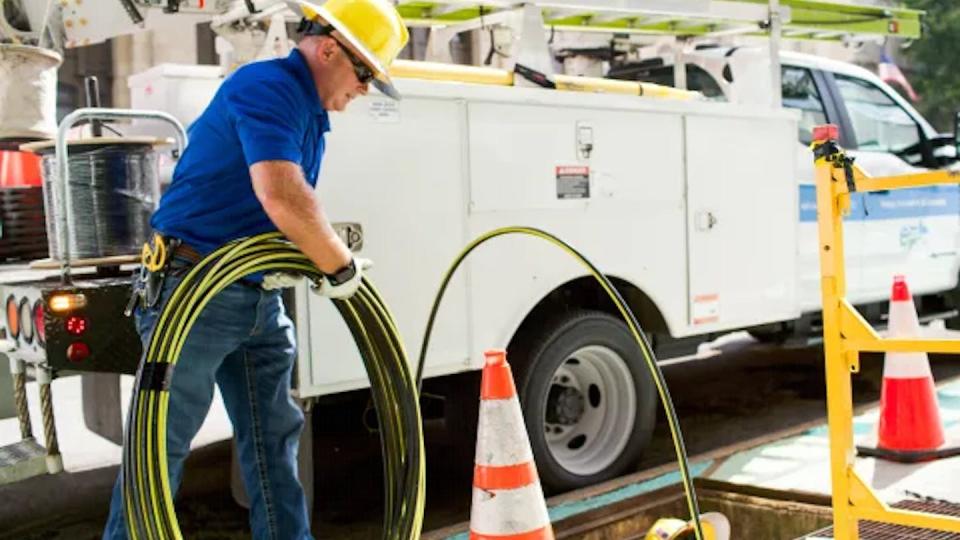
EPB laying fiber

At the same time, regional monopolies that benefit from muted competition and oversight continued to fare poorly in the magazine’s rankings.

Expensive and usage-capped satellite broadband services fared the worst (HughesNet (14) and Viasat (14)), followed by a peppering of regional cable and telco monopolies like Comcast Xfinity (28), CenturyLink/Lumen (25), Mediacom’s Xtream (25), or Altice’s Optimum (20).