
legislation

Content tagged with "legislation"

Related Topics
Displaying 231 - 240 of 405

Alabama Republican Speaks Out in Favor of Local Authority

As we have learned, communities with municipal networks have tended to be politically conservative. Nevertheless, conservative state level politicians have often supported measures to revoke local authority to encourage local Internet choice. Recently, Alabama State Senator Tom Whatley, a Republican from Auburn, expressed his support for local authority in AL.com.

Whatley introduced SB 438, which would remove service area restrictions on municipal providers and remove the currently restriction preventing other municipalities from providing voice, video, or Internet access services. As he notes in his opinion piece, the bill did not move beyond the Transportation and Energy Committee, but he also asserts that he will be back next year to press for the measure. 

Auburn is near Opelika where the community has deployed a FTTH network to serve residents and spur economic development. If the restrictions are eliminated, Opelika could expand to Auburn and even other rural areas nearby.

Whatley makes comparisons to the strides America made with the national interstate system. He also acknowledges the way Chattanooga's network has transformed what was once described as the "dirtiest city in America." Whatley takes the same approach we encounter from many communities where, after failed attempts to entice private providers to serve their citizenry, eventually decided to take on the task themselves.

He writes:

As a Republican, I believe the private sector is usually the best and most efficient method for providing a service. But when private companies, for whatever reason, make a decision not to serve an area, we should not handcuff the people of that region if they decide to use a public entity to receive that service (in this case, broadband Internet) in order to compete today for the jobs of tomorrow.

LD 1185 Advances in Maine With Overwhelming Support

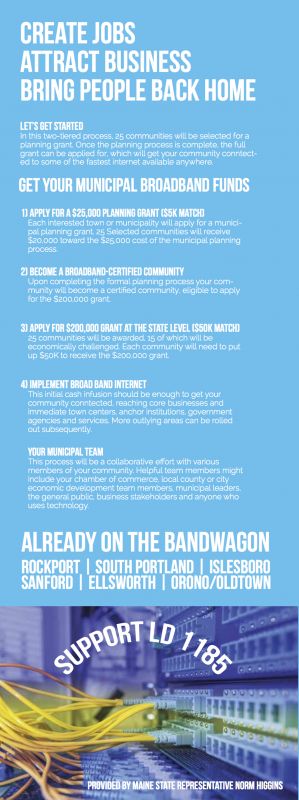
On June 5th, the Main House of Representatives voted 143 - 0 in favor of LD 1185, the Maine bill to provide state planning and implementation grants for local municipal networks. Representative Norm Higgins, the sponsor of the bill, contacted us to let us know about the incredible support for the bill.

LD 1185 proposes to provide $6 million this year for local communities seeking to establish networks that want to take advantage of the state's middle-mile network, the Three Ring Binder. The House amended the bill to include general goals for the fund and its purpose in bringing better connectivity to Maine. 

The amendment also creates specifications between planning and implementation grants and establishes caps on awards. Planning grants cannot exceed $25,000 and implementation grants cannot exceed $200,000. Implementation grants require a 25 percent match from the requesting municipality; planning grants require a one-to-one match. The amendment is available online.

Now that the House has put their stamp of approval on the bill, it is up to the Maine Senate to  approve the measure and send it on to the Governor. According to Higgins, it appears to have strong bipartisan support; funding is the only area of uncertainty. He anticipates it will be before the Appropriations Committee within the next two weeks.

ALEC in Savannah: Local News Video Exposes the Corrupt Process of Lawmaking

We have reported on the American Legislative Exchange Council (ALEC) in the past and stories about ALEC sponsored legislative retreats pop up in the news on a regulary basis. Most recently, NBC Channel 11 from Atlanta reported on the shadowy world of big corporate influence in Georgia. 

None of this will be new to anyone familiar with ALEC's shadowy way of doing business, but having it on video makes it more compelling.

Brendan Keefe visited Savannah and tried to observe one of these meetings between ALEC corporate members and state legislators. Even though Keefe and his crew had an official press pass, they were blocked from entering the meeting.

Keefe spoke with a Georgia State Senator Nan Orrock, who once belonged to ALEC. She told him about the meetings, paid for with ALEC funds or "legislator scholarships," and pointed out the true nature of the closed door gatherings:

It's really a corporate bill mill…the truth be told, they write the bills.

Even though Keefe was not able to attend one of the meetings, he did encounter a legislator and several lobbyists in the bar the night before. They didn't mind describing what they were doing in Savannah and who paid the bill. Watch the brief expose below.

We also include a 2013 Real News video with Branden Fischer from the Center for Media and Democracy. He goes more indepth on ALEC's modus operandi and its membership.

Graphic: LD 1185 Proposes Planning Grants for Munis in Maine

In late April, LD 1185 and several other broadband bills came before the Maine House Energy, Utilities, and Technology Committee. We have seen a flurry of activity in Maine this year as local communities deploy networks, develop plans, or begin feasibility studies. Likewise, the state legislature has been active as House and Senate members try to defibrillate the barely beating heart of the state listed as 49th for broadband availability.

The national providers in Maine - Time Warner Cable and FairPoint have little interest or capacity to invest in high quality services in Maine. Time Warner Cable is more focused on major metros and being acquired. FairPoint is laying off workers and also, positioning itself to be acquired. Fortunately, these big companies aren't the only option for improving Internet connectivity in Maine.

LD 1185, presented by Representative Norm Higgins, seeks to establish $6 million this year in funds for local communities that wish to deploy municipal networks. Maine already has the middle mile Three Ring Binder in place; the focus of this proposal is to help communities get the infrastructure they need to connect to it. In an effort to get the word out about the bill and grow support, Higgins and his team created this graphic explaining the proposal (a 2-page printable edition of the graphic is available for download from the link below):

LD 1185 Graphic

LD 1185 Graphic

ECFiber Seeks New Business Model Designation

ECFiber hopes to transform its business model in order to attract investors, reported Valley News in February. The organization is now an "inter-local contract," an entity somewhat unique to Vermont, but seeks to change to a "telecommunications union district." Similar to a municipal utility district, the telecommunications union district is created by two or more municipalities. The new business model would not change ECFiber's governance or require financial support from local towns but officials believe it would attract more outside investors.

Last year, ECFiber announced it would expand in 2015, seeking large scale funding to help speed up deployment. Since 2008, the organization has raised over $6 million for deployment from individual investors and now serves more than 1,000 subscribers. Unfortunately, this method financing slows expansion. The results are bad for ECFiber and bad for local consumers:

“The worst thing (about ECFiber’s delay) is a lot of the people who wanted to have it weren’t able to get it right away,” said [ECFiber Treasurer John] Roy.

At this point, FairPoint, Northern New England’s provider of land-line service, is able to reach more rural areas than ECFiber with its high-speed Internet service. But, FairPoint’s speeds of up to 30 megabits per second are slower than the 400 megabits per second ECFiber’s cables can provide, said Roy.

“If we’re going to get this job done before the end of this decade, we need to step up the rate,” said [Irv] Thomae [ECFiber's Governing Board Chariman].

It would take another 17 - 18 years to deploy 1,600 miles of fiber, the ECFiber goal. If the organization can raised $40 million from larger investors, that period can be reduced to 3 - 5 years, estimated Roy.

Minnesota House Proposal to Kill Broadband is the Wrong Move for Economic Development

Representative Pat Garofalo’s (R-53B) proposal to cut funding for broadband grants is the wrong move for Minnesota. The Institute for Local Self-Reliance (ILSR) is absolutely opposed to any suggestion Minnesota should have two-tiered Internet access - a fast standard in urban areas and slower, less reliable access in Greater Minnesota.

Wireless technology and satellite Internet are not sufficient for homes and businesses in the modern economy. They certainly won’t lead to the kind of job creation or retention that Greater Minnesota needs. Modern jobs require modern connections.

ILSR has long fought the notion, often advanced by the cable monopoly lobbyists in Saint Paul, that wireless is good enough for people that don't live in the metro. Nearly 100 years ago, the United States wisely pursued policies to electrify farms and the boosts to the economy were staggering. Given the significant budget surplus, now is the not the time for the Legislature to turn its back on Greater Minnesota.

“It’s outrageous to us that a lawmaker who is supposedly in favor of needed job creation for our communities would turn around and slash the very thing that could support it,” says Christopher Mitchell, director of the Community Broadband Networks Initiative at the Institute for Local Self-Reliance (ILSR). “Rural Minnesotans should not be constantly moved to the back of the line for 21st century connectivity. We can’t wait any longer for the kinds of investments that will carry our schools and businesses across the digital divide.”

In Windom, Minnesota, for instance, the community has seen strong job growth, including at the Toro Manufacturing plant, because it could get better Internet access from the small city's utility than it could get at Twin City locations. Those jobs would not exist if local employers relied only on wireless or satellite technologies.

More information:

Tennessee Bill to Strike Anti-Muni Laws Tabled Until Next Session

Senator Janice Bowling and Representative Kevin Brooks have decided to table their legislative efforts to remove state restrictions in Tennessee. While backing for SB 1134 and HB 1303 was growing beyond the walls of the state Capitol, the sponsors decided to shore up stronger legislative support rather than risk derailing the bill entirely. 

Brooks told the Tennessean:

"We have had a lot of good progress, and we don't want to throw it all away," Brooks said. The votes were not there in the Senate, and he and co-sponsor state Sen. Janice Bowling, R-Tullahoma, have asked to roll the bill to the beginning of the 2016 calendar, giving them more time to garner support from their colleagues.

"We have pressed the pause button to keep it alive," Brooks said.

Communities around the state, including Bristol, went on record in support of the bill. The Tennessee Farm Bureau, representing 600,000 members, also backed the legislation

Energized by the recent FCC decision nullifying state laws restricting Chattanooga from expanding, Bowling, Brooks, and other local leaders thought the time was right to once again try to eliminate state barriers. The FCC decision has already been formerly challenged by Tennessee's Attorney General with the support of the Governor. Rather than depend on federal intervention to establish an environment that will encourage connectivity, SB 1134 and/or its companion HB 1303 would have solved the problem on the home front.

Bristol City Council Passes Resolution Supporting Bill to End Tennessee Muni Barriers

At its March 3rd City Council meeting, elected leaders in Bristol voted 4 - 1 to adopt resolution 15 - 8 reported TriCities.com. The resolution officially supports state legislation removing state barriers that prevent municipal electric utilities from offering Internet service beyond their electric service footprint. State Senator Janice Bowling and Representative Kevin Brooks are sponsoring SB 1134 and its companion HB 1303 [PDF].

Bristol Tennessee Essential Services (BTES) is one of the state's gigabit FTTH networks but like Chattanooga, is limited by state geographic restrictions. The recent FCC decision to overturn Tennessee and North Carolina state barriers has removed that legal provision but Bowling and Brooks want to make sure it happens and that Tennessee is able to embrace smarter policy without FCC intervention.

Bristol recognizes that its gigabit network provides a rare advantage in Tennessee. From the City Council agenda on the issue:

The service is an essential element of economic development, enhances educational opportunities, increases regional and global competitiveness, and provides a better quality of life. While we enjoy the benefits of being a “Gigabit Community”, there are many areas of Tennessee that lack access to high-speed broadband service. The ability to extend this service beyond the municipal electric service territory will provide an opportunity for customers to choose their provider and ensure a high quality of broadband service at a competitive price.

At the meeting, members of the Council noted that eliminating the restriction would allow BTES the ability to bring service to areas left behind by traditional providers. TriCites.com reported:

Missouri Anti-Muni Bill Advances Out of Committee

The Missouri Senate Jobs, Economic Development and Local Government Committee voted to pass anti-local choice SB 266 on March 18th. This bill, sponsored by Senator Kurt Schaefer, will increase barriers for municipal networks and damage the possibility of highly-effective partnerships with the private sector. Call your Missouri State Senator and let them know you consider this bill anti-competitive, hostile to local interests, and that you will remember their vote at the next election.

The bill was discussed in the same committee earlier this month when a number of private tech firms, industry associations, and utilities groups wrote to members to express their concern with the bill. A dozen entities, including Google, NATOA, and APPA wrote that the provisions in the bill would prevent public private partnerships that improve connectivity at the local level. [See a PDF of the letter here.]

At the time, the committee chose not to vote. Rather than listen to experts, however, they postponed the decision and voted to pass the bill on Wednesday. The only amendment was a provision excluding Kansas City, Springfield, and St. Louis.

The exceptions will help Google and SpringNet but other communities will be shackled. The legislation states that its goal is to encourage innovation but the result is just the opposite by discouraging investment through intimidation.

Columbia is watching the course of this legislation with particular interest. As we reported last fall, the city is considering expanding use of its current fiber resources to spur economic development. This bill could derail their plans and keep Columbia's population limping along with CenturyLink's dismal DSL.  Mid-Missouri Public Radio reported on the bill in February:

Tennessee Farm Bureau Association Backs State Legislation to End Barriers

The Tennessee Farm Bureau Association recently put its support behind state legislation from Senator Janice Bowling and Rep. Kevin Brooks reports the Times Free Press

The Bureau told the Times Free Press:

"Our members are hungry to have broadband," said Rhedonna Rose, executive vice president of the 600,000-member Tennessee Farm Bureau Federation. "We represent a lot of Tennesseans in very rural areas of the state who are frustrated that they don't have high-speed Internet."

SB 1134 and its companion HB 1303 are brief and direct, allowing municipal power distributors the right to extend Internet access beyond current geographic boundaries established by state barriers. Bradley County, one of EPB's neighbors, would like to have EPB expand service to them but state laws, backed by large corporate incumbents not interested in serving Bradley, forbid expansion.

According to a Chattanoogan article, EPB and Bradley County are planning for the expansion which will serve about 1,000 people; about 800 of those people rely on dial-up for Internet access. From the Chattanoogan article:

“We have people who live within half a mile of our service territory … who have nothing but dial-up, and that doesn’t make any sense” [EPB CEO Harold] DePriest said. “In a lot of cases we can get to those areas fairly easily.”

The recent FCC decision changed the landscape in Tennessee and North Carolina for now but policy advocates, telecommunications attorneys, and community leaders are braced for legal challenges. In a Times Free Press article from last week, Tennessee Republican Governor Bill Haslam stated that his office would consider appealing the FCC decision.