
Benton Institute for Broadband & Society

Content tagged with "Benton Institute for Broadband & Society"

Related Topics
Displaying 1 - 10 of 22

Illinois Bill Seeks Broadband Price Caps for Low-Income Customers

*The following story by Broadband Breakfast Reporter Sergio Romero was originally published here.

lllinois State Sen. Rachel Ventura, D-Joliet, has introduced legislation directing regulators to set broadband price protections for low-income residents, though the bill text leaves key details to be determined later.

The measure joins those in other states, including Connecticut, Maryland, and Minnesota, that have introduced measures aimed at capping broadband prices for qualifying households.

Ventura said Senate Bill 3612 would require providers to offer broadband at “a minimum broadband download speed of 25 Megabits per second (Mbps) for no more than $15 per month and $20 per month for high-speed service of at least 200 Mbps per second, including all recurring taxes and equipment fees,” she said in a Feb. 9 press release.

Image
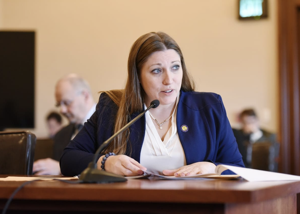
Illinois State Sen. Rachel Ventura speaks into microphone at table during a legislative hearing

But the bill itself does not reference specific price points or speed tiers. Instead, it directs the Illinois Commerce Commission to establish rules requiring broadband providers to offer “affordable rates” for low-income customers beginning Jan. 1, 2027. 

The commission would be tasked with setting minimum service speeds and a maximum low-income rate through rulemaking.

NTIA Signals It Will Follow Law on Non-Deployment Funds, But Wants More Ideas

Close to a 1,000 broadband-minded registrants attended yesterday’s listening session on how to spend an estimated $21 billion in “non-deployment” funds states should have at their disposal from the federal BEAD (Broadband Equity, Access and Deployment) program.

Hosted by the National Telecommunication and Information Administration (NTIA), the Commerce Department agency administering the program, the online listening session featured about 50 selected speakers. Most of those who spoke advocated using the money to tackle the array of non-infrastructure barriers to expand broadband (affordability, device distribution, and digital skills programs) – made all the more urgent in light of the Trump administration’s sudden “termination” of the Digital Equity Act last year.

Though it runs counter to the bipartisan infrastructure law that established the program, a handful of speakers actually suggested the funds simply be returned to the U.S. Treasury, presumably to “save taxpayer dollars.”

One speaker even tried to make the case that money Congress explicitly intended to address the nation’s massive digital divide should instead be given to Air Traffic Controllers.

Starlink Demands Less Oversight As It Receives Hundreds Of Millions In New Subsidies

Elon Musk’s Starlink is making new demands of states with an eye on eroding accountability and oversight, reheating concerns about whether spending big money on the Low Earth Orbit (LEO) network is the best possible use of taxpayer resources.

Last year, the Trump administration made revisions to NTIA rules surrounding the $42.5 billion Broadband, Equity, Access, And Deployment (BEAD) program, demanding that states de-prioritize fiber and dole out significantly more money to LEO satellite providers – a move broadly seen as a personal gift to one of the President’s biggest financial donors.

This subsidy reward, slated to be at least $733 million to start, is money that in some cases is being redirected away from higher-capacity, more affordable local options like open access community-owned fiber networks.

The NTIA changes introduced significant new delays in a program already rife with them. The Trump administration’s threat to withhold grant awards from states that focus on affordability – and the high consumer costs, environmental impact, and capacity constraints of the LEO network – risks undermining BEAD’s promise of faster, more affordable access.

Standoff Orbits 'LEO participation' 

Last week, Broadband.io and the Benton Institute for Broadband & Society obtained a copy of a letter Starlink parent company SpaceX sent to individual states, demanding freedom from state oversight and monitoring should they bungle installs or fail to deliver acceptable bandwidth.

The Big Beautiful Bill’s Ugly Choice: Internet or Food?

Today, The American Prospect published some of our original reporting on the One Big Beautiful Bill Act that was signed into law on Independence Day. In it, our Associate Director for Communications Sean Gonsalves writes:

"Sold to voters as a way to cut 'waste, fraud, and abuse,' a more honest assessment of the One Big Beautiful Bill Act (OBBBA) is that it’s just a Big Brazen Bid to shred the social safety net.

Naturally, the looming cuts to Medicaid and what they will mean for rural hospitals in particular has received the most press.

But there are numerous other ways those in need of government assistance will be further pressed into poverty, including through a particularly narrow-minded Sophie’s Choice: internet access or food?

Image
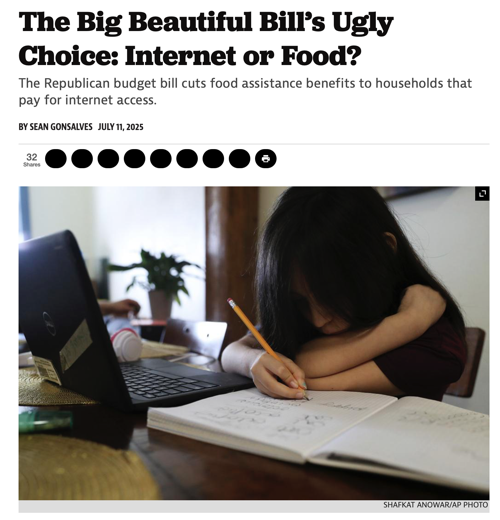
Screenshot of article in the American Prospect

Last year, GOP leaders blocked bipartisan efforts to fund an extension of the Affordable Connectivity Program (ACP), which offered 23 million eligible households a $30-per-month voucher to help pay for internet service. As if letting the ACP die wasn’t a big enough blow, OBBBA not only increases the paperwork burden required to qualify for Supplemental Nutrition Assistance Program (SNAP) benefits, it completely removes internet service costs as an eligible deduction.

The USF Survives Supreme Court, But Massive Challenges Remain

The FCC’s Universal Service Fund (USF) has survived a Supreme Court challenge by a right wing activist nonprofit, but the program – which for decades has helped extend broadband to underserved rural homes and schools – still faces a precarious immediate future.

It is a peculiar political story, given that the rural regions that overwhelmingly vote for Republicans are now seeing Republicans try to dismantle a program that has been crucial for rural investment and development.

The FCC established the fund in 1997 in compliance with the Telecommunications Act of 1996. Historically a program with broad, bipartisan support, the USF leverages around $8 billion annually to expand broadband access to rural communities, libraries, and schools. The program is primarily paid for by consumers via a small levy on traditional phone lines.

In 2023, a right wing activist nonprofit named “Consumer’s Research” sued the government over the USF, claiming that the FCC lacked the constitutional authority to levy a fee on consumers’ bills. The lawsuit claimed that the USF depended on what amounted to an “unconstitutional tax” on consumers to fund operations.

BEAD: No NOFO Fo Sho - Episode 650 of the Community Broadband Bits Podcast

In this episode of the podcast, Chris welcomes back Gigi Sohn, Benton Senior Fellow and Public Advocate, for a fast-paced reaction to recent testimony by Commerce Secretary Howard Lutnick.

They dig into the political motivations behind the BEAD program’s freeze, the misleading justifications around climate and affordability requirements, and the sweeping changes that could derail state broadband plans. 

Gigi brings sharp insight to a frustrating moment in broadband policy, explaining why the clock is ticking and who’s paying the price for the delay.

This show is 37 minutes long and can be played on this page or via Apple Podcasts or the tool of your choice using this feed.

Transcript below.

We want your feedback and suggestions for the show-please e-mail us or leave a comment below.

Listen to other episodes or view all episodes in our index. See other podcasts from the Institute for Local Self-Reliance.

Thanks to Arne Huseby for the music. The song is Warm Duck Shuffle and is licensed under a Creative Commons Attribution (3.0) license

Trump Administration Imposed BEAD Changes Introduce Significant New Delays

Trump administration changes to the $42.5 billion Broadband Equity, Access, and Deployment (BEAD) grant program are poised to introduce years of potential new delays to the already slow-moving program, potentially undermining the program’s goal of bringing universal broadband access to mostly rural communities.

Worse, the looming changes would eliminate efforts to ensure taxpayer-funded broadband is affordable for low-income Americans, while driving billions in new subsidies to the world’s richest man and Trump mega donor Elon Musk.

Testifying this week before a Senate Appropriations Committee, Commerce Secretary Howard Lutnick confirmed that the National Telecommunications and Information Administration (NTIA) will "soon" issue a new Notice of Funding Opportunity (NOFO) that states will have 90 days to respond to.

The revisions will ensure that billionaire Elon Musk – and his capacity-constrained satellite broadband network Starlink – will receive significantly more taxpayer money. Such Low-Earth orbit satellite networks were slated to get some funds, but federal changes may result in them dominating grant funding, overruling the mix of technology states had originally preferred.

Other changes being implemented include elimination of provisions ensuring affordable access for low-income Americans.

AAPB and ILSR Prepare For Inaugural ‘Future of Public Broadband’ Conference

Some of the nation’s leading thinkers and doers in the community broadband sector will connect and collaborate in the nation’s capital for the inaugural Community First: The Future of Public Broadband Conference and Hill Day next week.

Slated for May 14 and 15, the two-day conference is being hosted by the American Association for Public Broadband (AAPB) and New America Open Technology Institute (OTI), in partnership with ILSR's Community Broadband Networks Initiative, the Benton Institute for Broadband & Society, and the Community Broadband Action Network.

The in-person gathering will bring together public broadband champions, community leaders, policymakers, and industry experts to focus on strategy and advocacy in the face of potentially dramatic changes to the $42.5 billion BEAD program – the single-largest federal investment to ensure every household in the nation has access to high speed Internet connectivity.

Registration and tickets are still available here.

Image
Gigi Sohn AAPB

With the rise of community-owned broadband networks and cooperatives now flourishing across the nation, organizers are hoping to create “an essential space to share best practices, discuss financing, shape public policy, and support the development and expansion of public broadband networks.”

‘The Human Infrastructure of Broadband’ Will Take Center Screen at Upcoming B4DE

As digital inclusion advocates look to get their bearings amid an all-out assault on federal broadband funding programs, the next Building For Digital Equity livestream offers a port in the storm.

Slated for March 13 from 3 to 4:15 pm ET – and once again co-hosted by ILSR’s Community Broadband Networks Initiative and the National Digital Inclusion Alliance (NDIA) – the keynote speaker for the UTOPIA Fiber sponsored event will be Revati Prasad, Vice President of Programs with the Benton Institute for Broadband & Society.

Charting the Course: Adapting to Policy Shifts While Keeping Our Eyes on the Prize” promises to bring hundreds of digital inclusion practitioners together to regroup and recalibrate while hearing from those working in the trenches to adequately address broadband access challenges across the nation.

Registration for the increasingly popular live stream is now open here.

Prasad will focus on Benton’s recently published report: “The Human Infrastructure of Broadband: Looking Back, Looking Around, and Looking Ahead.”

How U.S. Courts Are Reshaping Broadband Access - Episode 623 of the Community Broadband Bits Podcast

In this episode of the podcast, Chris Mitchell speaks with Andy Schwartzman, Senior Counselor at the Benton Institute for Broadband & Society, about pressing legal issues affecting telecommunications policy in the U.S. Schwartzman, with decades of experience in media and telecom law, discusses the shifting landscape following recent Supreme Court decisions that limit regulatory agency powers. 

They explain the implications of the Major Questions Doctrine and the end of the Chevron Doctrine for the Federal Communications Commission (FCC), particularly how these changes impact the agency’s authority to support broadband access through the Universal Service Fund (USF) and Title II regulations.

The conversation also covers the FCC's policy on Wi-Fi for school buses, facing legal challenges due to the narrowed definition of "classroom." Schwartzman provides insights into the FCC's efforts to classify broadband under Title II, emphasizing how critical this designation is for public safety, cybersecurity, and broadband deployment through infrastructure like utility pole attachments. 

As Schwartzman explains, these legal battles highlight the complex intersections of telecommunications law, regulatory authority, and the broader challenges of fostering universal Internet access in a polarized political environment.

This show is 44 minutes long and can be played on this page or via Apple Podcasts or the tool of your choice using this feed.

Transcript below.

We want your feedback and suggestions for the show-please e-mail us or leave a comment below.

Listen to other episodes or view all episodes in our index. See other podcasts from the Institute for Local Self-Reliance.

Thanks to Arne Huseby for the music. The song is Warm Duck Shuffle and is licensed under a Creative Commons Attribution (3.0) license